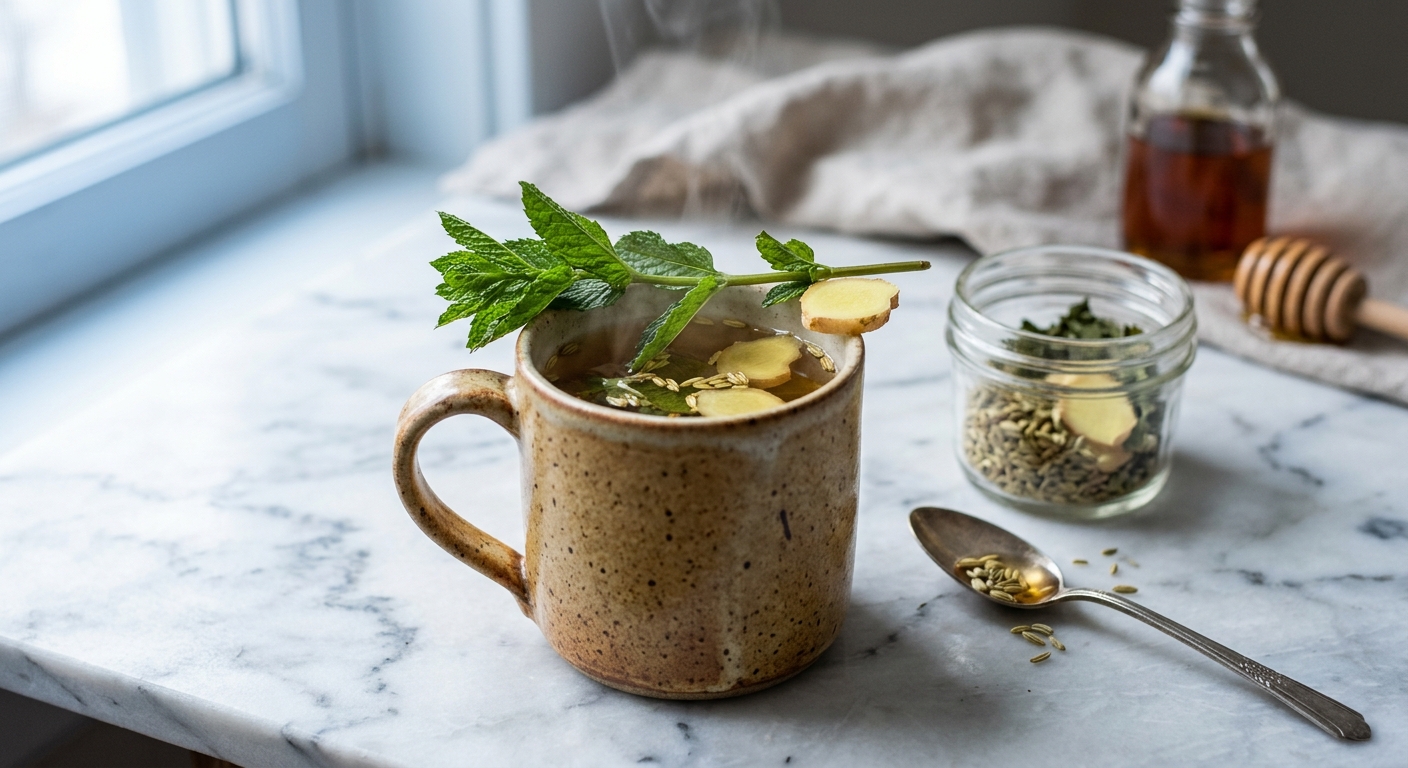
When digestion stalls, the effects ripple through your entire day. That heavy, sluggish feeling after meals, the bloating that refuses to budge, the dull discomfort that settles in after eating – these are signs your digestive system needs a little coaxing. For thousands of years, herbalists across cultures have reached for the same handful of warming, carminative plants to get things moving again. This Sluggish Digestion Tea brings together three of the most trusted botanicals in plant medicine: ginger root, fennel seed, and peppermint leaf, each chosen for a specific and complementary role in digestive support.
Ginger has been a cornerstone of Ayurvedic and Traditional Chinese Medicine for over 2,500 years, prized as a digestive stimulant that increases the production of digestive juices and speeds gastric emptying. Fennel seed, long used around Mediterranean and Middle Eastern tables as a post-meal digestif, is renowned for its ability to relax smooth muscle in the intestinal wall and expel trapped gas. Peppermint, a staple of European folk medicine, rounds out the blend with menthol compounds that calm intestinal spasms and ease the discomfort of a cramping gut. Together, they form a warming, slightly sweet, beautifully aromatic tea that works on multiple mechanisms at once.
What makes this blend particularly effective is how synergistically these three herbs act. Ginger stimulates motility so food moves through the digestive tract more efficiently. Fennel addresses the gas and bloating that often accompany slow digestion. Peppermint soothes the smooth muscle lining of the intestines, reducing cramping and that tight, knotted feeling. The result is a tea that is not only clinically sensible but genuinely pleasurable to drink, with a warming spice note, a bright cooling finish, and the faint sweetness of fennel tying it all together.
2
cups
Ingredients
- 1 tspfresh ginger root, thinly sliced (or 0.5 tsp dried ground ginger)
- 1 tspfennel seeds, lightly crushed
- 1 tspdried peppermint leaf
- 480 mlwater (95°C / 203°F)
- —raw honey or maple syrup to taste (optional)
- —a squeeze of fresh lemon juice (optional)
How to Brew
Click on an item below to shop for the recommended items for this recipe on Amazon.
As an Amazon Associate, we earn from qualifying purchases.
- Place the fennel seeds in a mortar and pestle or on a cutting board and crush them lightly – just enough to crack them open, not grind them to powder. This releases the anethole-rich oils that make fennel so effective for gas and bloating.
- Combine the crushed fennel seeds and sliced fresh ginger in a small saucepan with 480 ml of cold water. Bring to a gentle simmer over medium heat and simmer for 5 minutes. This brief decoction step extracts the deeper volatile oils and gingerols from the harder root and seed material that a simple steep would not fully capture.
- Remove the saucepan from heat and add the dried peppermint leaf directly to the hot liquid. Cover the pan immediately with a lid to trap the menthol-rich steam, which would otherwise evaporate. Steep the peppermint for 3 to 5 minutes.
- Strain the tea through a fine mesh strainer into two mugs. Press gently on the solids with the back of a spoon to extract the remaining liquid.
- Taste before adding sweetener. The natural sweetness of the fennel often means honey is unnecessary. Add a small squeeze of lemon if desired for brightness. Drink warm, ideally 15 to 20 minutes before or after a meal.
- Lightly crush the fennel seeds as described in the hot brew method. Slice the fresh ginger root into thin coins – no need to peel it for cold brewing, as the skin adds extra flavor compounds during the long steep.
- Combine the crushed fennel, ginger slices, and dried peppermint leaf in a clean glass jar. Pour 480 ml of room-temperature filtered water over the herbs. Do not use hot water – the goal is a slow, cold extraction that draws out a different and gentler spectrum of compounds.
- Stir briefly to ensure all herbs are submerged. Place a loose lid or a cloth cover on the jar and leave it at room temperature for 1 hour, then transfer to the refrigerator.
- Steep in the refrigerator for a full 10 to 12 hours, or overnight. The extended cold extraction draws out the carminative and anti-spasmodic compounds gradually, producing a smooth, mellow, slightly sweet infusion without harsh heat.
- Strain through a fine mesh strainer into glasses filled with ice. Add a sprig of fresh mint or a slice of lemon as a garnish. Sip slowly throughout the morning or before meals. The cold brew keeps refrigerated for up to 48 hours.
- Double all herb quantities: use 2 tsp crushed fennel seeds, 2 tsp sliced fresh ginger, and 2 tsp dried peppermint leaf. Place fennel and ginger in a medium saucepan with 480 ml of cold water – the same volume of water as the standard recipe, but with twice the herbs, producing a concentrated output.
- Bring to a full boil over medium-high heat, then reduce to a steady simmer. Simmer uncovered for 15 minutes, allowing roughly 20 percent of the water to evaporate and concentrate the liquid. Keep an eye on the pot to prevent it from simmering dry.
- Remove from heat and add the peppermint leaf. Cover the saucepan immediately with a tight-fitting lid and steep for 5 minutes. Covering is critical at this stage – the volatile menthol oils in peppermint are highly heat-sensitive and will escape with the steam if the pot is left open.
- Strain the concentrate through a fine mesh strainer lined with cheesecloth into a clean glass jar or bottle with a lid. Press the solids firmly to extract every drop.
- Allow to cool to room temperature before sealing and refrigerating. To serve hot, dilute one part concentrate with one part hot water in a mug. To serve cold, pour over ice and top with cold sparkling water for a digestive soda effect. Optionally add a small drizzle of honey to each serving at the time of drinking.
Health Benefits
6-Gingerol and shogaols in ginger have been shown in clinical trials to significantly speed the rate at which the stomach empties its contents into the small intestine, directly addressing the sensation of heaviness and fullness that characterizes sluggish digestion.
Anethole and fenchone from fennel seed act as carminatives, relaxing the smooth muscle of the intestinal wall and allowing trapped gas pockets to disperse. Multiple studies have confirmed fennel’s effectiveness in reducing postprandial bloating.
Menthol from peppermint blocks calcium channels in intestinal smooth muscle cells, producing a direct antispasmodic effect. A 2014 meta-analysis in the Journal of Clinical Gastroenterology found peppermint oil significantly outperformed placebo in reducing abdominal pain associated with IBS.
Ginger has been shown to increase the activity of pancreatic lipase and other digestive enzymes, improving the breakdown of fats and proteins and reducing the workload on the digestive tract after large meals.
Rosmarinic acid in peppermint and the phenolic compounds in ginger both exhibit anti-inflammatory properties that may reduce low-grade inflammation in the gut lining, offering comfort to those with chronic digestive sensitivity.
🧪 Key Bioactive Compounds
The Science Behind Ginger
The digestive benefits of this tea blend are not folklore guesswork – each herb has identifiable bioactive compounds whose mechanisms of action have been studied in laboratory and clinical settings. Ginger’s most important digestive compounds are the gingerols (particularly 6-gingerol) in fresh root and the shogaols that form when ginger is dried or exposed to heat. Both compound classes act on serotonin receptors (5-HT3) in the gastrointestinal tract, the same receptors targeted by pharmaceutical anti-nausea drugs. They also promote the release of digestive enzymes from the pancreas and accelerate gastric motility, meaning food moves through the stomach and small intestine at a faster, healthier rate rather than sitting and fermenting.
Fennel seed works through a completely different but complementary pathway. Its primary volatile oil, anethole, is a phenylpropanoid that acts as a smooth muscle relaxant in the intestinal wall. When smooth muscle in the gut contracts abnormally, the result is cramping, spasm, and the trapping of gas. Anethole, along with its supporting compound fenchone, interrupts this cycle by reducing the excitability of smooth muscle fibers, allowing the intestine to relax and peristaltic movement to resume normally. This is why fennel has been a post-meal digestif across so many cultures – it physically opens the gut to let trapped gas pass and motility to continue.
Peppermint’s active compound, menthol, targets yet another mechanism: calcium ion channels in the smooth muscle cells lining the colon. By blocking these channels, menthol prevents the excessive muscle contractions responsible for cramping and spasm. This is also the scientific basis behind enteric-coated peppermint oil capsules, which are used clinically for IBS management. In tea form, the effect is milder but still meaningful, particularly for people whose sluggish digestion is accompanied by cramping or the bloated tightness of a colon under stress. The three herbs together address motility, gas, and spasm simultaneously, making this blend a genuinely multi-targeted approach to digestive support.
Brewing Tips
- Always crush fennel seeds immediately before brewing rather than in advance. The volatile oils responsible for the carminative effect dissipate quickly once the seed coat is cracked, so freshly crushed seeds are significantly more potent than pre-ground fennel.
- For maximum ginger potency in the hot brew, do not peel the fresh ginger root before slicing. The skin contains additional flavor compounds and there is no need to remove it when the tea will be strained. Simply scrub the root clean under running water.
- Drink this tea warm rather than scalding hot. Extremely hot liquids can irritate the esophageal and gastric lining, counteracting the soothing properties of the peppermint. Allow the tea to cool to a comfortable sipping temperature of around 55 to 65°C before drinking.
- If you are making the concentrate and want to extend its shelf life, add a small squeeze of fresh lemon juice to the jar before refrigerating. The acidity helps preserve the concentrate for up to 7 days rather than 5.