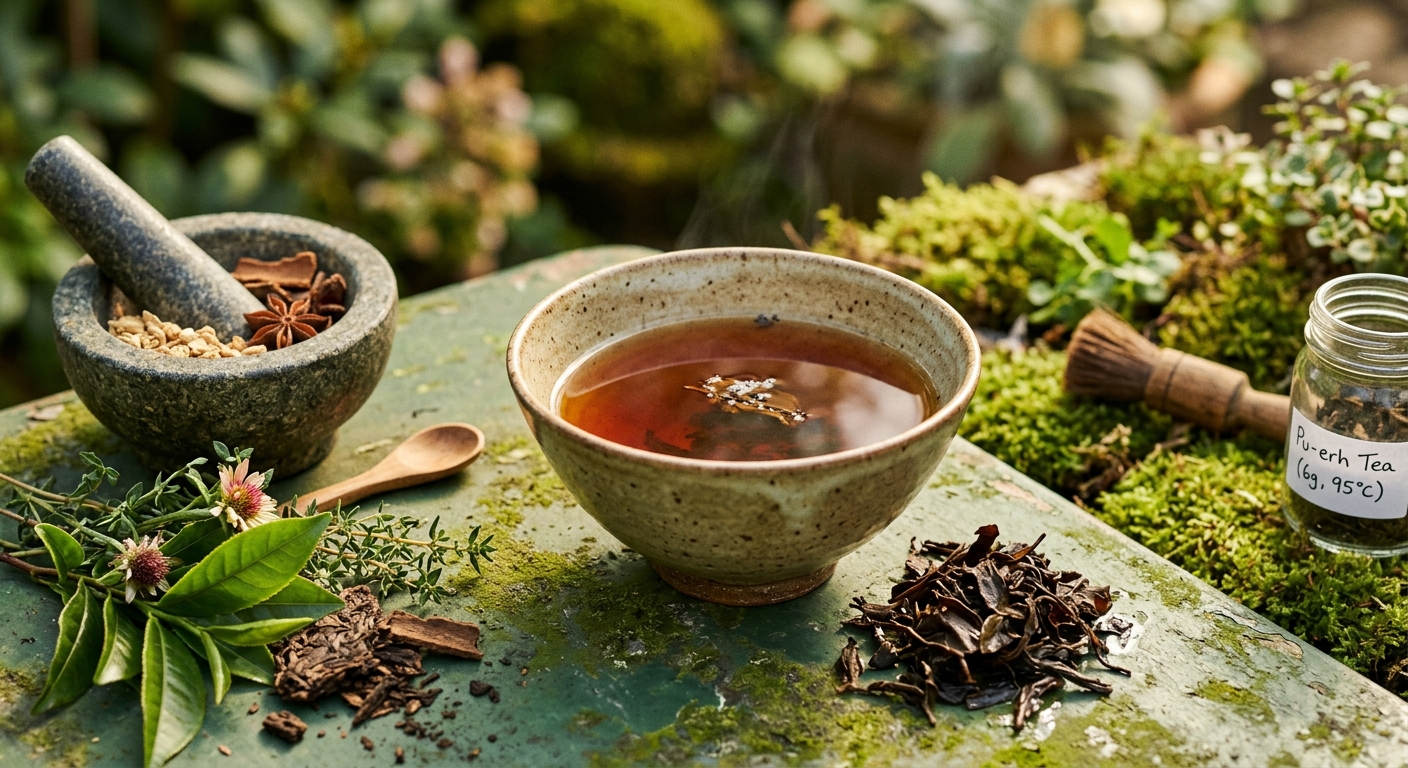
Few teas carry the weight of history quite like pu-erh. Produced exclusively in Yunnan Province, China, this ancient fermented tea has been traded along the legendary Tea Horse Road since the Tang Dynasty (618 to 907 CE), compressed into cakes and bricks for transport across the Himalayas into Tibet and beyond. Unlike any other tea in the world, pu-erh undergoes a true microbial fermentation process, either aging naturally over years or decades (raw, sheng pu-erh) or accelerated through a wet-piling technique developed in the 1970s (ripe, shou pu-erh). This living transformation gives pu-erh a depth of character that no other beverage can replicate.
In traditional Chinese medicine, pu-erh has long been prescribed to aid digestion after heavy or fatty meals, reduce cholesterol, and gently invigorate the mind without the jittery edge of coffee. Yunnan tea houses serve it as a daily ritual, aged cakes are gifted as treasured heirlooms, and connoisseurs across Asia seek out vintages the way a sommelier seeks rare wine. The older the pu-erh, the more prized and complex it becomes, with well-aged cakes fetching extraordinary prices at auction. This centuries-long relationship between people and fermented leaf reflects something profound: pu-erh is not merely a beverage, it is a practice.
What makes pu-erh particularly exciting for the modern wellness drinker is its unique biochemical profile. The fermentation process transforms the tea’s original compounds, generating a spectrum of beneficial microorganisms, statins, and polyphenols not found in green or black teas. The result is a brew that delivers focused, grounded energy through its caffeine and theanine pairing, supports gut health through microbial byproducts, and offers a flavor experience that ranges from clean and floral in young sheng to deeply earthy, woody, and smooth in aged shou. Whether you are new to pu-erh or deepening an existing ritual, this guide will help you brew it beautifully and understand exactly what it offers your body and mind.
2
cups
Ingredients
- 6 gpu-erh tea (loose leaf or broken from a cake)
- 500 mlwater (95°C / 203°F)
- —rinse water for awakening the leaves (discarded)
How to Brew
Click on an item below to shop for the recommended items for this recipe on Amazon.
As an Amazon Associate, we earn from qualifying purchases.
- Break off approximately 6 grams of pu-erh from a compressed cake using a pu-erh pick or sturdy knife, or measure 6 grams of loose-leaf pu-erh. For a small gaiwan or clay teapot (100 to 150 ml), use the full 6 grams. Scale proportionally for larger vessels.
- Perform a rinse steep: place the leaves in your gaiwan or teapot, pour boiling water over them completely, and immediately discard this first infusion after 5 to 10 seconds. This awakens the compressed leaves, removes any surface dust, and opens the cell walls for better flavor extraction in subsequent steeps.
- Pour fresh water heated to 95 to 100°C directly over the rinsed leaves. For the first infusion, steep for 30 seconds. Pour completely into a pitcher (fairness cup) to even out the concentration, then distribute into small cups.
- For each successive infusion, add 5 to 10 seconds to the steep time. Pu-erh can comfortably yield 6 to 10 infusions from a single session, with the flavor evolving from bold and earthy in early pours to mellow and sweet in later ones.
- Sip slowly between infusions and notice how the character of the tea shifts. The beauty of gongfu brewing is in this meditative progression through a single session.
- Measure 8 grams of loose-leaf pu-erh or break 8 grams from a cake and place it directly into a clean glass jar or cold brew pitcher. Do not rinse the leaves before cold brewing, as the cold extraction is gentle enough to omit this step.
- Pour 750 ml of cold or room-temperature filtered water over the leaves. Stir briefly with a long spoon to ensure all the leaves are submerged and in contact with the water.
- Seal the jar or pitcher and place it in the refrigerator. Allow the tea to steep undisturbed for 8 to 12 hours. For a lighter, more delicate result, check at 8 hours. For a deeper, more complex extraction, allow the full 12 hours.
- When steeping is complete, strain the leaves through a fine mesh strainer or cheesecloth into a clean glass pitcher. Press gently on the leaves to extract the last of the liquid.
- Serve over ice in tall glasses. Cold-brewed pu-erh keeps well in a sealed container in the refrigerator for up to 3 days. You can re-steep the same leaves once more with cold water for a second, lighter batch.
- Place 4 to 5 grams of loose shou (ripe) pu-erh directly into a large mug or heat-safe travel flask. No infuser is needed. The leaves will settle naturally to the bottom of the vessel as they become waterlogged.
- Pour 300 to 400 ml of water heated to 90 to 95°C directly over the dry leaves. Allow the leaves to sink and settle for 3 to 5 minutes before drinking. Avoid stirring, which can disturb the sediment.
- Tilt the cup gently and sip from the top, where the liquid is clear of leaves. The natural weight of wet pu-erh leaves keeps them anchored at the bottom, making this method surprisingly clean in practice.
- When the cup is approximately one-third full, top it up with fresh hot water and allow another 2 to 3 minutes of steeping. Pu-erh is robust enough for continuous top-ups over several hours, making this ideal for a long work session or study block.
- When the flavor becomes noticeably weak or pale, discard the spent leaves, rinse the vessel, and begin fresh. One measure of pu-erh can comfortably sustain 4 to 6 top-ups across a morning or afternoon.
Health Benefits
The synergistic combination of caffeine and L-theanine in pu-erh produces focused alertness without the spike-and-crash pattern of coffee. Research on this pairing consistently shows improved attention, working memory, and reaction time compared to caffeine alone.
Pu-erh’s microbial fermentation produces beneficial compounds including theabrownins and short-chain fatty acid precursors that support a healthy gut microbiome. Traditional Chinese medicine has long prescribed it after heavy meals, and modern research supports its ability to reduce bloating and aid fat digestion.
Multiple human clinical trials and animal studies have demonstrated that regular pu-erh consumption reduces LDL cholesterol and triglycerides while modestly increasing HDL cholesterol. The fermentation-derived lovastatin analogs and theabrownins are the primary compounds responsible for this effect.
Despite fermentation reducing catechin concentrations relative to green tea, pu-erh retains significant antioxidant capacity through gallic acid, EGCG, and the unique theabrownin complex. These compounds help neutralize free radicals and reduce systemic inflammation associated with chronic disease.
Several studies suggest pu-erh may support healthy weight by inhibiting fatty acid synthesis, enhancing fat oxidation, and improving insulin sensitivity. While not a standalone solution, it complements a balanced lifestyle as a low-calorie, metabolically active beverage.
🧪 Key Bioactive Compounds
The Science Behind Pu-Erh Tea
The scientific interest in pu-erh centers on what happens during its microbial fermentation, a process that fundamentally transforms the chemistry of the original tea leaf. During the wet-piling process used for shou pu-erh, strains of fungi including Aspergillus niger and bacteria from the genera Bacillus and Streptomyces break down chlorophyll, polyphenols, and proteins into a new class of compounds. Chief among these are theabrownins, large dark-brown polymer complexes that give ripe pu-erh its characteristic color and have become the subject of intense research for their effects on lipid metabolism and the gut microbiome. A 2011 study published in PLoS ONE found that theabrownins inhibit lipid absorption in the intestine and alter gut bacterial populations in ways that support metabolic health.
The presence of lovastatin-like compounds in pu-erh, a byproduct of Aspergillus fermentation, provides a compelling mechanistic explanation for the tea’s observed cholesterol-lowering effects. Lovastatin is a naturally occurring statin that inhibits the enzyme HMG-CoA reductase, which is the same target as pharmaceutical statin drugs. While the concentrations in brewed pu-erh are far lower than in medication, regular consumption over weeks and months may contribute meaningfully to lipid profile improvements, as suggested by several randomized controlled trials in Chinese populations. This makes pu-erh one of the very few teas with a plausible pharmacological mechanism for its most celebrated traditional health claim.
The caffeine and L-theanine synergy in pu-erh is well-documented across the broader tea science literature. L-theanine, found almost exclusively in the Camellia sinensis plant, crosses the blood-brain barrier and promotes alpha-wave activity in the brain, a neural state associated with relaxed alertness and creative focus. When combined with caffeine, multiple randomized trials show this pairing improves sustained attention, accuracy on cognitive tasks, and subjective alertness more effectively than either compound alone. Pu-erh’s fermentation may partially reduce L-theanine content compared to green tea, but the remaining levels are still sufficient to produce this characteristic calm, grounded focus that experienced drinkers describe as distinctly different from the alertness produced by coffee.
Brewing Tips
- Always rinse compressed pu-erh cakes with one quick pour of boiling water before your first real infusion. This 10-second rinse removes surface dust, opens tightly compressed leaves, and actually improves the flavor clarity of every subsequent steep.
- Store your pu-erh in a breathable clay or unglazed ceramic container away from strong odors. Pu-erh is a living product that continues to age and develop, but it will readily absorb surrounding smells from spices, coffee, or cleaning products, permanently altering its character.
- Use freshly filtered water and bring it to a full rolling boil for shou (ripe) pu-erh. Unlike green or white teas that scorch at high heat, pu-erh demands near-boiling temperatures to fully open its compressed, aged leaf structure and express its deepest flavors.