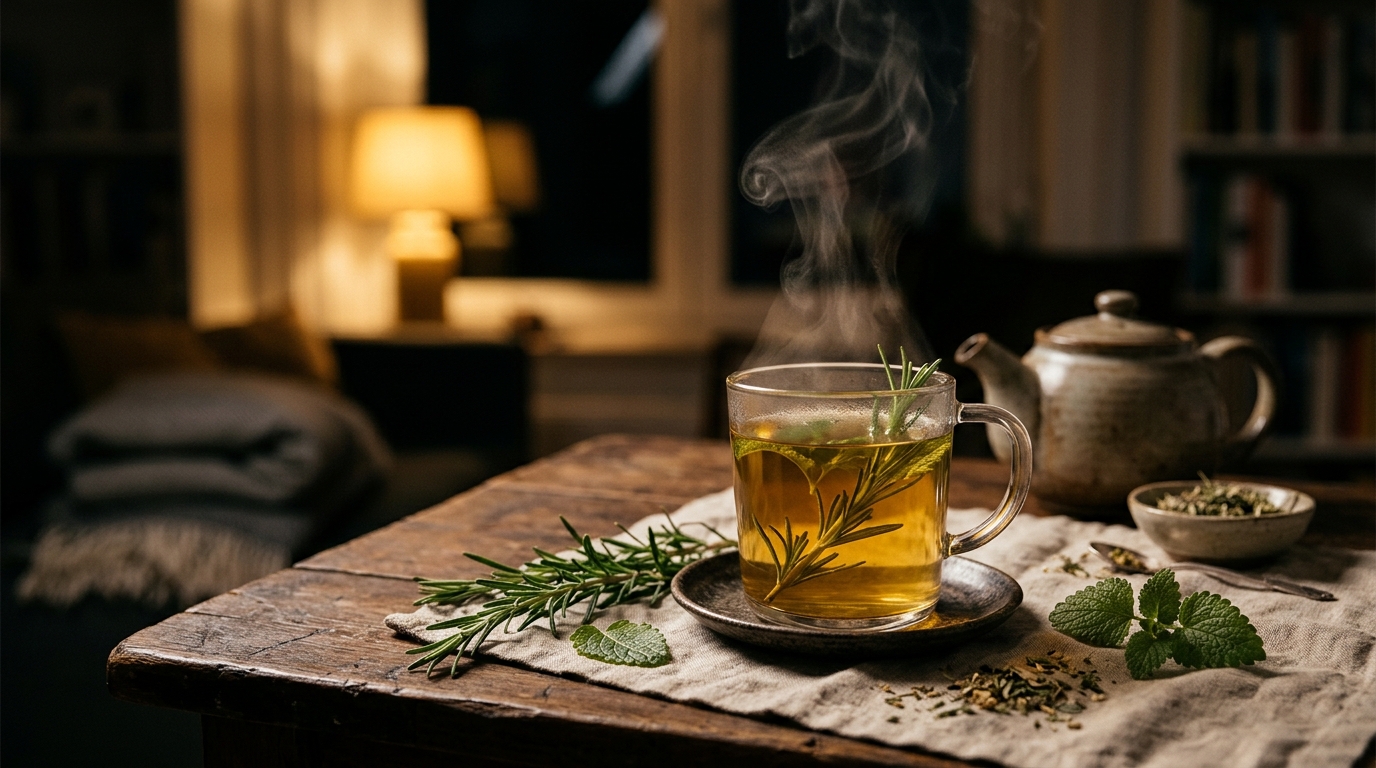
Lemon balm has been cherished for more than two thousand years. Greek physicians such as Dioscorides recommended it for melancholy and digestive upset, and medieval monks brewed it into the famous Carmelite water, a tonic said to ease nerves and lift the spirits. Its genus name, Melissa, is the Greek word for honeybee, and gardeners still plant it near hives because bees adore its small, nectar-rich flowers. The leaves smell brightly of lemon with a soft minty undertone, and the plant has long been called the gladdening herb.
Rosemary carries its own rich history. Ancient Greek students reportedly wove rosemary into their hair while studying, and in Shakespeare’s Hamlet, Ophelia declares, “There’s rosemary, that’s for remembrance.” Traditional herbalists used it as a circulatory and cognitive tonic, and modern research has begun to explore why. Its piney, resinous aroma is so distinctive that simply inhaling it has been studied for effects on alertness and memory.
Combined, these two herbs create a balance that is hard to find in a single cup. Lemon balm brings calm and a lightened mood, while rosemary adds a thread of clarity and warmth. The result is what many tea drinkers describe as relaxed focus: a mind that is quiet but not foggy, ideal for evening reading, journaling, gentle study, or simply settling into the night without reaching for caffeine.
2
cups
Ingredients
- 2 tbspdried lemon balm leaves (or 4 tbsp fresh, lightly bruised)
- 1 tspdried rosemary needles (or 1 fresh sprig about 5 cm / 2 in long)
- 480 mlwater (90°C / 194°F for hot brew)
- —raw honey to taste (optional)
- —thin lemon slice for serving (optional)
How to Brew
Click on an item below to shop for the recommended items for this recipe on Amazon.
As an Amazon Associate, we earn from qualifying purchases.
- Bring fresh, filtered water to a boil, then let it rest for about 1 minute so it cools to roughly 90 to 95°C. Lemon balm is delicate, and water straight off a rolling boil can dull its bright citrus notes.
- Add the lemon balm leaves and rosemary needles to a teapot or a large mug. If using fresh herbs, gently crush the leaves and bruise the rosemary sprig between your fingers first to release their essential oils.
- Pour the hot water over the herbs, then immediately cover the vessel with a lid or small plate. Covering traps the volatile aromatic oils, which are the source of much of the calming effect and flavor.
- Steep for 7 to 10 minutes. Closer to 7 minutes gives a lighter, lemon-forward cup, while 10 minutes brings out more rosemary depth.
- Strain the herbs, stir in honey if desired, and sip slowly. Add a thin lemon slice for extra brightness.
- Lightly rinse fresh herbs if using them, or measure out dried herbs, using a slightly higher ratio than hot brewing: 3 tablespoons of lemon balm and 1 teaspoon of rosemary for every 1 liter of cold water.
- Place the herbs in a clean glass jar and gently press them with the back of a spoon to bruise them, which helps the cold water draw out flavor.
- Fill the jar with cold, filtered water, seal the lid, and give it a gentle swirl to submerge all the leaves.
- Refrigerate for 8 to 12 hours, or overnight. Avoid going much beyond 12 hours, as rosemary can turn sharp and resinous.
- Strain through a fine mesh strainer into a clean pitcher or glass, discarding the herbs. Serve over ice, and drink within 2 days for the freshest flavor.
- Use double the herbs for the water: 4 tablespoons of dried lemon balm and 2 teaspoons of rosemary to 480 ml of hot water at about 95°C. This makes a concentrate that holds up to ice.
- Pour the hot water over the herbs in a heatproof pitcher, cover, and steep for 10 minutes. Because the tea will be diluted, a stronger infusion is intentional here.
- Strain out the herbs, then stir in honey or a little maple syrup while the tea is still warm so it dissolves fully.
- Let the concentrate cool at room temperature for 15 minutes, then pour it over a tall glass packed with ice, using roughly equal parts concentrate and ice.
- Garnish with a fresh lemon balm leaf, a thin lemon wheel, and a small rosemary sprig. Stir gently and serve right away.
Health Benefits
Lemon balm extracts have been shown in small clinical trials to improve self-rated calmness and reduce stress-related symptoms, likely through modulation of GABA activity in the brain.
Rosemary aroma and extracts have been linked to improved speed and accuracy on memory tasks in human studies, and lemon balm has shown benefits for attention and mood in similar research.
Lemon balm is traditionally used to ease restlessness, and clinical work has suggested it may improve sleep quality, especially when stress or anxiety is a factor, without the grogginess of stronger sedatives.
Both herbs have a long history as carminatives, helping to relieve gas, bloating, and tension-related stomach upset, which is a common cause of restless evenings.
The high rosmarinic acid content in this blend contributes meaningful antioxidant activity, which may help counter oxidative stress in the body.
🧪 Key Bioactive Compounds
The Science Behind Lemon Balm
The calming reputation of lemon balm rests largely on its essential oils and its phenolic acids. In laboratory studies, extracts of Melissa officinalis appear to interact with the GABA system, the brain’s primary inhibitory signaling pathway, and may also inhibit the enzyme GABA transaminase, which breaks down GABA. Small human trials using standardized extracts have reported improvements in calmness and alertness at moderate doses, a pairing that fits the idea of relaxed focus rather than drowsiness.
Rosemary approaches the mind from a different angle. Its main volatile compound, 1,8-cineole, has been measured in the blood after inhaling rosemary aroma, and higher levels have been correlated with better performance on certain cognitive tests in a well-known study. Rosmarinic acid and carnosic acid add an antioxidant and neuroprotective dimension, and some in vitro work suggests they may influence acetylcholine breakdown, the same general pathway targeted by some memory-supporting medications.
It is worth being honest about the limits of the evidence. Most studies use concentrated extracts or inhaled essential oils rather than a cup of tea, and many are small or short in duration. A brewed infusion delivers lower, gentler amounts of these compounds, so the tea is best understood as a supportive daily ritual rather than a treatment. Still, the combination of aroma, warmth, and mild bioactive activity makes this blend a thoughtful, well-grounded choice for the evening hours.
Brewing Tips
- Cover your cup or teapot while steeping, since the calming volatile oils in lemon balm escape quickly with the steam.
- Use a light hand with the rosemary. Too much turns the tea medicinal and sharp, so start with a small pinch and adjust to taste.
- Grow lemon balm in a pot, as it spreads vigorously, and harvest the leaves just before the plant flowers for the strongest lemon aroma.