Few things disrupt wellness routines quite like long-haul travel. When you cross multiple time zones, your internal body clock, governed by the suprachiasmatic nucleus in the brain, falls out of sync with local daylight and nighttime cues. The result is jet lag: fragmented sleep, daytime fatigue, poor concentration, and that unsettling feeling of being awake at 3 a.m. staring at an unfamiliar ceiling. Herbal medicine traditions from Europe, Asia, and the Americas have long turned to sedative and nervine plants to ease these transitional states, and modern research is beginning to explain exactly why they work.
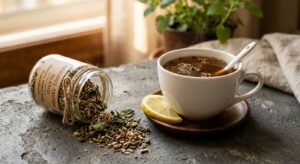
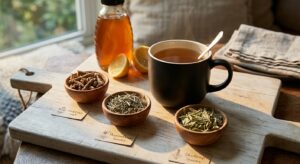
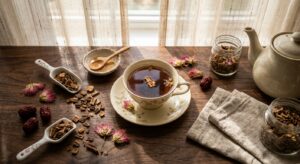
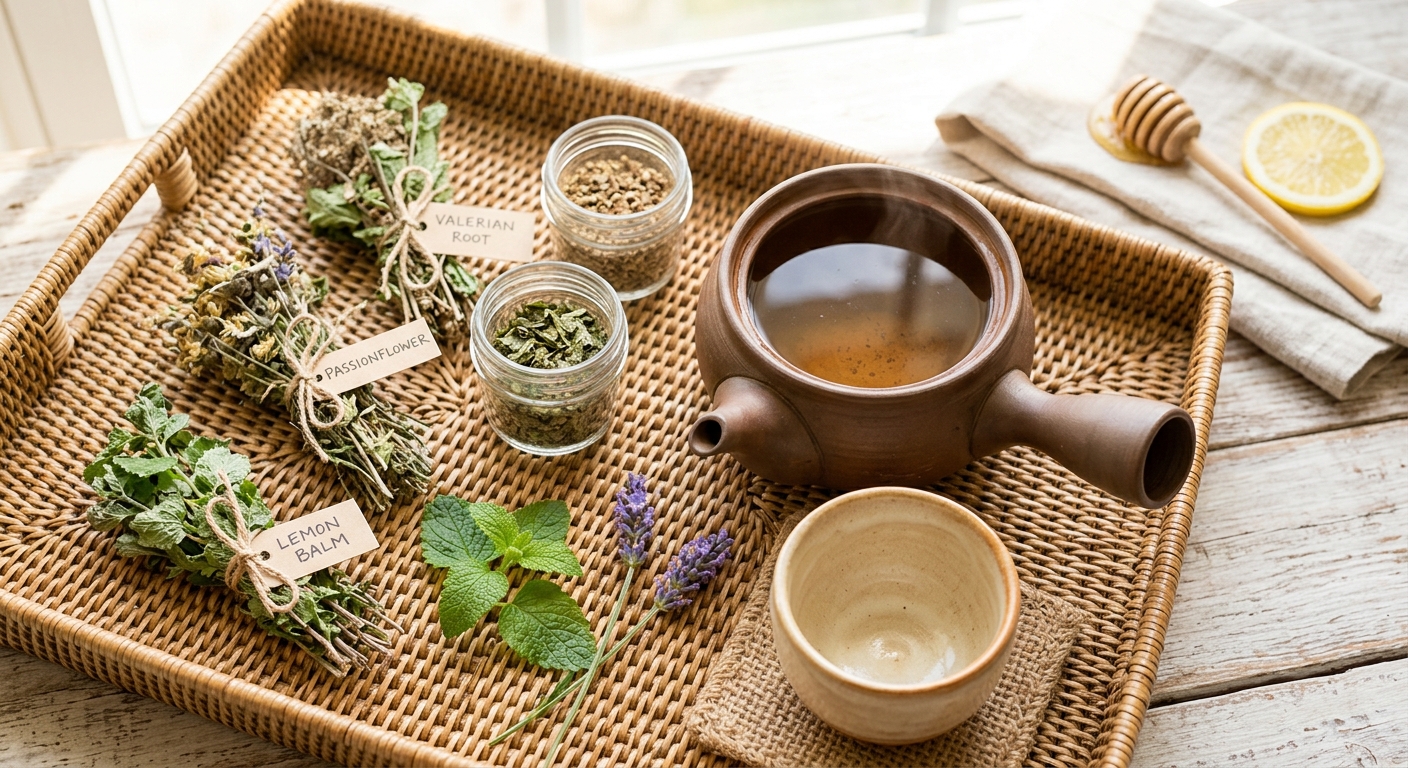
This sleep tea blend centers on three powerhouse herbs. Valerian root (Valeriana officinalis) has been used since ancient Greek and Roman times as a remedy for insomnia and nervous tension. Medieval European herbalists called it “all-heal” and prescribed it widely for restless sleep. Passionflower (Passiflora incarnata) was adopted by Native American healers in the southeastern United States and later embraced by European botanists in the 17th century for its remarkable calming qualities. Lemon balm (Melissa officinalis), a member of the mint family, has soothed anxious minds and stomachs across Mediterranean cultures for over 2,000 years, famously featured in the Carmelite monks’ restorative tonic of the 14th century.
Together these three herbs address the multifaceted misery of jet lag: valerian shortens the time it takes to fall asleep, passionflower quiets the racing, travel-wired mind, and lemon balm lifts the low-grade anxiety that disrupts sleep onset. Brewed together, they create a tea with a warm, earthy depth softened by gentle citrus and floral notes. Sip it 30 to 45 minutes before your intended new-timezone bedtime for the best results, and let this botanical blend do the resetting work your body needs.
2
cups
Ingredients
- 2 tspdried valerian root (cut and sifted)
- 2 tspdried passionflower herb (leaf and flower)
- 2 tspdried lemon balm leaf
- 480 mlwater (95°C / 203°F)
- —raw honey or chamomile honey to taste (optional)
- —thin lemon slice for garnish (optional)
How to Brew
Click on an item below to shop for the recommended items for this recipe on Amazon.
As an Amazon Associate, we earn from qualifying purchases.
- Bring filtered water to 90 to 95°C (194 to 203°F) using an electric kettle with a temperature setting, or bring to a full boil and let it rest for 60 seconds.
- Combine 1 teaspoon dried valerian root, 1 teaspoon dried passionflower, and 1 teaspoon dried lemon balm per cup into a large tea infuser or a heatproof teapot with a built-in strainer.
- Pour the hot water over the herbs, cover the mug or teapot with a lid or small plate to trap volatile aromatic oils, and steep for 10 to 15 minutes. Do not rush this steep – valerian root requires longer extraction than most herbs.
- Remove the infuser or strain the tea through a fine-mesh strainer into your mug. Press the herbs gently with the back of a spoon to extract the last of the beneficial compounds.
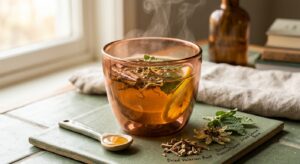
- Allow the tea to cool to a comfortable drinking temperature, approximately 60 to 65°C (140 to 149°F). Stir in raw honey if desired and add a thin lemon slice to brighten the flavor. Drink 30 to 45 minutes before your target bedtime in the new time zone.
- Measure 2 teaspoons dried valerian root, 2 teaspoons dried passionflower, and 2 teaspoons dried lemon balm into a clean glass jar with a lid.
- Add 480 ml of cool, filtered water at room temperature. Do not use refrigerator-cold water at this stage, as extremely cold water significantly slows the initial extraction. Stir the herbs gently to ensure full saturation.
- Let the jar sit uncovered at room temperature for 30 minutes to begin the infusion process. This brief ambient-temperature phase helps the herbs begin releasing their water-soluble compounds before chilling.
- Seal the jar with its lid and transfer to the refrigerator. Allow the tea to cold-infuse for 8 to 12 hours. Overnight cold brewing is ideal for travelers preparing for the following evening.
- When ready, strain the liquid through a fine-mesh strainer or cheesecloth into a glass, pressing the herbs firmly. The resulting tea will be noticeably lighter in color and smoother on the palate than the hot-brewed version. Stir in honey and serve over a small amount of ice, or warm gently on the stovetop without boiling if you prefer a warm drink before bed.
- In a small saucepan, combine 4 teaspoons dried valerian root, 4 teaspoons dried passionflower, and 4 teaspoons dried lemon balm with 480 ml of filtered water. This double-strength ratio is intentional for a concentrate.
- Heat the water to 95°C (203°F) – just below a rolling boil. Once the target temperature is reached, reduce heat to the lowest setting and cover the saucepan with a tight-fitting lid to prevent evaporation of volatile aromatic oils.
- Simmer gently (do not boil aggressively) for 20 to 25 minutes, checking occasionally to ensure the liquid is not reducing too quickly. The final volume should be approximately 350 to 400 ml of concentrated liquid.
- Remove from heat and allow to cool for 10 minutes, then strain through a fine-mesh strainer lined with cheesecloth into a clean, airtight glass bottle. Press the spent herbs firmly to extract all liquid.
- Seal and refrigerate for up to 5 days, or pour into a small leakproof travel bottle. At your destination, mix 60 to 80 ml (about 2 to 3 tablespoons) of concentrate into 180 ml of hot or warm water, sweeten with honey if desired, and drink 30 to 45 minutes before your new-timezone bedtime.
Health Benefits
Multiple randomized controlled trials on valerian root demonstrate a statistically significant reduction in the time it takes to fall asleep, making it especially valuable when crossing time zones and attempting to sleep at biologically “wrong” times. Passionflower augments this effect by calming pre-sleep mental activity.
Passionflower has demonstrated anxiolytic effects comparable to low-dose benzodiazepines in some clinical studies, without causing impaired motor function or cognitive dulling. This makes it well-suited for the heightened nervous system arousal that accompanies long-haul travel.
By enabling deeper, more consolidated sleep on arrival, this blend allows the body to receive stronger light-dark signals during the correct local hours, which accelerates the natural resetting of the suprachiasmatic nucleus and shortens the overall duration of jet lag symptoms.
Lemon balm’s rosmarinic acid has been shown in clinical studies to reduce cortisol levels and improve mood during periods of stress. Since travel elevates cortisol and disrupts the normal diurnal cortisol curve, lemon balm helps dampen this stress response and makes sleep physiologically easier to achieve.
Lemon balm has a long history as a digestive herb and is backed by clinical evidence for reducing bloating, cramping, and nausea. Since jet lag commonly disrupts digestive rhythms alongside sleep, this benefit adds meaningful comfort during the adjustment period.
🧪 Key Bioactive Compounds
The Science Behind Valerian Root
The science behind this sleep tea blend centers on the gamma-aminobutyric acid (GABA) neurotransmitter system, the brain’s primary inhibitory signaling network. When GABA activity is high, neural firing slows, anxiety diminishes, and sleep becomes easier to initiate and maintain. Valerian root’s key compound, valerenic acid, blocks the GABA transaminase enzyme responsible for breaking down GABA in the synapse. The result is an elevated local concentration of this calming neurotransmitter, effectively mimicking a mild pharmaceutical sedative effect without the receptor tolerance or withdrawal associated with prescription drugs. A 2006 meta-analysis published in the American Journal of Medicine reviewed 16 randomized controlled trials and concluded that valerian may improve sleep quality without producing adverse side effects.
Passionflower operates through a complementary mechanism. Its flavonoid compounds, primarily vitexin and isovitexin, bind directly to GABA-A receptor sites, the same molecular targets as benzodiazepine drugs, but with far lower affinity and without the dependency risks. A 2011 randomized, double-blind controlled trial published in Phytotherapy Research found that passionflower tea produced measurable improvements in subjective sleep quality scores compared to placebo over a seven-day period. Critically, participants reported improved sleep without next-day impairment, which is a significant advantage for travelers who need to function in a new time zone. Chrysin, another flavonoid in passionflower, has also demonstrated anxiolytic activity in preclinical models.
Lemon balm contributes to the blend through two distinct pathways. Rosmarinic acid, its primary polyphenol, inhibits GABA transaminase much as valerenic acid does, creating a synergistic boost to GABA levels throughout the central nervous system. A 2004 human clinical trial published in Psychosomatic Medicine found that a standardized lemon balm extract significantly reduced cortisol responses and improved mood and calmness in participants under laboratory-induced stress. The aromatic compound linalool adds a second route of action: inhaled through the steam of a hot cup, it crosses the blood-brain barrier and modulates the limbic system, the emotional processing center of the brain, producing a measurable reduction in anxiety-related behaviors documented in both animal and human research. When these three herbs are combined, their overlapping but distinct mechanisms create a synergistic sedative and anxiolytic effect greater than any single herb could achieve alone.
Brewing Tips
- Use cut-and-sifted valerian root rather than powdered root for cleaner straining and a less intensely bitter cup. Powdered valerian releases compounds too rapidly and can make the tea unpleasantly harsh.
- Time your first cup to coincide with the intended bedtime of your destination, not your home time zone. Consistency over the first three nights is more important than a single large dose.
- Store your pre-mixed dry herb blend in a small amber glass jar or airtight tin while traveling to protect the volatile aromatic compounds from light and air exposure. Pre-measuring servings into individual compostable tea bags before your trip saves time and guesswork in hotel rooms.
- If you find the valerian aroma too strong, steeping at a slightly lower temperature of 85 to 88°C (185 to 190°F) will reduce the extraction of isovaleric acid, the compound most responsible for the pungent, earthy scent, while still releasing adequate valerenic acid for sleep support.
- Avoid drinking this tea within four hours of needing to be alert. Valerian’s sedative effects can persist for six to eight hours in some individuals, and passionflower may intensify drowsiness if combined with alcohol consumed during the flight.