Ashwagandha (Withania somnifera) has been a cornerstone of Ayurvedic medicine for more than 3,000 years. Its Sanskrit name loosely translates to ‘smell of the horse,’ a nod to the root’s distinctly earthy, musky aroma and to the traditional belief that it imparts the vigor and resilience of a stallion. Classified as a rasayana, or rejuvenating tonic, it was prescribed to steady the mind, build stamina, and help the body adapt to the wear and tear of daily life. Today it is among the most studied adaptogens in the world.
Passionflower (Passiflora incarnata) comes from a very different tradition. Native to the southeastern United States, it was used by Indigenous peoples of the Americas as a calming plant long before Spanish explorers carried it back to Europe in the 16th century. The missionaries saw the elaborate, fringed blossom as a symbol of the crucifixion, which is how the plant earned its name. By the 19th century, American Eclectic physicians were using the dried aerial parts for nervous restlessness and sleeplessness, and it remains a staple of Western herbal practice for a racing mind.
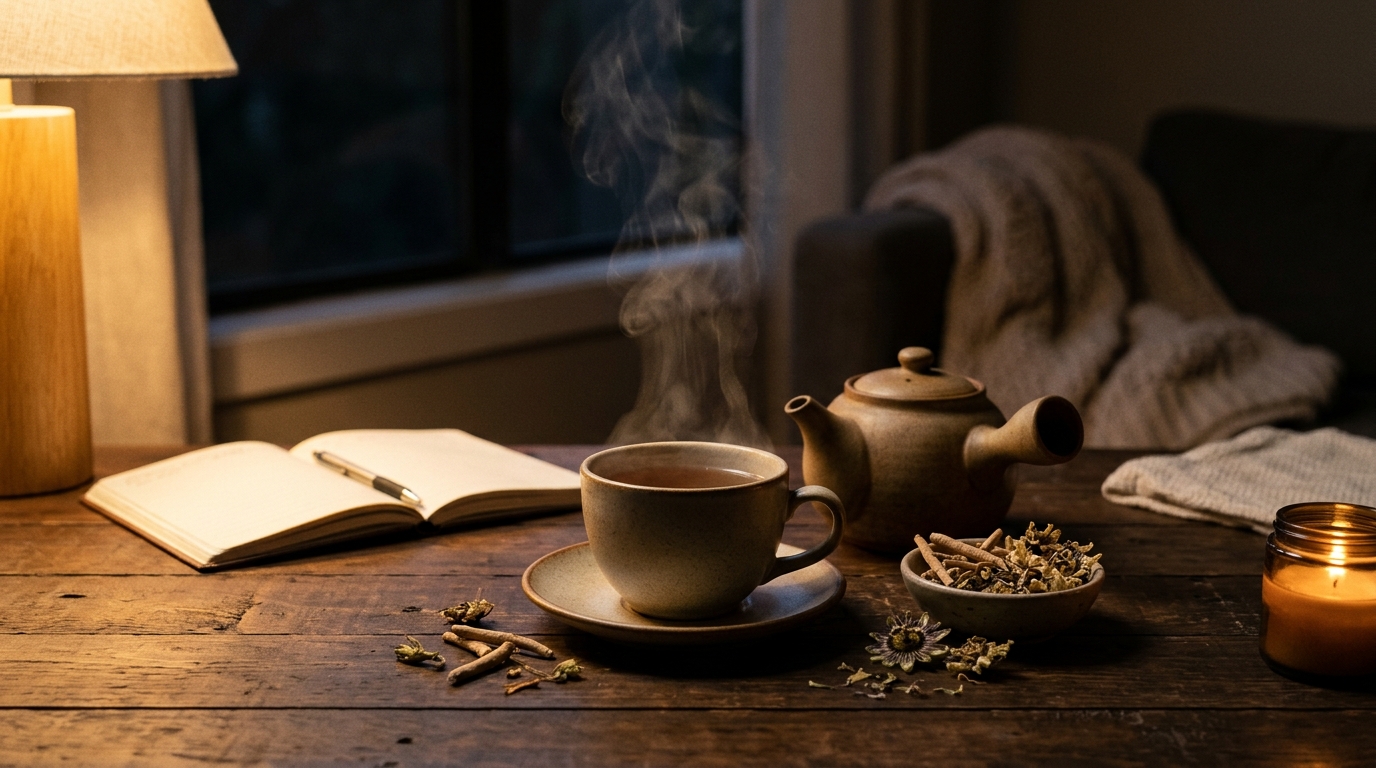
Brought together in one cup, the two herbs complement each other well. Ashwagandha works over time to support the body’s stress response, while passionflower offers a more immediate softening of mental chatter. The result is a deep golden-brown tea with a warm, earthy-sweet character, a grassy floral lift, and a ritual quality that makes it ideal for the last hour before bed on days when your shoulders have been up around your ears.
2
cups
Ingredients
- 2 tspdried ashwagandha root, cut and sifted
- 2 tspdried passionflower (aerial parts)
- 480 mlfiltered water (95°C / 203°F for hot brew)
- —raw honey or maple syrup to taste (optional)
- —splash of oat milk or coconut milk (optional, pairs well with ashwagandha)
- —pinch of cinnamon or a slice of fresh ginger (optional)
How to Brew
Click on an item below to shop for the recommended items for this recipe on Amazon.
As an Amazon Associate, we earn from qualifying purchases.
- Measure 2 teaspoons of cut and sifted ashwagandha root and 2 teaspoons of dried passionflower into a teapot or large mug fitted with a fine-mesh infuser.
- Bring filtered water to just off the boil, around 95°C (203°F), then pour 480 ml over the herbs, wetting all of the plant material evenly.
- Cover immediately with a lid or small saucer to trap the steam and volatile oils, then steep for 10 to 12 minutes. The longer steep softens the root’s bitterness into a rounder, earthier flavor.
- Remove the infuser, pressing the herbs lightly against the side to release the last of the liquid.
- Stir in honey or maple syrup if you like, and add a splash of warm oat or coconut milk for a creamier, more grounding cup.
- Sip slowly, ideally 45 to 60 minutes before bed, in dim light and without a screen in your hand.
- Add 3 teaspoons of cut ashwagandha root and 2 teaspoons of dried passionflower to a clean glass jar.
- Pour in 700 ml of cool filtered water, stir gently to saturate the herbs, and seal the jar.
- Leave on the counter for the first hour, then transfer to the refrigerator and steep for 8 to 10 hours or overnight.
- Strain through a fine-mesh sieve lined with a piece of muslin or a coffee filter to catch the fine root particles, which can otherwise leave a slightly gritty texture.
- Serve over a few ice cubes with a thin lemon wheel, or gently warm a portion on the stove to just below a simmer if you want a mellow evening drink with the smoother cold-extracted flavor.
- Store any leftover tea in a sealed container in the refrigerator and drink within 48 hours.
- Combine 2 teaspoons of ashwagandha root with 360 ml of water in a small saucepan, along with a cinnamon stick or a few slices of fresh ginger if desired.
- Bring to a boil over medium heat, then reduce to the gentlest simmer, partially covered, and cook for 15 minutes until the liquid has reduced by roughly a quarter and turned a deep golden brown.
- Pour in 120 ml of oat milk, whole milk, or coconut milk and warm through for another minute without letting it boil hard.
- Remove from the heat, add 2 teaspoons of dried passionflower, cover the pan, and let it steep for 5 minutes. Adding it off the heat protects its delicate flavonoids and keeps the flavor green and floral rather than hay-like.
- Strain through a fine-mesh sieve into a warmed mug and sweeten with honey, maple syrup, or a drizzle of date syrup.
- Finish with a light dusting of cinnamon or a tiny pinch of ground cardamom and drink while warm.
Health Benefits
Several randomized, placebo-controlled trials of standardized ashwagandha root extract have found significant reductions in perceived stress scores and serum cortisol over 8 weeks. Results come mostly from concentrated extracts, so a tea is a gentler, milder version of this effect.
Both herbs have clinical support for reducing anxiety symptoms. Ashwagandha has outperformed placebo in multiple small trials, while passionflower has performed comparably to some conventional anxiolytics in short-term studies, though more research is needed.
Ashwagandha leaf and root extracts have been shown to improve sleep quality and onset in people with insomnia, and passionflower tea has been shown to modestly improve subjective sleep quality in a small human trial. The effect is supportive rather than sedating.
Passionflower’s flavonoids appear to raise levels of GABA, the brain’s main inhibitory neurotransmitter, which is why it has long been used for the mental over-activity that keeps people awake at night.
As an adaptogen, ashwagandha seems to work best with consistent use over weeks, helping the body respond more evenly to stressors rather than acting as an instant calming agent.
🧪 Key Bioactive Compounds
The Science Behind Ashwagandha
Ashwagandha’s reputation as an adaptogen rests largely on a group of compounds called withanolides, steroid-like molecules found throughout the root. Human clinical trials, most of which use standardized root extracts delivering a defined amount of withanolides, report reductions in perceived stress and serum cortisol compared with placebo. The proposed mechanism involves modulation of the HPA axis, the body’s central stress-response system, which becomes overactive under chronic pressure. Because withanolides are not highly water-soluble, a long steep or gentle simmer, especially with a little milk or fat, helps pull more of them into the cup.
Passionflower works through a different pathway. Its flavonoids, including apigenin, vitexin, and chrysin, appear to interact with GABA-A receptors in the central nervous system. GABA is the main inhibitory neurotransmitter, responsible for dampening neural excitability, and boosting its activity is the same general approach used by many anti-anxiety medications. A small randomized trial of passionflower tea taken for a week found improved subjective sleep quality compared with placebo, and other studies have found it effective for pre-surgical and generalized anxiety.
It is worth being candid about the limits of the evidence. Most of the strongest ashwagandha data comes from concentrated extracts rather than tea, and passionflower trials are generally small and short. A cup of this blend is best understood as a supportive daily ritual, one that combines a plausible pharmacology with the proven calming power of slowing down, rather than a substitute for professional care when anxiety or sleeplessness is severe or persistent.
Brewing Tips
- Consistency matters more than quantity with ashwagandha. A cup in the evening over several weeks is more likely to help than an occasional large dose.
- Buy cut and sifted root rather than fine powder for tea, as powder clouds the cup and makes it gritty and harder to strain.
- Cover the cup while steeping. Passionflower’s aromatic compounds are volatile and escape quickly with the steam.
- If the earthy bitterness of ashwagandha is too strong, balance it with a little honey, cinnamon, or warm milk, or try the cold brew method for a smoother flavor.
- Store both herbs in airtight, light-proof containers away from heat, and use within a year for the best flavor and potency.
- Pair the tea with a wind-down habit such as dimming the lights, stretching, or journaling so the ritual itself reinforces the calming effect.