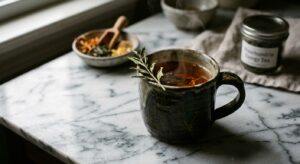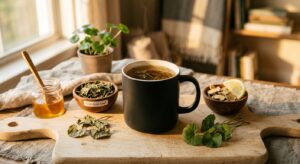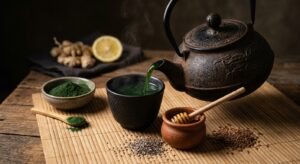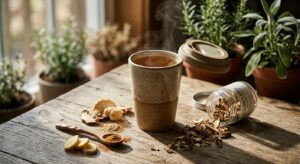
The 3 PM energy crash is one of the most universally recognized experiences of modern life. Your eyelids grow heavy, concentration slips, and the afternoon stretches out like an impossible horizon. Long before coffee became the default solution, herbalists and healers across cultures had already mapped out a pharmacopeia of plants capable of restoring alertness, lifting mood, and supporting mental clarity. From the peppermint fields of the Mediterranean to the ginger markets of ancient India, the ingredients in this blend have centuries of use as natural energizers behind them.
What makes this blend genuinely different from a strong cup of black coffee is how each ingredient plays a distinct role. Peppermint delivers a brisk, cooling alertness through menthol, a compound that stimulates cold-sensitive receptors and increases the sensation of wakefulness. Green tea contributes a modest, clean caffeine lift paired with L-theanine, an amino acid that smooths out stimulation into calm, sustained focus. Ginger adds warming circulation support and settles the digestive restlessness that so often accompanies afternoon fatigue. Lemon balm rounds the blend out with its mild anxiolytic properties, keeping the mental tone bright and calm rather than wired.
Together, these four herbs create something greater than the sum of their parts. The result is a tea that tastes vibrant and alive, with a crisp minty top note, a warm gingery finish, and a faint citrus lift from the lemon balm. It is a cup designed to be drunk with intention, a 10-minute pause that resets the second half of your day rather than just pushing through it on borrowed energy.
2
cups
Ingredients
- 2 tspdried peppermint leaves
- 1 tspgreen tea (sencha or gunpowder)
- 1 tspdried lemon balm leaves
- 3 slicesfresh ginger root (or 0.5 tsp dried ground ginger)
- 480 mlwater (80 to 85°C / 176 to 185°F)
- —raw honey or agave to taste (optional)
- —fresh lemon slice for serving (optional)
How to Brew
Click on an item below to shop for the recommended items for this recipe on Amazon.
As an Amazon Associate, we earn from qualifying purchases.
- Heat your water to 80 to 85°C (176 to 185°F). This temperature range extracts the best flavor from green tea without releasing harsh tannins that cause bitterness.
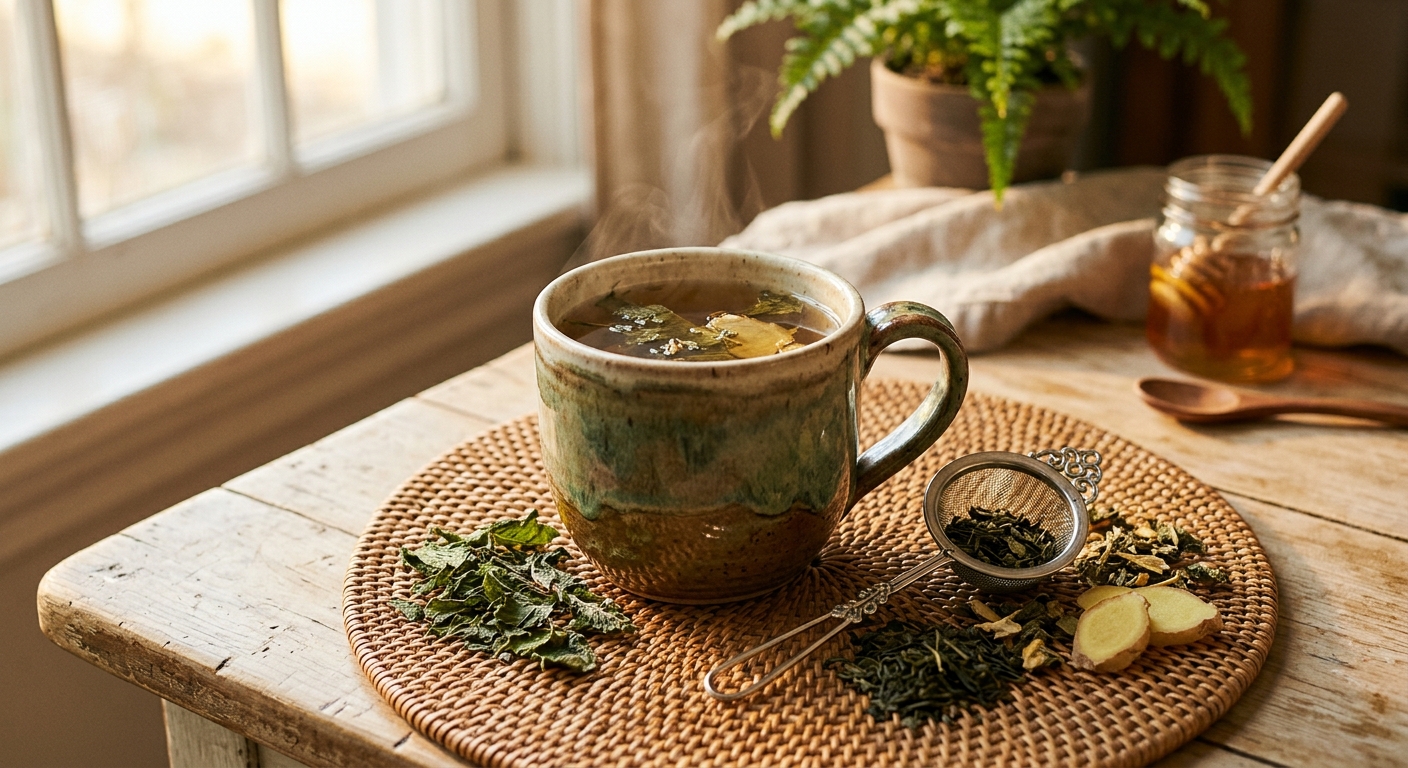
- Add the dried peppermint leaves, green tea, dried lemon balm, and fresh ginger slices into your tea infuser or teapot. If using dried ground ginger, stir it directly into the dry blend.
- Pour the heated water over the herbs and cover the vessel with a lid or small plate. Covering the steep is especially important for peppermint, which loses its volatile menthol oils to evaporation in an open cup.
- Steep for 4 minutes for a lighter, more delicate cup or up to 6 minutes for a stronger, more invigorating brew. Do not exceed 6 minutes or the green tea will begin to turn astringent.
- Remove the infuser or strain the herbs. Add a squeeze of fresh lemon and sweeten with honey if desired. Drink within 10 minutes while the aromatic oils are still at their most potent.
- Combine the dried peppermint leaves, green tea, dried lemon balm, and fresh ginger slices in a clean glass jar or pitcher. Increase the herb quantities by 50 percent compared to the hot brew recipe, as cold water extracts more slowly and you need more surface area to compensate.
- Pour cold, filtered water at room temperature over the herbs. Do not use hot water. Stir briefly to ensure the herbs are fully submerged, then seal the jar or cover the pitcher tightly.
- Leave the jar at room temperature for 30 minutes, then transfer it to the refrigerator. Allow it to steep for a minimum of 8 hours and up to 12 hours. The slow cold extraction draws out the sweet, floral, and minty notes while leaving bitter tannins and harsh compounds largely undisturbed.
- When ready, strain the herbs through a fine mesh strainer or cheesecloth into glasses filled with ice. The brew will have a noticeably lighter color than the hot version but a surprisingly full and rounded flavor.
- Serve over ice with a sprig of fresh mint and a thin slice of lemon for an afternoon cold brew that is genuinely refreshing rather than simply cold tea. Sweeten lightly with a liquid honey or agave if desired, as granulated sugar will not dissolve well in a cold brew.
- Double all herb quantities relative to the standard hot brew recipe. Add the peppermint, green tea, lemon balm, and ginger into a small saucepan or heatproof pitcher.
- Heat water to 80 to 85°C (176 to 185°F) and pour only half the usual volume over the herbs. The reduced water volume with doubled herb quantities creates a highly concentrated extraction.
- Steep covered for 8 to 10 minutes. The longer steep at this ratio is intentional and extracts the full energizing compound profile from each herb, including the menthol from peppermint, the catechins from green tea, and the gingerols from ginger.
- Strain the concentrate through a fine mesh strainer into a clean glass jar or bottle. Press the spent herbs gently with a spoon to extract the last of the liquid. Allow to cool before sealing and refrigerating.
- To serve hot, combine equal parts concentrate and freshly heated water in a mug. To serve cold, pour the concentrate over a glass full of ice and top with cold filtered water or sparkling water for an energizing afternoon spritzer. The concentrate keeps well in the refrigerator for up to 3 days.
Health Benefits
The combination of green tea caffeine and L-theanine is one of the most well-researched cognitive pairings in herbal medicine. Multiple controlled trials have shown that this combination improves attention, working memory, and reaction time more effectively than caffeine alone, and without the spike-and-crash pattern associated with coffee or energy drinks.
Inhaling and consuming peppermint has been shown in studies at Wheeling University to significantly improve alertness, memory, and mood. The menthol compounds stimulate trigeminal nerve endings, creating an immediate sensory wake-up signal that complements the biochemical effects of the green tea and lemon balm.
Afternoon fatigue is frequently worsened by post-lunch digestive heaviness. Ginger is a well-documented prokinetic agent, meaning it accelerates gastric emptying and reduces bloating, while peppermint relaxes the smooth muscle of the gastrointestinal tract. Together they address one of the most overlooked physical causes of the 3 PM slump.
Lemon balm has been the subject of multiple clinical trials showing significant reductions in acute stress and anxiety at supplemental doses. In tea form, its rosmarinic acid and flavonoid content contribute a calming quality that counters the mental friction of a long workday without producing drowsiness, making it ideal for afternoon focus rather than evening wind-down.
All four herbs in this blend are rich in polyphenols and flavonoids. Green tea’s catechins, peppermint’s flavones, ginger’s gingerols, and lemon balm’s rosmarinic acid collectively provide broad-spectrum antioxidant coverage, helping to reduce the low-grade oxidative stress that contributes to both mental fog and physical fatigue during long work days.
🧪 Key Bioactive Compounds
The Science Behind Peppermint
The energizing effect of this blend is not a matter of one compound doing all the work. It is the result of several distinct biochemical pathways firing in coordination. Green tea caffeine blocks adenosine A1 and A2A receptors, which are the receptors responsible for signaling fatigue accumulation in the brain. As adenosine builds up throughout the day, you feel progressively more tired; caffeine temporarily occupies those receptors without triggering the fatigue signal, giving the brain space to operate at a sharper level. However, caffeine alone often produces a jittery, unfocused quality because it also elevates cortisol and adrenaline. This is precisely where L-theanine earns its place. By promoting alpha brain wave activity and modulating dopaminergic and serotonergic pathways, L-theanine converts the raw stimulation of caffeine into something resembling a calm, clear-headed flow state.
Peppermint’s contribution operates through an entirely different mechanism. Menthol activates the TRPM8 receptor channel, a cold-sensitive receptor found in the nasal mucosa, oral cavity, and skin. When these receptors are stimulated, they send alerting signals through the trigeminal nerve to the brain, triggering a sensory wakefulness response that is almost instantaneous. Research from Northumbria University has demonstrated that simply being in a room scented with peppermint oil improves memory and alertness in human subjects, and consuming peppermint tea provides both olfactory and gustatory stimulation simultaneously. This is a neurological wake-up call delivered through the senses rather than through receptor blockade.
Lemon balm’s role is perhaps the most nuanced. Its primary active compounds, rosmarinic acid and the flavonoids apigenin and luteolin, inhibit the enzyme GABA transaminase, which is responsible for breaking down gamma-aminobutyric acid in the brain. By preserving GABA levels, lemon balm produces a gentle anti-anxiety effect that prevents the afternoon stress response from escalating into cortisol-driven fatigue. A 2014 randomized controlled trial published in Nutrients found that lemon balm supplementation significantly improved mood and cognitive performance under stress conditions, making it an ideal modulating agent in a blend designed for high-demand workday hours.
Brewing Tips
- Always cover your cup or teapot during steeping. Peppermint and lemon balm are rich in volatile aromatic oils that evaporate quickly in an open vessel, and those oils are responsible for a significant portion of the alertness and mood benefits. A small plate or saucer placed over your mug is sufficient.
- Use fresh ginger whenever possible rather than dried ground ginger. Fresh ginger slices contain higher concentrations of 6-gingerol, the most bioactive form of ginger’s key compounds, while dried ginger is richer in shogaol. Fresh ginger gives a brighter, more circulatory warmth that suits the energizing intent of this blend perfectly.
- Brew this tea at the first sign of fatigue rather than waiting until you are fully in the slump. The compounds in this blend work best as a preventive rhythm-setter rather than a rescue remedy. If you know your energy typically dips at 2:30 PM, start brewing at 2:15 PM so the cup is ready at the right moment.