Cortisol, often called the ‘stress hormone,’ plays a vital role in the body’s fight-or-flight response. In small, well-timed bursts it sharpens focus and mobilizes energy. But in today’s world of chronic deadlines, disrupted sleep, and relentless notifications, cortisol can remain elevated long after the stressor has passed. Over weeks and months, that sustained elevation is linked to fatigue, poor sleep, weight gain, and mood disturbances. Herbal traditions from Ayurveda, Traditional Chinese Medicine, and European folk herbalism have long recognized plants that help the body navigate stress more gracefully, and modern phytochemistry is beginning to explain why they work.
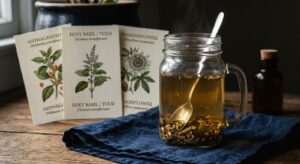
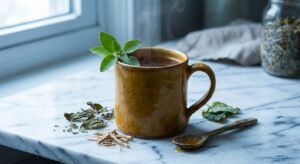
This Cortisol Regulation Tea centers on three time-honored herbs: ashwagandha root, holy basil (Ocimum tenuiflorum, also called tulsi), and lemon balm (Melissa officinalis). Ashwagandha is one of Ayurveda’s most revered rasayanas, or rejuvenating tonics, prized for over 3,000 years for its ability to fortify the nervous system and restore vitality to those depleted by chronic stress. Holy basil, sacred in Hindu tradition and cultivated around temples throughout South Asia, was described in ancient Sanskrit texts as an adaptogen that ‘lightens the heart.’ Lemon balm has graced European monastery gardens since the Middle Ages, where Benedictine monks brewed it as a remedy for nervous tension and sleeplessness.
Together these three herbs form a synergistic blend that addresses cortisol dysregulation from multiple angles: adapting the stress response at the HPA axis level, calming the nervous system, and supporting the quality of sleep that allows cortisol to reset overnight. This is not a sedative tea that leaves you foggy. It is a grounding, gently clarifying blend that you can work with daily, much as traditional healers always intended these plants to be used.
2
cups
Ingredients
- 1 tspdried ashwagandha root powder or sliced root
- 1 tspdried holy basil (tulsi) leaves
- 1 tspdried lemon balm leaves
- 480 mlwater (95°C / 203°F for hot brew)
- —raw honey to taste (optional)
- —a slice of fresh ginger (optional, enhances absorption)
- —a pinch of black pepper (optional, improves ashwagandha bioavailability)
How to Brew
Click on an item below to shop for the recommended items for this recipe on Amazon.
As an Amazon Associate, we earn from qualifying purchases.
- Bring 480 ml of filtered water to 95°C (203°F). If you do not have a temperature-controlled kettle, bring water to a full boil and let it rest for one minute.
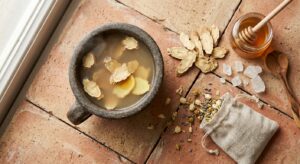
- If using ashwagandha sliced root (rather than powder), add it to a small saucepan with the water and simmer gently for 5 minutes before proceeding. If using powder, skip this step.
- Place 1 tsp ashwagandha root powder (or the pre-simmered sliced root), 1 tsp dried holy basil, and 1 tsp dried lemon balm into a tea infuser or teapot. Add the optional ginger slice and pinch of black pepper if using.
- Pour the hot water over the herbs. Cover the teapot or mug with a lid or small plate to trap volatile aromatic compounds, especially from the lemon balm.
- Steep for 10 to 15 minutes. The longer steep draws out more of the withanolides from ashwagandha that contribute to its adaptogenic action.
- Strain thoroughly into your mug. Stir in raw honey if desired. Sip slowly, ideally 30 minutes before a known stressful period or as part of an evening wind-down ritual.
- Combine 1 tsp ashwagandha root powder, 1.5 tsp dried holy basil, and 1.5 tsp dried lemon balm in a clean glass jar. The slightly higher ratio of the aromatic herbs compensates for the gentler cold extraction of their volatile oils.
- Pour 480 ml of cold, filtered water over the herbs. Stir gently to ensure the ashwagandha powder is dispersed rather than clumped at the surface.
- Seal the jar and let it steep at room temperature for 1 hour to initiate extraction, then transfer to the refrigerator.
- Continue cold-brewing for 9 to 13 hours (overnight works perfectly). The slow, cold extraction draws out adaptogenic compounds while keeping bitter notes subdued.
- Strain through a fine mesh strainer or cheesecloth, pressing gently on the spent herbs. If using ashwagandha powder, a double-strain through a coffee filter removes any remaining fine particles.
- Serve over ice or chilled. Stir in a small drizzle of honey or a few drops of liquid stevia. Consume within 48 hours and keep refrigerated.
- Measure 600 ml of cold, filtered water into a small saucepan. Add 1.5 tsp of ashwagandha sliced root or powder directly to the cold water before heating. Starting from cold water improves the extraction of dense root compounds.
- Bring to a gentle boil over medium heat, then immediately reduce to a low simmer. The surface should barely bubble. Add the optional ginger slice and pinch of black pepper at this stage.
- Simmer uncovered for 20 to 25 minutes, stirring occasionally. The liquid will reduce by roughly one quarter, concentrating the adaptogenic compounds. Watch the heat carefully to prevent a rolling boil, which can degrade heat-sensitive constituents.
- Remove the saucepan from heat and add 1 tsp dried holy basil and 1 tsp dried lemon balm directly to the hot decoction. Cover the saucepan immediately with a lid.
- Allow the aromatic herbs to infuse off the heat for 5 to 7 minutes. This two-stage method protects the volatile oils of lemon balm and holy basil, which would be lost during prolonged simmering.
- Strain through a fine mesh strainer into a mug or teapot. You should have approximately 360 to 400 ml of concentrated, amber-brown tea. Sweeten with honey if desired and sip warm. This concentration is suitable for one strong serving or two moderate servings.
Health Benefits
A double-blind, randomized controlled trial published in the Indian Journal of Psychological Medicine found that ashwagandha root extract (300 mg twice daily) produced a statistically significant reduction in serum cortisol compared to placebo over 60 days. The withanolides in ashwagandha appear to act on the HPA axis, reducing the adrenal glands’ output of cortisol in response to chronic stressors.
Holy basil has been shown in clinical studies to reduce generalized anxiety, stress-related cognitive impairment, and mood disturbances. A 2012 study in the Journal of Ayurveda and Integrative Medicine found significant improvements in stress scores and anxiety after six weeks of tulsi supplementation, attributed to its combined adaptogenic, antioxidant, and GABAergic activity.
Lemon balm’s rosmarinic acid inhibits the enzyme that breaks down GABA, resulting in more available inhibitory neurotransmitter activity in the brain. Clinical research, including a crossover study published in Nutrients (2014), found that lemon balm extract significantly improved mood, calmness, and sleep quality in mildly stressed adults.
Chronic cortisol elevation is known to impair memory and executive function by reducing hippocampal volume over time. Ashwagandha has demonstrated neuroprotective effects in multiple studies, with a 2017 trial in the Journal of Dietary Supplements showing improved memory, attention, and information-processing speed in adults who took ashwagandha root extract for eight weeks.
Sustained cortisol elevation paradoxically promotes systemic inflammation by desensitizing immune cells to cortisol’s anti-inflammatory signals. The combined action of eugenol from holy basil and withanolides from ashwagandha addresses this by inhibiting NF-kB signaling pathways and COX-2 enzyme activity, reducing inflammatory markers such as CRP and IL-6.
🧪 Key Bioactive Compounds
The Science Behind Ashwagandha
The most intensively studied compounds in this blend are the withanolides, a class of naturally occurring steroidal lactones unique to the Withania somnifera plant. The most bioactive of these, Withaferin A and Withanolide D, have been shown to modulate the hypothalamic-pituitary-adrenal (HPA) axis, the central command system that governs cortisol release. In chronic stress, the HPA axis becomes dysregulated, producing excess cortisol even in the absence of acute threat. Withanolides appear to normalize this by reducing the sensitivity of cortisol-releasing corticotropin-releasing hormone (CRH) neurons in the hypothalamus and by lowering adrenal responsiveness to ACTH stimulation. The result is a measurable reduction in serum cortisol that has been replicated across multiple randomized controlled trials.
Lemon balm operates through a distinct but complementary mechanism. Its dominant polyphenol, rosmarinic acid, has been identified as a potent inhibitor of GABA transaminase, the enzyme responsible for breaking down gamma-aminobutyric acid (GABA) in the synaptic cleft. By slowing GABA degradation, rosmarinic acid effectively raises inhibitory tone in the central nervous system, calming overactivated stress circuits without the dependency risks associated with pharmaceutical GABAergic drugs. This action has been confirmed in both in vitro receptor binding studies and human clinical trials, where lemon balm extract consistently improved self-reported anxiety, calmness, and sleep latency measures.
Holy basil contributes its own multidimensional pharmacology to the blend. Eugenol, the compound responsible for its distinctive clove-like aroma, acts as a selective inhibitor of cyclooxygenase (COX) enzymes, reducing the production of prostaglandins that contribute to neuroinflammation, a key downstream consequence of chronic cortisol elevation. Meanwhile, ursolic acid in holy basil has demonstrated adaptogenic activity in animal models by normalizing stress-induced increases in blood glucose, adrenal weight, and anxiety behavior. The interplay of these three herbs, each targeting a different node of the stress-response cascade, is what makes this blend genuinely greater than the sum of its parts.
Brewing Tips
- Use ashwagandha root powder rather than capsule-form extract for brewing: the whole-root powder contains the full spectrum of withanolides, alkaloids, and saponins that work together synergistically, rather than isolated standardized extracts.
- Brew this tea consistently for at least three to four weeks before evaluating results. Adaptogens like ashwagandha operate through gradual HPA axis recalibration rather than immediate pharmacological action, and clinical studies typically show meaningful cortisol changes only after 30 to 60 days of regular use.
- Store your dried herb blend in a sealed dark glass jar away from heat and light. Lemon balm’s volatile oils, which carry both its aroma and much of its rosmarinic acid content, degrade quickly when exposed to air, sunlight, or fluctuating temperatures. Pre-blending your herbs in the correct ratio and storing them together makes daily brewing faster and more consistent.