Long before antibiotics existed, healers across the ancient world reached for barberry root. Known as zereshk in Persian traditional medicine and revered in Ayurvedic practice as daruharidra, the barberry shrub has been used for over 3,000 years to combat infections, soothe inflamed tissues, and support the liver. Its distinctive bright yellow inner root bark, stained vivid by the alkaloid berberine, made it immediately recognizable to traditional apothecaries from the Middle East to the Appalachian mountains, where Cherokee and other Indigenous peoples similarly employed it as a digestive and fever remedy.
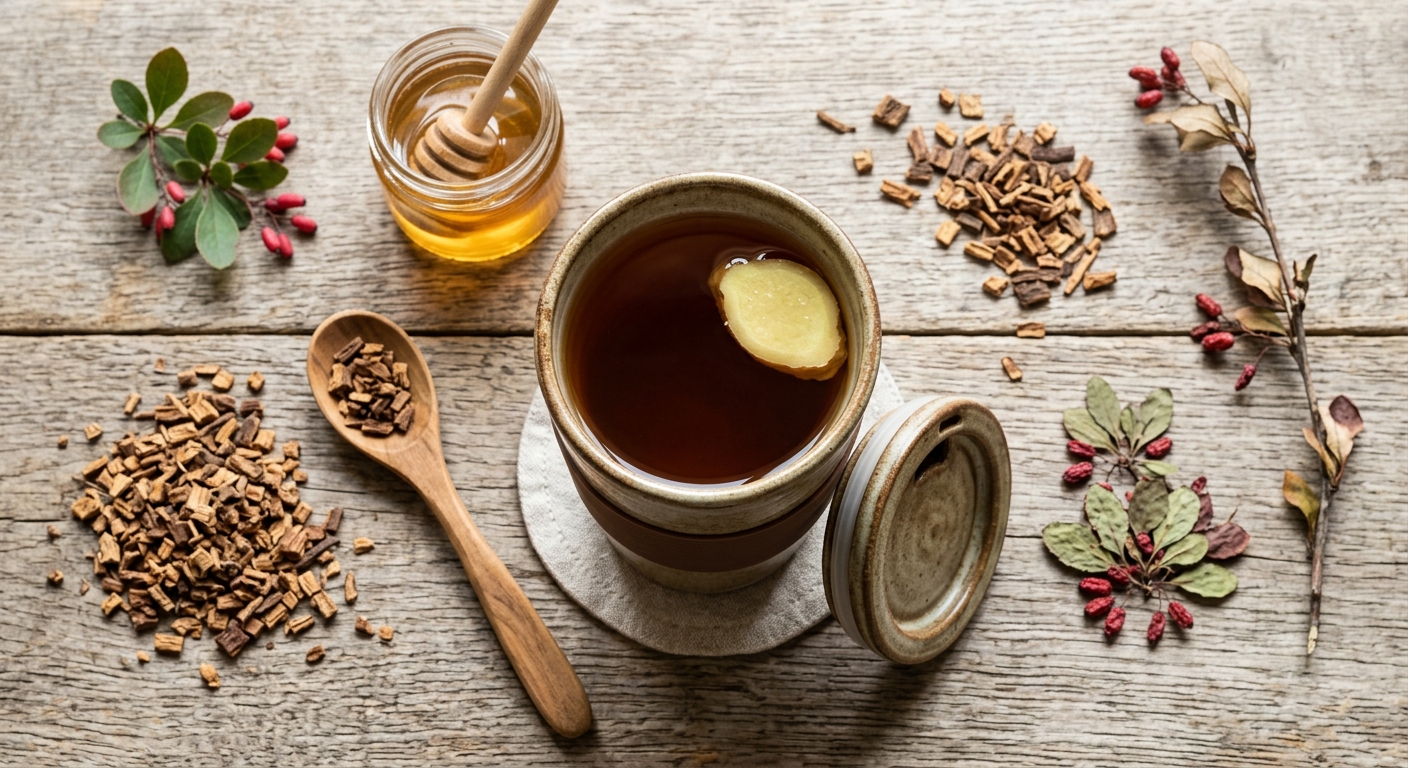
What makes barberry root so remarkable is its potency. Unlike many gentle herbal teas that nudge the body toward wellness, barberry root is a serious botanical medicine with measurable antimicrobial action. The taste reflects this: unmistakably bitter and deeply earthy, with a faint woody warmth. It is not a casual sipping tea but a purposeful tonic, traditionally brewed at the first sign of a cold, a digestive upset, or a sluggish immune system. Its golden brew color and sharp, resinous aroma signal that something medicinal is genuinely at work.
Today, barberry root is experiencing a renaissance among herbalists and integrative health practitioners, largely driven by the growing body of research on berberine, one of the most studied plant alkaloids in contemporary pharmacology. Whether you are drawn to it for its storied history, its striking appearance, or its science-backed benefits, barberry root tea offers a direct connection to one of humanity’s oldest healing traditions. This guide will walk you through everything you need to brew it safely and effectively.
2
cups
Ingredients
- 2 tspdried barberry root bark (coarsely chopped or ground)
- 480 mlwater (100°C / 212°F for decoction)
- —raw honey or licorice root to taste (optional, to temper bitterness)
- —slice of fresh ginger (optional, for warmth and palatability)
How to Brew
Click on an item below to shop for the recommended items for this recipe on Amazon.
As an Amazon Associate, we earn from qualifying purchases.
- Add 2 teaspoons of coarsely chopped or ground dried barberry root bark to a small saucepan. For two servings, use 480 ml of cold filtered water.
- Place the saucepan over medium-high heat and bring the water to a full rolling boil, then immediately reduce the heat to a low, steady simmer.
- Simmer uncovered for 15 to 20 minutes. The liquid will reduce slightly and deepen from pale yellow to a rich golden amber. Keep the simmer gentle – a vigorous boil can drive off volatile aromatic compounds.
- Remove from heat and allow the decoction to rest for 5 minutes. This brief resting period allows additional extraction as the liquid cools slightly.
- Strain the liquid through a fine mesh strainer or cheesecloth into two mugs, pressing the root material gently to recover all the liquid.
- Sweeten with a small amount of raw honey or a strip of licorice root if desired. Drink warm, ideally between meals for optimal digestive and immune support.
- Measure 2 heaped teaspoons of finely ground or thinly sliced dried barberry root bark into a clean glass jar. Use 480 ml of cold, filtered water at room temperature.
- Stir the root and water together briefly to ensure the root material is fully submerged. You can place a small ramekin or lid on top of the floating root to keep it beneath the waterline.
- Leave the jar uncovered or loosely covered at room temperature for the first 2 hours to initiate extraction. Then seal the jar and transfer it to the refrigerator.
- Allow the cold maceration to continue in the refrigerator for a total of 12 to 18 hours. A longer steep time of 16 to 18 hours produces a more concentrated, richer golden extract.
- Strain the cold-brewed liquid through a fine mesh strainer lined with cheesecloth into a clean vessel, pressing the root residue firmly to extract the maximum amount of liquid.
- Serve over ice with a squeeze of lemon juice, which brightens the bitter profile, or gently warm a single serving without boiling. The cold brew keeps refrigerated for up to 48 hours.
- Combine 4 tablespoons of coarsely chopped dried barberry root bark with 750 ml of cold filtered water in a medium saucepan. This higher root-to-water ratio is intentional for the concentrate method.
- Bring to a full boil over medium-high heat, then reduce immediately to the lowest simmer your stove can maintain. The surface should show only occasional gentle bubbles.
- Simmer uncovered for 35 to 45 minutes, allowing the liquid to reduce by roughly half, to approximately 350 to 400 ml. Watch the pot closely in the final 10 minutes to prevent over-reduction.
- Remove from heat and allow the concentrate to cool in the pan for 10 minutes before straining through a fine mesh strainer lined with cheesecloth into a clean glass jar with a tight-fitting lid.
- Do not sweeten the concentrate at this stage if you intend to store it. Label the jar with the date. Store in the refrigerator for up to 5 days.
- To use, measure 1 to 2 tablespoons of concentrate per serving and dilute in 180 to 240 ml of warm water or herbal tea. Add honey or ginger to improve palatability at the point of consumption.
Health Benefits
Berberine activates macrophages and natural killer cells while directly disrupting the cell membranes of a wide range of bacterial, viral, and fungal pathogens. Clinical trials have demonstrated efficacy comparable to some antibiotics in treating certain gastrointestinal infections, making barberry root one of the most robustly supported antimicrobial herbs in the traditional pharmacopoeia.
Barberry root’s bitter compounds stimulate bile production and digestive enzyme secretion, improving nutrient absorption and relieving sluggish digestion. Berberine has been shown in multiple studies to selectively inhibit pathogenic bacteria in the gut while supporting the populations of beneficial microorganisms, making it valuable for both acute gastrointestinal infections and longer-term gut health maintenance.
The combined protoberberine alkaloids in barberry root exhibit significant free-radical scavenging activity, reducing oxidative stress that contributes to chronic inflammation and immune dysfunction. Studies have shown that berberine inhibits key pro-inflammatory signaling pathways, including NF-kB, providing a plausible mechanism for the herb’s traditional use in reducing fever and inflammatory conditions.
Palmatine and berberine together have demonstrated hepatoprotective effects in animal studies, reducing liver enzyme elevations associated with toxic injury and improving bile flow. Traditional Persian and Ayurvedic medicine specifically used barberry root as a liver and gallbladder tonic, a use now supported by emerging laboratory and clinical evidence.
Berberine is one of the most studied natural compounds for metabolic health, with clinical trials showing it can lower fasting blood glucose and HbA1c levels through activation of AMPK, the same cellular energy-sensing pathway targeted by the pharmaceutical drug metformin. Several meta-analyses have also found significant reductions in total cholesterol and LDL levels following berberine supplementation.
🧪 Key Bioactive Compounds
The Science Behind Barberry Root
The pharmacological story of barberry root is largely the story of berberine, one of the most extensively researched plant alkaloids in modern science. Berberine belongs to the isoquinoline alkaloid family and is responsible for barberry root’s vivid yellow pigmentation. Its antimicrobial mechanism is multifaceted: berberine intercalates into bacterial DNA, disrupting replication, and also inhibits a bacterial enzyme called FtsZ that is critical for cell division. This dual mechanism makes it effective against a broader range of organisms than single-target antibiotics, and importantly, it has shown activity against certain drug-resistant strains of bacteria, including methicillin-resistant Staphylococcus aureus (MRSA), in laboratory settings.
Beyond its antimicrobial properties, berberine exerts significant effects on human metabolism and immune regulation. It activates adenosine monophosphate-activated protein kinase (AMPK), a master metabolic regulator that controls glucose uptake, fat oxidation, and energy homeostasis. This is the same mechanistic pathway exploited by metformin, and multiple randomized controlled trials have confirmed that berberine produces clinically meaningful reductions in fasting blood glucose, HbA1c, and LDL cholesterol in people with type 2 diabetes and metabolic syndrome. On the immune side, berberine modulates the NF-kB signaling pathway, one of the central coordinators of inflammatory responses, reducing the production of pro-inflammatory cytokines including TNF-alpha and IL-6 while simultaneously enhancing the activity of macrophages and natural killer cells that identify and destroy pathogens.
The full alkaloid profile of barberry root, which includes berbamine, palmatine, columbamine, and jatrorrhizine alongside berberine, produces what herbalists describe as a whole-plant synergy. Research comparing isolated berberine to whole barberry extracts has suggested that the companion alkaloids both enhance berberine’s bioavailability and contribute independent antimicrobial, antioxidant, and hepatoprotective effects. Palmatine, for instance, has demonstrated hepatoprotective activity in rodent models of chemical liver injury, while berbamine has shown immunomodulatory properties distinct from berberine’s direct antimicrobial action. This synergy is part of why traditional medicine systems that relied on the whole root persisted for millennia, long before any individual compound was identified or named.
Brewing Tips
- Always use coarsely chopped or lightly ground root bark rather than fine powder in a decoction, as fine powder can pass through strainers and create a gritty, overly astringent brew. Reserve finely ground barberry for capsule preparations.
- The saucepan and strainer will stain a vivid yellow from berberine. Soak them immediately after use in cold water with a splash of white vinegar to prevent permanent staining.
- Start with smaller amounts, about 1 teaspoon per serving rather than 2, if you are new to bitter herbs or have a sensitive digestive system. Increase gradually over several days to assess your individual tolerance before reaching a full therapeutic dose.