Long before energy drinks lined convenience store shelves, students, scholars, and monks across Asia relied on the quiet intelligence of plants to sustain their concentration. Ginkgo biloba, one of the oldest living tree species on Earth, was revered in Traditional Chinese Medicine for over 5,000 years as a tonic for the mind and circulation. Gotu kola, a creeping herb native to the wetlands of South and Southeast Asia, earned the nickname ‘the herb of enlightenment’ in Ayurvedic and traditional Balinese medicine, where it was consumed daily by yogis and scholars seeking clarity of thought. Peppermint, the aromatic cooling herb familiar across European herbal traditions, rounds out this trio by awakening the senses and supporting alertness through scent and taste alone.
What makes this blend genuinely special is the complementary nature of its three herbs. Ginkgo works at the circulatory level, increasing blood flow to the brain and delivering more oxygen to neurons under cognitive demand. Gotu kola supports the nervous system more structurally, encouraging the synthesis of nerve growth factor and calming stress hormones that interfere with memory encoding. Peppermint, meanwhile, acts through both aroma and digestion: its menthol compounds trigger alertness pathways and ease the stomach tension that often accompanies marathon study sessions. Together, they create a tea that is greater than the sum of its parts.
This recipe is designed with the modern student in mind: flexible brewing methods, a refreshing flavor profile that is easy to drink in volume, and a carefully balanced ratio of herbs that delivers noticeable effect without overstimulation. Whether you brew it hot on a cold morning before lectures or cold brew a pitcher the night before finals, Student Brain Booster Tea is the ritual your study desk has been missing.
2
cups
Ingredients
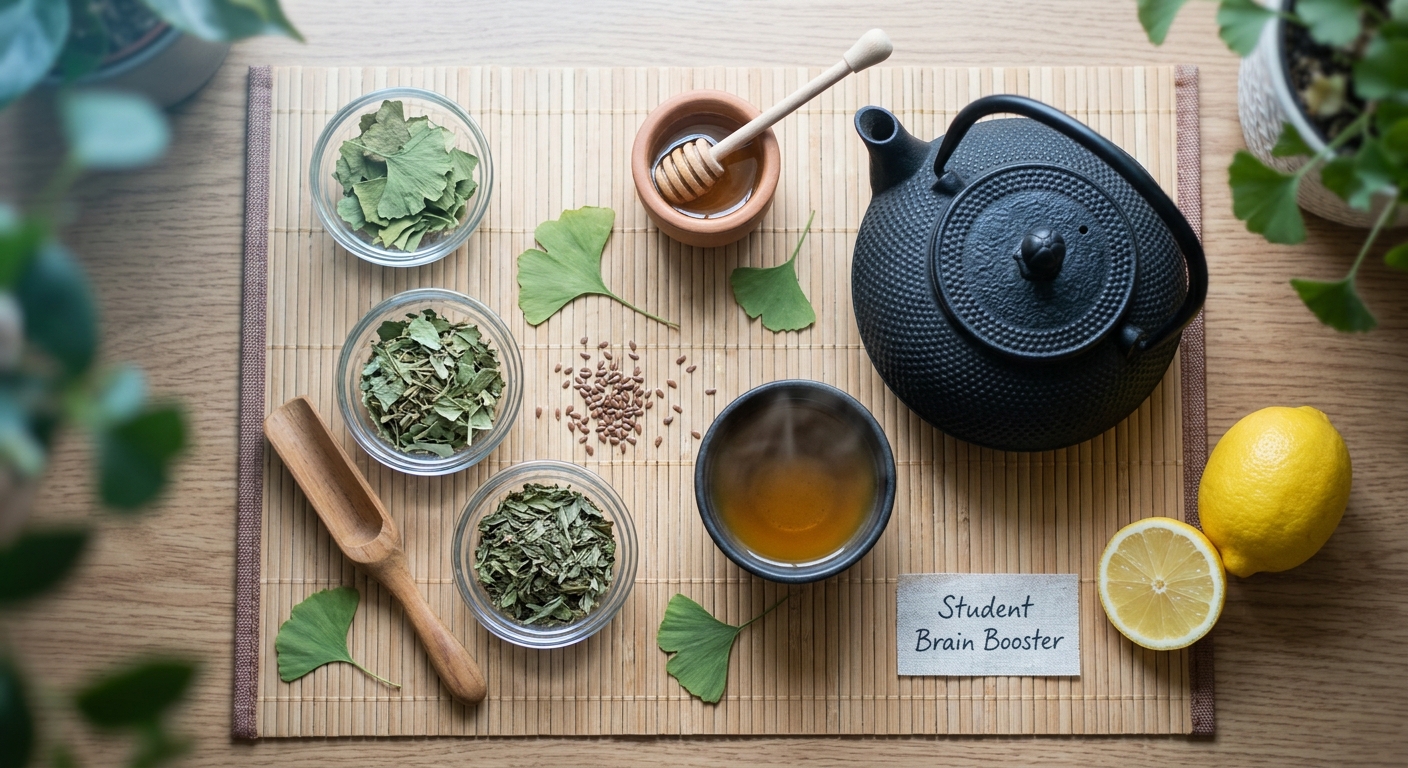
- 1.5 tspdried ginkgo biloba leaves
- 1.5 tspdried gotu kola leaf
- 1 tspdried peppermint leaf
- 480 mlwater (90°C / 194°F)
- —raw honey or lemon slice to taste (optional)
How to Brew
Click on an item below to shop for the recommended items for this recipe on Amazon.
As an Amazon Associate, we earn from qualifying purchases.
- Heat filtered water to 90 to 95°C (194 to 203°F). If you do not have a temperature-controlled kettle, bring water to a boil and let it rest uncovered for 90 seconds before using.
- Measure 1.5 tsp dried ginkgo biloba leaves, 1.5 tsp dried gotu kola leaf, and 1 tsp dried peppermint leaf into a tea infuser or strainer. Place the infuser in a prewarmed ceramic mug or teapot.
- Pour the hot water slowly over the herbs, ensuring all the plant material is fully submerged. Cover the mug with a small saucer or lid to trap the volatile aromatic compounds, particularly the menthol from the peppermint.
- Steep for 7 to 10 minutes. Seven minutes yields a lighter, more aromatic cup; ten minutes produces a fuller-bodied infusion with more bitterness from the ginkgo. Taste at seven minutes and adjust to your preference.
- Remove the infuser and gently press the herbs against the strainer to release the remaining liquid. Add raw honey or a slice of lemon if desired, and sip slowly over 15 to 20 minutes for best absorption.
- Measure out a double batch: 3 tsp dried ginkgo biloba leaves, 3 tsp dried gotu kola leaf, and 2 tsp dried peppermint leaf. Place all herbs into a clean glass jar or a cold brew pitcher fitted with a fine-mesh filter.
- Pour 960 ml of cold, filtered water over the herbs. Do not use warm or hot water for this method, as the slow cold extraction is what creates the smooth, low-bitterness flavor profile. Stir gently to ensure the herbs are fully saturated.
- Seal the jar or pitcher and place it in the refrigerator. Allow the herbs to steep for a minimum of 8 hours, and up to 12 hours for a stronger concentration. Avoid steeping beyond 12 hours, as gotu kola can develop an overly grassy, bitter note.
- Strain the cold brew through a fine-mesh strainer or cheesecloth into a clean pitcher or serving glass, discarding the spent herbs. Serve over ice with a sprig of fresh mint or a wheel of lemon for a bright, visual finish.
- Store the strained cold brew covered in the refrigerator for up to 36 hours. Give it a gentle stir before each serving, as some fine sediment may settle.
- Combine 3 tsp dried ginkgo biloba leaves, 3 tsp dried gotu kola leaf, and 2 tsp dried peppermint leaf in a small saucepan or heatproof measuring cup. This double-strength ratio is intentional for the concentrate method.
- Heat 240 ml of filtered water to 85 to 90°C (185 to 194°F). A slightly lower temperature than hot brew is used here because the extended steep time compensates for reduced temperature, preventing bitterness from becoming unpleasant when diluted.
- Pour the water over the herbs and cover the vessel tightly with a lid or a piece of plastic wrap to prevent volatile menthol from escaping during the long steep. Steep for 15 to 20 minutes at room temperature without disturbing.
- Strain through a fine-mesh strainer into a small glass jar with a lid, pressing the herbs firmly to extract all liquid. You should yield approximately 180 to 200 ml of concentrate.
- To serve, pour 60 to 80 ml of concentrate into a mug or glass and dilute with 180 to 200 ml of hot water, room-temperature water, or sparkling water. Add honey or lemon as desired. Seal and refrigerate remaining concentrate for up to 48 hours.
Health Benefits
Ginkgo biloba extract has been studied extensively in clinical trials and consistently demonstrates improvement in both short-term and working memory, particularly under cognitive stress. Its ability to increase cerebral blood flow means more glucose and oxygen reach the hippocampus during active learning.
Gotu kola’s triterpenoid saponins have been shown in double-blind studies to reduce cognitive fatigue and improve sustained attention over periods of 2 to 4 hours. Combined with peppermint’s aromatic alertness stimulus, this blend provides both biochemical and sensory support for deep concentration.
Brahmoside and madecassoside in gotu kola modulate activity in the amygdala and reduce circulating cortisol, the stress hormone that directly impairs the hippocampus’s ability to encode new memories. A calmer nervous system learns more efficiently.
The high flavonoid content of ginkgo, including quercetin and kaempferol, provides broad antioxidant protection to neurons, which are particularly vulnerable to oxidative damage during prolonged mental effort and sleep deprivation common in student life.
Peppermint’s menthol content relaxes smooth muscle in the gastrointestinal tract, reducing the bloating, cramping, and nervous stomach that frequently accompany high-stress study periods, allowing the body to remain physically comfortable during extended desk work.
🧪 Key Bioactive Compounds
The Science Behind Ginkgo Biloba
The cognitive benefits of this blend are rooted in three complementary mechanisms that operate at different levels of brain physiology. Ginkgo biloba’s most studied active compounds, the ginkgolides and bilobalide, work primarily at the vascular level. Ginkgolides A and B are potent inhibitors of platelet-activating factor, a phospholipid mediator that causes platelet aggregation and vasoconstriction. By blocking this pathway, ginkgo promotes vasodilation in the cerebral microvasculature, increasing regional blood flow to cortical and hippocampal areas most active during learning, problem solving, and memory consolidation. Multiple randomized controlled trials, including a notable 2002 study published in Human Psychopharmacology, have confirmed statistically significant improvements in working memory and spatial processing speed following ginkgo supplementation compared to placebo.
Gotu kola’s mechanisms are more structural and hormonal. Its primary saponins, including asiaticoside, brahmoside, and madecassoside, stimulate fibroblast activity and have been shown in cell culture and animal studies to promote synthesis of nerve growth factor (NGF), a protein essential for the survival, growth, and maintenance of neurons in the central and peripheral nervous systems. Equally important is gotu kola’s demonstrated ability to reduce the activity of the hypothalamic-pituitary-adrenal (HPA) axis, the body’s central stress-response system. Elevated cortisol, a hallmark of chronic academic stress, actively shrinks the hippocampus over time and impairs long-term potentiation, the synaptic mechanism underlying new memory formation. By dampening the cortisol response, gotu kola removes a significant biochemical obstacle to efficient learning.
Peppermint’s contribution to cognitive performance is perhaps the most immediate and sensory of the three, but no less scientifically grounded. A widely cited 2006 study by Moss et al. published in the International Journal of Neuroscience found that inhaling peppermint aroma significantly enhanced memory, increased alertness, and reduced mental fatigue in healthy adults compared to control groups. This effect is mediated by menthol’s activation of the TRPM8 receptor in the olfactory epithelium, which sends direct stimulatory signals to the reticular activating system, the brain region governing arousal and attention. Additionally, rosmarinic acid, found in both peppermint and gotu kola, inhibits acetylcholinesterase, the enzyme that breaks down acetylcholine, thus prolonging the availability of this critical learning neurotransmitter in the synaptic cleft. The result is a blend where each herb reinforces the others across three distinct pathways: circulation, neuroplasticity, and neurotransmitter availability.
Brewing Tips
- Source ginkgo biloba leaves from a reputable herbal supplier and verify they are the leaf form, not ginkgo seed or raw whole leaf extract, as some raw preparations contain ginkgolic acids that can cause contact allergies. Standardized or well-dried loose leaf from a certified supplier is safest.
- Prepare your cold brew pitcher the night before your exam or a demanding day at work: the 8 to 12 hour cold extraction produces a noticeably smoother, less bitter cup that is more pleasant to drink in larger volumes throughout the day.
- Store all three dried herbs in separate airtight amber glass jars away from light and heat, and blend only the amount you need for each week. Peppermint in particular loses its volatile menthol compounds quickly once mixed with other herbs, so pre-blending large batches will diminish the aroma and alertness benefits over time.