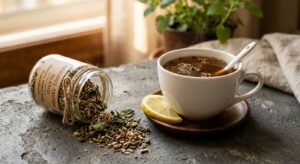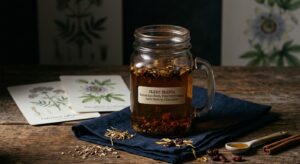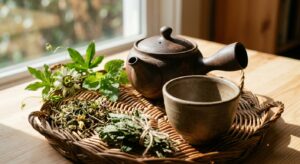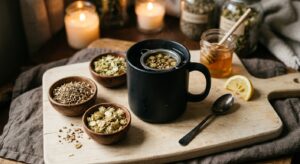
Before you sit, before you breathe, before the stillness settles in, there is the ritual of preparation. For centuries, meditators across traditions have reached for plant medicines to help the restless mind arrive at the present moment. Tibetan monks brewed adaptogenic herbs before dawn practice. Indian yogis sipped tulsi, the sacred basil, before pranayama. European hermits and monastics cultivated lemon balm in their cloistered gardens, calling it the herb of the heart’s ease. This pre-meditation calming tea draws on all of those traditions in a single, grounded cup.
The blend centers on three complementary herbs: lemon balm (Melissa officinalis), which lifts anxious mood and sharpens gentle focus; passionflower (Passiflora incarnata), which quiets the loop of repetitive thought and softens physical tension in the body; and holy basil, or tulsi (Ocimum tenuiflorum), an Ayurvedic adaptogen revered for harmonizing the stress response and elevating the spirit. Where lemon balm brightens and passionflower softens, tulsi grounds, creating a trio that works synergistically on the nervous system without sedating or clouding the mind. You remain alert, but spacious.
What makes this blend particularly well suited to meditation practice is its balance. It does not push you toward sleep the way valerian or high-dose chamomile might. Instead, it gently turns down the volume on the inner noise, releasing muscular holding, slowing the breath almost imperceptibly, and creating the quiet internal conditions in which awareness can settle and expand. Brew it twenty minutes before you sit, hold the warm cup in both hands, and let the preparation itself become the beginning of your practice.
2
cups
Ingredients
- 2 tspdried lemon balm leaves
- 1.5 tspdried passionflower herb (leaf and vine)
- 1 tspdried holy basil (tulsi) leaves
- 480 mlwater (90°C / 194°F)
- —raw honey or coconut sugar to taste (optional)
- —a thin slice of fresh lemon (optional, for serving)
How to Brew
Click on an item below to shop for the recommended items for this recipe on Amazon.
As an Amazon Associate, we earn from qualifying purchases.
- Heat filtered water to 88 to 92°C (190 to 198°F). If you do not have a temperature-controlled kettle, bring water to a boil and allow it to rest off-heat for 90 seconds before pouring.
- Measure 2 tsp dried lemon balm, 1.5 tsp dried passionflower, and 1 tsp dried tulsi into a tea infuser, muslin bag, or small teapot strainer basket. For two servings, double the quantities.
- Place the infuser in your mug or teapot and pour the hot water directly over the herbs. Cover the cup with a small plate or lid to trap the volatile aromatic oils, which carry much of the calming benefit.
- Steep for 7 to 10 minutes. For a lighter, brighter cup with more lemon character, remove at 7 minutes. For a deeper, earthier brew with more pronounced passionflower and tulsi, steep the full 10 minutes.
- Remove the infuser and gently press it with a spoon to extract the remaining liquid. Sweeten lightly with raw honey if desired and serve immediately, holding the cup in both hands as part of your pre-meditation grounding ritual.
- Use 1.5 times the standard dry herb quantity per serving because cold water extracts more slowly and less completely than hot water. For two servings, combine 3 tsp dried lemon balm, 2 tsp dried passionflower, and 1.5 tsp dried tulsi in a clean glass jar.
- Pour 480 ml of room-temperature filtered water over the herbs. Stir gently to ensure all plant material is submerged. Do not use hot water at any stage.
- Seal the jar and leave it at room temperature for 30 minutes to begin the initial extraction, then transfer it to the refrigerator and steep for a further 8 to 12 hours, or overnight.
- Strain the brew through a fine mesh strainer or cheesecloth into a clean vessel, pressing the herbs firmly to capture all liquid. Discard the spent plant material.
- Serve the cold brew over a small amount of ice, or allow it to come to cool room temperature before your session. Cold brew retains a notably smooth, mellow sweetness with subtle citrus and floral notes that benefit from no additional sweetener.
- Triple the standard dry herb quantities. Combine 6 tsp dried lemon balm, 4.5 tsp dried passionflower, and 3 tsp dried tulsi in a medium saucepan or heatproof pitcher.
- Bring 480 ml of filtered water to 88 to 92°C and pour it over the herbs. Cover the saucepan or pitcher with a lid or plate and steep for 15 to 20 minutes, keeping the temperature warm but not simmering. You want a long, covered infusion, not a boil.
- Strain the concentrate through a fine mesh strainer into a clean glass jar, pressing the herbs firmly. You should have roughly 360 to 400 ml of concentrated liquid after accounting for absorption by the plant material.
- Allow the concentrate to cool to room temperature, then seal and refrigerate. It will keep for up to four days.
- To serve, combine 80 to 100 ml of concentrate with 120 to 160 ml of hot water (heated to 88 to 92°C) in a mug. Adjust the dilution ratio to taste. Sweeten with honey if desired, and serve immediately before your meditation session.
Health Benefits
Lemon balm’s rosmarinic acid raises GABA availability in the brain, while passionflower’s flavone glycosides modulate GABA-A receptors directly. Together they reduce the anxious, looping thought activity that makes settling into meditation difficult. A 2014 randomized crossover study found lemon balm extract significantly reduced anxiety and insomnia in subjects with mild stress disorders.
Holy basil (tulsi) is classified as an adaptogen in Ayurvedic medicine for its ability to modulate the hypothalamic-pituitary-adrenal (HPA) axis. Clinical studies have shown tulsi supplementation reduces cortisol levels and improves scores on perceived stress scales, helping the nervous system move out of fight-or-flight and into the parasympathetic state needed for deep meditation.
Passionflower has demonstrated skeletal muscle-relaxant properties in animal models, and its GABAergic activity helps release the physical holding patterns, such as tight shoulders and jaw clenching, that accompany mental stress. Unlike kava or valerian, passionflower at moderate tea doses does not impair alertness or cognitive function, making it ideal for an active practice like meditation.
Lemon balm has shown mild monoamine-modulating activity, increasing serotonin availability in the brain. In a placebo-controlled study, a single dose of lemon balm extract significantly improved self-rated calmness and mood. The aromatic compounds citronellal and geranial also act rapidly on the limbic system through olfaction, producing an almost immediate brightening of emotional tone when the tea is inhaled.
The combination of GABAergic activity from passionflower and lemon balm with the adaptogenic cortisol regulation of tulsi creates a state of calm alertness that mirrors the target state of mindfulness meditation: reduced stress reactivity, clear awareness, and a relaxed but attentive nervous system. This is distinct from sedation and supports the quality of wakefulness meditators seek.
🧪 Key Bioactive Compounds
The Science Behind Lemon Balm, Passionflower, And Holy Basil (Tulsi)
The calming action of this blend operates primarily through the GABAergic system, the brain’s main inhibitory neurotransmitter pathway. Gamma-aminobutyric acid (GABA) is the neurochemical that quiets overactive neural circuits, reducing anxiety, slowing racing thoughts, and releasing muscular tension. Both lemon balm and passionflower influence this system through complementary mechanisms. Lemon balm’s rosmarinic acid inhibits GABA transaminase, the enzyme responsible for breaking down GABA in the synaptic cleft, effectively raising the amount of GABA available to exert its calming effect. Passionflower’s flavone glycosides, principally vitexin and isovitexin, act as partial agonists at the GABA-A receptor itself, mimicking the binding action that benzodiazepine drugs use, but with far gentler, non-addictive potency. This two-pronged approach, more GABA available and a more responsive receptor, produces a meaningful anxiolytic effect without the sedation or cognitive blunting associated with pharmaceutical intervention.
Holy basil (tulsi) adds a third dimension of action through the adrenal and neuroendocrine systems. As a classified adaptogen, tulsi modulates the hypothalamic-pituitary-adrenal (HPA) axis, the cascade of hormonal signals that governs the body’s stress response. Chronic or acute stress elevates circulating cortisol, which in turn keeps the nervous system in a state of hypervigilance, making it neurobiologically difficult to achieve the quiet, receptive awareness that meditation requires. The eugenol, ursolic acid, and flavonoids in tulsi have been shown in clinical trials to reduce salivary cortisol, lower blood pressure, and improve scores on validated stress and anxiety scales. Where passionflower and lemon balm address the symptomatic experience of anxiety in the moment, tulsi works at the hormonal root, retraining the stress response over time with consistent use.
The aromatherapeutic dimension of this blend also deserves scientific acknowledgment. Lemon balm’s signature volatile compounds, primarily the monoterpene aldehydes geranial and citronellal, are detected by olfactory receptors that connect directly to the amygdala and hippocampus, the brain’s centers for emotional regulation and memory. This means that simply inhaling the steam from your cup initiates a neurological calming signal before the first sip is taken. Research on aromatherapy with Melissa officinalis essential oil has confirmed measurable reductions in agitation and anxiety, suggesting that the ritual of holding and inhaling a freshly brewed cup of this tea is not merely ceremonial but genuinely therapeutic at the level of brain chemistry.
Brewing Tips
- Source passionflower from a reputable herbalist or organic supplier, as the quality of dried passionflower varies considerably. Look for whole leaf and vine material with visible purple-tinged stems rather than a powdery, dull green commercial blend.
- Brew and drink this tea 15 to 25 minutes before your meditation session rather than immediately before sitting. This gives the active compounds time to begin crossing the blood-brain barrier and producing their calming effects before your practice begins.
- Keep the cup covered while steeping. Lemon balm and tulsi both contain volatile aromatic oils that evaporate rapidly in steam. Trapping the steam with a small plate or lid preserves these compounds in the liquid and significantly improves both the flavor and the therapeutic potency of the brew.
- Use filtered or spring water if possible. The minerals and pH of your water affect extraction efficiency. Hard tap water with high mineral content can inhibit the solubility of some plant polyphenols, producing a flatter, less effective cup.