Deep within the brain’s chemistry lies one of the most important proteins you have probably never heard of: brain-derived neurotrophic factor, or BDNF. Often described as “Miracle-Gro for the brain,” BDNF is a neurotrophin that stimulates the growth of new neurons, strengthens synaptic connections, and protects existing brain cells from degeneration. Low BDNF levels have been associated with depression, cognitive decline, and even neurodegenerative conditions like Alzheimer’s disease. The remarkable news is that certain herbs have been shown in modern research to meaningfully support BDNF expression, a fact that traditional healers across Asia, Europe, and Ayurvedic medicine intuited long before the science caught up.
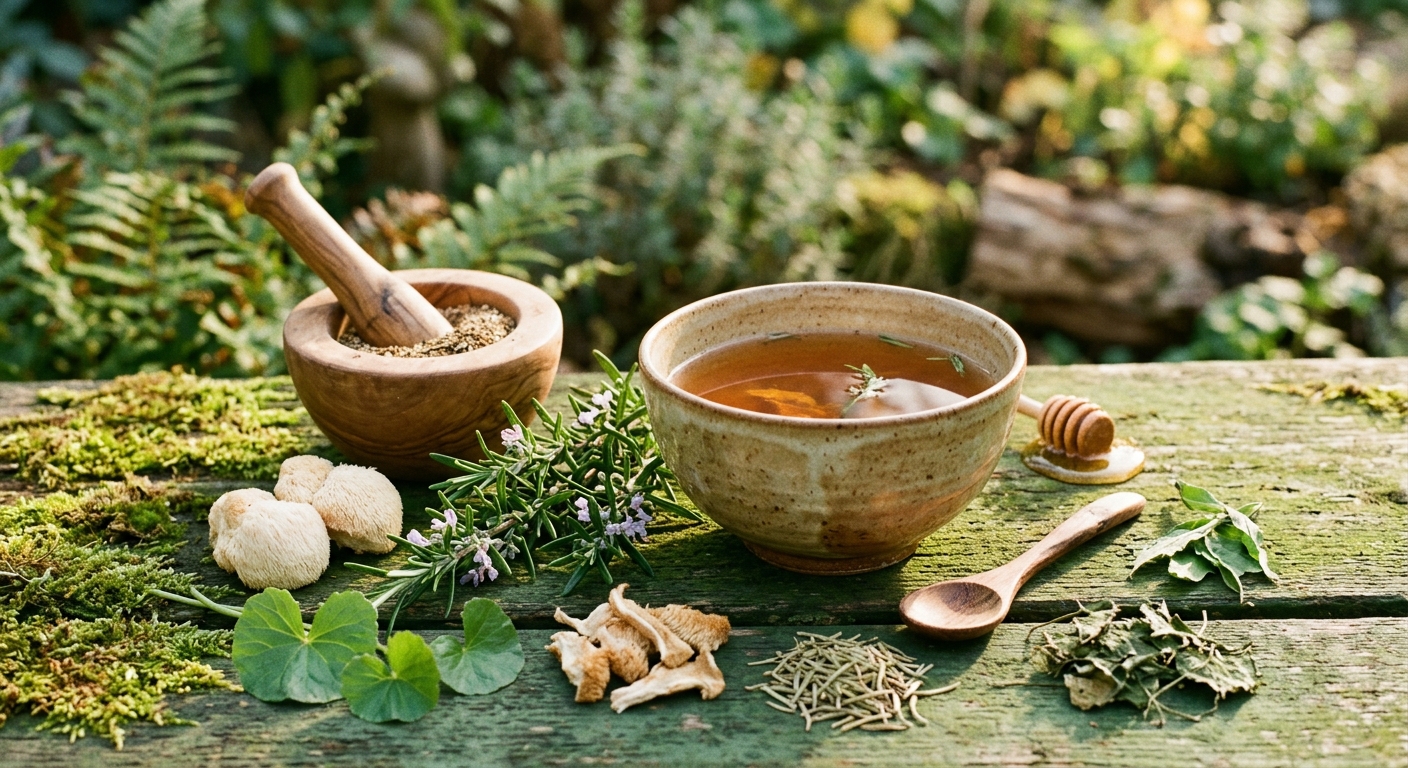
This blend draws on three of the most well-researched BDNF-supporting botanicals. Lion’s mane mushroom (Hericium erinaceus), revered in Traditional Chinese Medicine for centuries as a tonic for the mind and spirit, contains unique compounds called hericenones and erinacines that directly stimulate nerve growth factor (NGF) synthesis. Rosemary (Salvia rosmarinus), the ancient herb of remembrance that European scholars wore in garlands during exams, is rich in rosmarinic acid and carnosic acid, both linked to neuroprotective and BDNF-modulating effects. Gotu kola (Centella asiatica), a cornerstone of Ayurvedic and Traditional Chinese Medicine, has been used for millennia as a brain tonic, earning the nickname “the herb of longevity” in texts like the Charaka Samhita.
Together these three botanicals create a tea that is more than the sum of its parts. The earthy, savory depth of lion’s mane is brightened by the resinous pine warmth of rosemary and softened by the subtly grassy, mild sweetness of gotu kola. The result is a complex, grounding cup that suits a morning ritual before deep work, a midday reset, or a focused creative session. Unlike caffeine-driven stimulants, this blend nourishes the brain structurally rather than simply revving it up, making it a sustainable, long-term ally for cognitive health.
2
cups
Ingredients
- 2 tspdried lion’s mane mushroom powder or finely sliced dried pieces
- 1 tspdried rosemary leaves
- 1 tspdried gotu kola leaf
- 480 mlwater (90°C / 194°F)
- —raw honey or maple syrup to taste (optional)
- —a pinch of black pepper (optional, enhances absorption)
How to Brew
Click on an item below to shop for the recommended items for this recipe on Amazon.
As an Amazon Associate, we earn from qualifying purchases.
- Heat filtered water to 88 to 92°C (190 to 198°F). Avoid a full rolling boil, as temperatures above 95°C can degrade the delicate hericenone compounds in lion’s mane and diminish rosemary’s volatile aromatic oils.
- Add 2 teaspoons of dried lion’s mane mushroom (powder or sliced pieces), 1 teaspoon of dried rosemary leaves, and 1 teaspoon of dried gotu kola leaf to a tea infuser or teapot strainer. If using loose powder, a fine-mesh infuser is essential.
- Pour the hot water over the herbs, ensuring all plant material is fully submerged. Place a small saucer or lid over the top of your mug to trap volatile oils and prevent heat loss during steeping.
- Steep for 10 to 12 minutes. The longer end of this range extracts more of the beta-glucans from the lion’s mane, which support the neurological benefits. Stir gently at the halfway point.
- Remove the infuser and allow the tea to cool for 60 to 90 seconds. Taste before adding sweetener. Add raw honey or maple syrup if desired, and a pinch of black pepper to enhance bioavailability of the rosemary’s carnosic acid.
- Measure out 2.5 teaspoons of dried lion’s mane mushroom, 1.5 teaspoons of dried rosemary leaves, and 1.5 teaspoons of dried gotu kola leaf. Slightly increasing the herb ratio compensates for the reduced extraction efficiency of cold water.
- Place all herbs into a clean glass jar. Pour 480 ml of cold, filtered water over the herbs, making sure all plant material is submerged. Stir gently with a long spoon to ensure full contact between water and herbs.
- Seal the jar loosely with a lid or cover with a clean cloth secured with a rubber band. Allow the jar to sit at room temperature for 1 hour to begin the initial extraction, then transfer to the refrigerator.
- Let the blend steep in the refrigerator for 10 to 14 hours, ideally overnight. The slow, cold extraction preserves the more fragile aromatic compounds in rosemary and produces a gentler, more rounded flavor from the lion’s mane.
- Strain the tea through a fine-mesh strainer or a piece of cheesecloth into a glass, pressing gently on the spent herbs to release any remaining liquid. Serve over ice or chilled. Sweeten with a cold-soluble sweetener like simple syrup if desired.
- Place 480 ml of cold filtered water and 2.5 teaspoons of dried lion’s mane mushroom pieces (not powder) into a small saucepan. Using pieces rather than powder prevents scorching on the pan base.
- Bring the water to a very gentle simmer over medium-low heat, aiming for 85 to 90°C (185 to 194°F). You should see small bubbles rising slowly but no vigorous rolling boil. Reduce heat as needed to maintain this range.
- Simmer the lion’s mane uncovered for 15 to 20 minutes, stirring occasionally. The liquid will deepen in color to a rich amber and take on a more concentrated, umami-forward aroma. Add a small splash of water if the volume reduces significantly.
- In the final 5 minutes of simmering, add 1 teaspoon of dried rosemary leaves and 1 teaspoon of dried gotu kola leaf directly to the saucepan. This two-stage approach preserves the volatile aromatic oils of rosemary and the delicate triterpenes in gotu kola, which would be lost during the longer simmer.
- Remove from heat and allow to rest for 3 minutes with a lid on. Strain through a fine-mesh strainer into a warmed mug. Taste the tea before sweetening. This method produces the most potent cup of the three, with a rich, deeply earthy flavor. Add honey and a squeeze of fresh lemon juice to brighten.
Health Benefits
Lion’s mane’s erinacines directly stimulate synthesis of nerve growth factor, while rosemary’s carnosic acid and gotu kola’s asiaticoside have each been independently linked to increased BDNF expression in the hippocampus. A 2009 double-blind clinical trial published in Phytotherapy Research found that lion’s mane supplementation significantly improved mild cognitive impairment scores over 16 weeks, with benefits reversing after discontinuation.
The combination of NGF stimulation from lion’s mane, acetylcholinesterase inhibition from rosmarinic acid, and dendritic branching support from gotu kola’s asiaticoside creates a multi-pathway approach to supporting the synaptic plasticity that underlies memory formation and recall.
A 2019 randomized controlled trial found that lion’s mane supplementation significantly reduced depression and anxiety scores in overweight adults. Gotu kola has demonstrated anxiolytic effects in both animal and human trials, and rosmarinic acid has shown antidepressant-like activity by modulating monoamine neurotransmitter levels.
Carnosic acid in rosemary activates the Nrf2 antioxidant response element, triggering the brain’s own internal antioxidant defenses. This mechanism is particularly relevant for protecting the hippocampus from the oxidative stress associated with aging, chronic stress, and neurodegenerative disease.
Gotu kola has centuries of use in Ayurvedic medicine for wound healing and nerve repair, and modern research confirms that its triterpenoids accelerate axon regrowth and improve myelination. Lion’s mane extracts have shown the ability to accelerate peripheral nerve regeneration in rodent models of nerve injury.
🧪 Key Bioactive Compounds
The Science Behind Lion’S Mane Mushroom
The concept of using plants to support brain health is ancient, but the molecular mechanisms behind this BDNF-boosting blend are now being mapped with scientific precision. Brain-derived neurotrophic factor belongs to the neurotrophin family and acts through the TrkB receptor to activate signaling cascades, including the MAPK/ERK and PI3K/Akt pathways, that govern neuronal survival, synaptic plasticity, and the formation of long-term memory. When BDNF levels are chronically low, as occurs under conditions of chronic stress, poor sleep, sedentary lifestyle, and aging, the hippocampus (the brain’s primary memory center) literally shrinks. The herbs in this blend address this from multiple angles simultaneously.
Lion’s mane mushroom stands apart from most herbal nootropics because its active compounds, the hericenones from the fruiting body and erinacines from the mycelium, work through the NGF pathway rather than BDNF directly. Nerve growth factor and BDNF are functionally related neurotrophins that share downstream signaling overlap, and upregulating NGF has been shown to produce measurable increases in BDNF expression in the cortex and hippocampus. Erinacine A in particular has demonstrated the ability to penetrate the blood-brain barrier in animal models, something many herbal compounds cannot achieve, and has been shown to increase locus coeruleus BDNF in a dose-dependent manner. Rosemary’s carnosic acid takes a different but complementary approach: by activating the Nrf2 transcription factor, it induces the expression of neurotrophic support genes and reduces the oxidative load on hippocampal neurons, indirectly preserving the cellular environment in which BDNF signaling can thrive.
Gotu kola’s contribution is particularly interesting from a structural neuroscience perspective. Its primary triterpenoids, asiatic acid and asiaticoside, have been shown in multiple in vitro and animal studies to increase dendritic arborization, the branching complexity of neurons that determines how richly they can connect to neighboring cells. A 2016 study in Scientific Reports found that asiatic acid significantly increased the length and branching of dendrites in hippocampal neurons, an effect mediated partly through BDNF-TrkB signaling. Rosmarinic acid, present in both rosemary and gotu kola, adds another layer by inhibiting acetylcholinesterase (the enzyme that breaks down the memory neurotransmitter acetylcholine) and by modulating serotonin and dopamine systems in ways that indirectly support BDNF transcription. Together, these compounds represent a genuinely multi-target, systems-level approach to supporting the neurochemical foundation of a healthy, adaptable brain.
Brewing Tips
- Use lion’s mane mushroom powder made from the fruiting body rather than mycelium-only products for the highest concentration of hericenones. Look for dual-extract products when possible for maximum bioavailability of both water-soluble beta-glucans and alcohol-soluble hericenones.
- Consistency matters more than any single cup. The neurological benefits of lion’s mane and gotu kola are cumulative, with clinical trials typically showing measurable effects after 4 to 8 weeks of regular use. Build this tea into a daily ritual rather than drinking it sporadically.
- Store dried lion’s mane powder in an airtight container away from light and moisture, as the active compounds are sensitive to oxidation. Buy in small quantities and use within 3 months for optimal potency. Whole dried pieces generally retain their bioactive compounds longer than pre-ground powder.