Helicobacter pylori is a spiral-shaped bacterium that colonizes the stomach lining of roughly half the global population, quietly triggering gastritis, peptic ulcers, and in some cases contributing to more serious gastric conditions. For centuries before the bacterium was even identified, traditional healers across the Mediterranean, Middle East, and East Asia were already reaching for plants that modern science now confirms have direct antimicrobial activity against it. Mastic resin from the Greek island of Chios, licorice root revered in Ayurvedic and Chinese medicine, and the ancient tea leaf of Camellia sinensis each carry a legacy of gut healing that long predates our understanding of H. pylori itself.
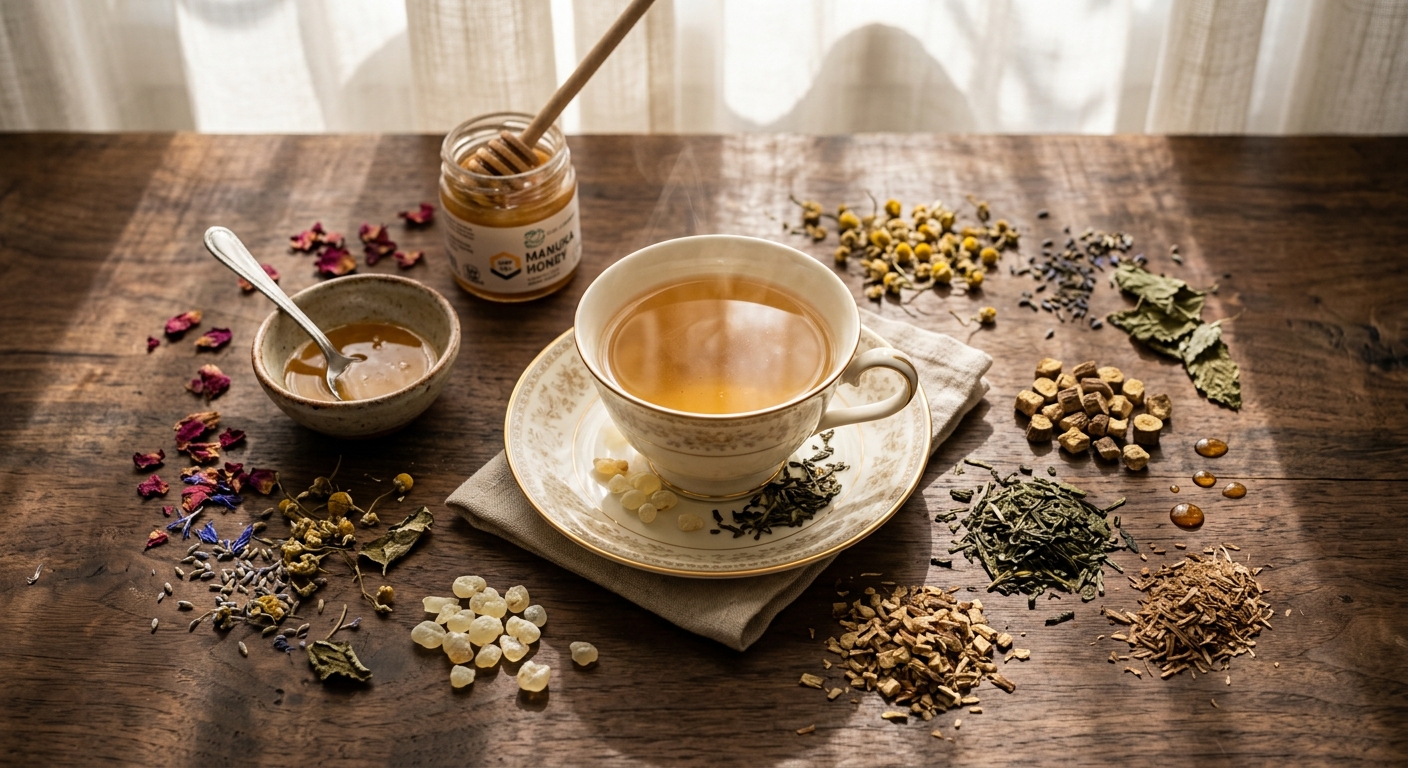
This tea blend brings together three of the most rigorously studied botanical allies against H. pylori: mastic (Pistacia lentiscus), deglycyrrhizinated licorice root (DGL), and green tea. Mastic has been shown in clinical trials to reduce H. pylori load in the stomach. Licorice root soothes the gastric mucosa and contains compounds that inhibit bacterial adhesion. Green tea contributes powerful catechins with demonstrated antibacterial and anti-biofilm properties. Together, they form a complementary, synergistic blend that tastes pleasantly herbaceous and slightly resinous, warming from the inside out.
This is not a replacement for medical treatment if you have been diagnosed with a confirmed H. pylori infection, but it can serve as a meaningful supportive tool alongside your healthcare provider’s protocol. Many integrative practitioners include botanical teas as part of a broader gut-healing plan, pairing them with dietary changes, probiotics, and in clinical cases, antibiotic therapy. Brewed with care and consumed consistently, this tea is a daily ritual that honors both the wisdom of plant medicine and the demands of modern evidence-based health.
2
cups
Ingredients
- 1 tspmastic resin tears (Pistacia lentiscus)
- 1 tspdried licorice root pieces (DGL preferred)
- 1 tsploose-leaf green tea (sencha or gunpowder)
- 0.5 tspdried slippery elm bark (optional, for extra mucosa support)
- 500 mlwater (80°C / 176°F for hot brew)
- —raw Manuka honey to taste (optional, UMF 10+ preferred)
How to Brew
Click on an item below to shop for the recommended items for this recipe on Amazon.
As an Amazon Associate, we earn from qualifying purchases.
- Lightly crush 1 tsp of mastic resin tears using a mortar and pestle until they begin to break apart into smaller fragments. This increases surface area and maximizes the release of triterpenic acids and other bioactives into the water.
- Combine the crushed mastic tears and dried licorice root pieces in a small saucepan. Add 500 ml of filtered water and bring to a very gentle simmer over low heat for 5 minutes. Do not allow the water to boil vigorously as mastic resins can become bitter and some volatile compounds are lost at high temperatures.
- Remove the saucepan from heat and allow the liquid to cool to approximately 80°C (176°F). Add the loose-leaf green tea and optional slippery elm bark. Steep for 3 to 5 additional minutes with a lid on to trap volatile aromatic compounds.
- Strain through a fine mesh strainer or cheesecloth into two mugs to remove all plant material. Mastic fragments are particularly small so a fine strainer is important.
- Add Manuka honey (UMF 10+ recommended) only after the tea has cooled slightly below 70°C to preserve its own antimicrobial methylglyoxal content. Sip slowly, ideally 20 to 30 minutes before a meal for best gastric contact.
- Begin with a warm mastic extraction: combine the crushed mastic tears and licorice root in 120 ml of hot water at 90°C (194°F) and steep for 10 minutes. This short hot extraction is necessary because mastic resins do not dissolve well in cold water alone. Allow this concentrate to cool to room temperature.
- Pour the cooled mastic and licorice concentrate into a clean glass jar. Add the loose-leaf green tea and optional slippery elm bark directly to the jar.
- Top up with 380 ml of cold filtered water to reach 500 ml total volume. Stir gently to combine. Seal the jar with a lid.
- Refrigerate for 10 to 14 hours, ideally overnight. The cold, slow extraction draws out delicate catechins from the green tea without the bitterness that high-heat brewing can introduce, while the mastic and licorice compounds continue to infuse gradually.
- Strain through a fine mesh strainer lined with cheesecloth into a pitcher or directly into two glasses filled with ice. Stir in Manuka honey if desired (it dissolves better in slightly warmed liquid, so warm a small amount separately and then blend in). Consume within 48 hours of straining.
- Place the crushed mastic tears and licorice root pieces in a small stainless steel or ceramic saucepan. Add 600 ml of cold filtered water (extra volume is used because some will evaporate during the longer simmer).
- Bring the water to a gentle boil over medium heat, then reduce immediately to a low simmer. Partially cover the saucepan and allow the mixture to decoct for 15 minutes. The liquid will reduce slightly and deepen in color to a warm amber. Stir occasionally and monitor closely to avoid scorching.
- Remove from heat and allow the decoction to cool, uncovered, to approximately 80°C (176°F). This takes roughly 5 minutes. Use a kitchen thermometer for accuracy if possible.
- Add the loose-leaf green tea and optional slippery elm bark to the still-hot decoction. Place the lid back on and steep for 5 to 7 minutes. The lower temperature protects the green tea catechins from degradation.
- Strain through a fine mesh strainer lined with muslin into two mugs, pressing gently on the plant material to extract remaining liquid. If the decoction has reduced to less than 400 ml after straining, top each mug with a small amount of hot water at 80°C to reach the desired volume.
- Sweeten with Manuka honey once the tea has cooled slightly. This concentrated brew is especially potent and can be taken in smaller 150 ml doses before meals for a more targeted therapeutic approach.
Health Benefits
Multiple compounds in this blend, particularly mastic triterpenic acids and green tea EGCG, have been shown in in vitro studies and small clinical trials to suppress H. pylori proliferation, impair its motility, and reduce expression of the cagA virulence gene associated with more severe gastric disease.
Licorice root’s glycyrrhizin stimulates mucus secretion and promotes the regeneration of gastric epithelial cells, while slippery elm’s polysaccharides form a physical protective gel layer over irritated tissue, reducing pain and vulnerability to acid damage.
H. pylori infection triggers significant inflammatory cascades in the stomach lining. EGCG from green tea and glabridin from licorice root both inhibit NF-kB signaling, a key driver of gastric inflammation, helping to reduce chronic irritation and lower the risk of ulcer progression.
H. pylori shelters itself from antibiotics and immune responses by forming protective biofilms on the stomach lining. Oleanolic acid from mastic and catechins from green tea have been shown to inhibit biofilm assembly, potentially making the bacterium more susceptible to both herbal and pharmaceutical eradication strategies.
Beyond its antimicrobial properties, this blend eases the bloating, nausea, and epigastric discomfort commonly associated with H. pylori infection. Licorice root has antispasmodic properties that calm the stomach wall, while mastic has long been used in Mediterranean folk medicine as a digestive soother and breath freshener.
🧪 Key Bioactive Compounds
The Science Behind Mastic (Pistacia Lentiscus)
The scientific case against H. pylori using plant medicine is more robust than many people realize. Mastic resin, harvested from Pistacia lentiscus trees on the Greek island of Chios, has been the subject of several controlled trials. A landmark study published in the New England Journal of Medicine demonstrated that 1 gram of mastic daily for two weeks significantly reduced H. pylori populations in infected patients. Subsequent research identified the triterpenic acids, particularly isomasticadienolic acid and oleanolic acid, as the primary agents responsible. These compounds inhibit the bacterial urease enzyme that allows H. pylori to neutralize stomach acid and survive, effectively undermining the bacterium’s core survival mechanism.
Green tea’s contribution centers on its catechin content, especially epigallocatechin gallate (EGCG). Studies published in the Journal of Antimicrobial Chemotherapy and Antimicrobial Agents and Chemotherapy have confirmed EGCG’s ability to inhibit H. pylori growth in vitro and reduce virulence factor expression in animal models. Crucially, EGCG appears to work by disrupting the bacterial cell membrane and interfering with the cagA pathogenicity island, a genetic element associated with increased ulcer risk and gastric cancer susceptibility. The cold brew method in this recipe is particularly beneficial for preserving EGCG, as cold water extracts catechins without promoting their thermal degradation.
Licorice root’s bioactives round out the antimicrobial and mucosal support profile of this blend. Glycyrrhizin and its aglycone glycyrrhetinic acid have been shown to inhibit H. pylori adhesion to the gastric epithelium by competing for the same receptor sites the bacterium uses to anchor itself. Glabridin, a prenylated isoflavone specific to licorice root, further contributes anti-inflammatory effects by downregulating cyclooxygenase-2 (COX-2) expression in gastric tissue. Meanwhile, slippery elm’s mucilaginous polysaccharides provide a purely physical benefit: they form a viscous gel in the stomach that buffers the mucosa from acid and H. pylori toxins while the longer-acting botanical compounds work at a cellular level.
Brewing Tips
- Freeze mastic tears for 15 minutes before crushing them in a mortar and pestle. Cold makes the naturally sticky resin brittle and much easier to grind into fragments without it clumping together.
- Drink this tea on an empty stomach or 20 to 30 minutes before meals so the active compounds have maximum contact time with the gastric lining before food dilutes them.
- Cycle this tea in four-week rounds with a one-week break to avoid licorice root accumulation effects. If using standard (non-DGL) licorice root, limit use to no more than four to six weeks without medical supervision.
- If the resinous flavor of mastic is too strong for your palate, reduce to half a teaspoon and increase green tea to one and a half teaspoons. The antimicrobial benefits diminish slightly but remain meaningful at lower doses.
- Store any leftover cold brew in a sealed glass jar in the refrigerator for up to 48 hours. Beyond that, the catechin content begins to degrade and the flavor becomes noticeably more bitter.