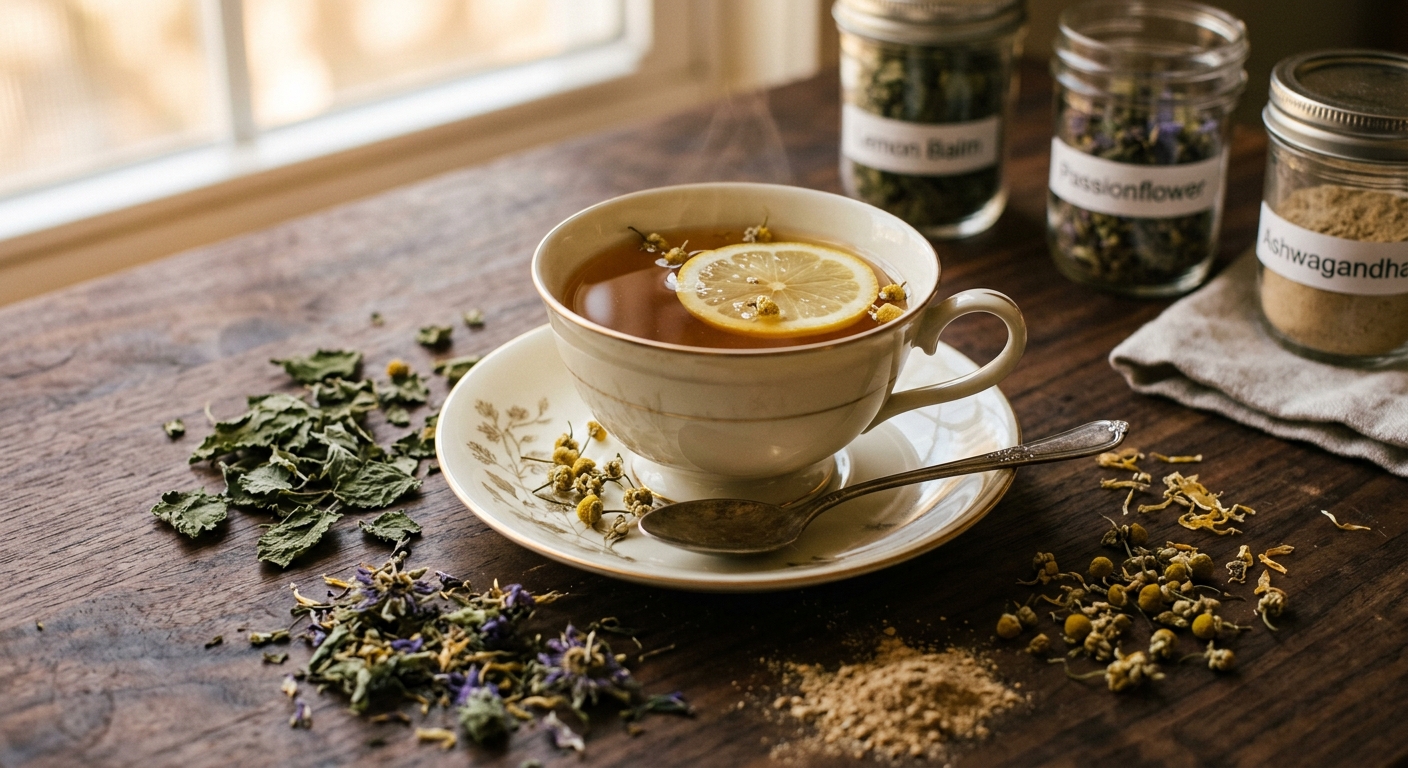
Social anxiety is one of the most common forms of anxiety, touching millions of people who dread gatherings, public speaking, or even casual conversation. Long before pharmaceutical interventions, herbalists across Europe, Asia, and the Americas reached for specific nervine plants, herbs that calm and restore the nervous system without dulling the mind. This tea blends three of the most well-researched of those plants: lemon balm from the Mediterranean, passionflower from the Americas, and ashwagandha from the Ayurvedic tradition of India.
Lemon balm (Melissa officinalis) has been prized since at least the 14th century, when Carmelite nuns brewed it as “Carmelite Water” for nervous complaints and melancholy. Passionflower (Passiflora incarnata) was used ceremonially and medicinally by Indigenous peoples of the southeastern United States and was later adopted by European herbalists as a gentle sedative. Ashwagandha (Withania somnifera) has anchored Ayurvedic medicine for over 3,000 years as an adaptogen, a substance that helps the body regulate its stress response over time. The convergence of these three traditions in a single cup is both historically rich and practically powerful.
What makes this blend especially well-suited to social anxiety is how its components address different layers of the experience: the immediate physical tension, the racing thoughts, and the underlying baseline of elevated cortisol that makes social stress feel so overwhelming. Brewed as a warm, fragrant tea, it offers a ritual of preparation as much as a physiological benefit, giving you a quiet moment to center yourself before stepping into the world.
2
cups
Ingredients
- 2 tspdried lemon balm leaves
- 1 tspdried passionflower herb
- 0.5 tspashwagandha root powder
- 480 mlwater (90°C / 194°F)
- —raw honey to taste (optional)
- —thin lemon slice for garnish (optional)
How to Brew
Click on an item below to shop for the recommended items for this recipe on Amazon.
As an Amazon Associate, we earn from qualifying purchases.
- Heat filtered water to 90°C (194°F). If using a standard kettle, bring water to a boil and allow it to cool for 2 to 3 minutes before pouring.
- Place 2 tsp dried lemon balm, 1 tsp dried passionflower, and 0.5 tsp ashwagandha root powder into a tea infuser or strainer set over your mug or teapot.
- Pour 480 ml of hot water slowly over the herbs, ensuring all plant material is saturated. Place a small saucer or lid over the mug to trap the volatile aromatic oils inside.
- Steep for 7 to 10 minutes. A longer steep will draw out more of the bitter ashwagandha compounds, so taste at 7 minutes and adjust to your preference.
- Remove the infuser and gently press the herbs against the strainer with a spoon to extract the remaining concentrated liquid.
- Sweeten with raw honey if desired and garnish with a thin lemon slice. Drink slowly 30 to 45 minutes before a social event or whenever anxiety surfaces.
- Combine 4 tsp dried lemon balm, 2 tsp dried passionflower, and 1 tsp ashwagandha root powder in a clean glass jar. This double quantity compensates for the slower, less efficient cold extraction.
- Pour 960 ml of cold filtered water over the herbs. Stir gently with a long spoon to ensure all plant material is submerged and fully saturated.
- Seal the jar with a lid and let it sit at room temperature for 1 hour, then transfer to the refrigerator.
- Allow the herbs to steep in the refrigerator for a total of 8 to 12 hours, or overnight. The extended cold steep draws out calming glycosides and flavonoids while keeping the flavor mellow and smooth.
- Strain the liquid through a fine-mesh strainer or cheesecloth into a pitcher, pressing the herbs gently to release the last of the infusion.
- Serve over ice in a tall glass. Add a squeeze of fresh lemon juice and a drizzle of honey to brighten the flavor. Store remaining cold brew in the refrigerator for up to 48 hours.
- Combine 4 tsp dried lemon balm, 2 tsp dried passionflower, and 1 tsp ashwagandha root powder in a small saucepan.
- Add 480 ml of water heated to 90°C (194°F). Stir the herbs briefly to ensure full contact with the water.
- Cover the saucepan with a lid and allow the herbs to steep off direct heat for 15 to 20 minutes. The covered environment prevents volatile oils from escaping and intensifies the extraction of active compounds.
- Strain through a fine-mesh strainer into a glass jar or bottle, pressing the herbs firmly to extract every drop of the concentrated liquid.
- Allow the concentrate to cool completely before sealing and refrigerating. Label the jar with the date.
- To serve, dilute 60 to 80 ml of concentrate with 160 to 180 ml of hot or cold water per serving. Sweeten with honey or add a few drops of lemon juice to taste. Shake or stir well before each use if concentrate has settled.
Health Benefits
Both lemon balm and passionflower have been studied in randomized controlled trials showing significant reductions in self-reported anxiety scores. Lemon balm’s rosmarinic acid raises GABA levels in the brain, while passionflower’s chrysin mimics mild GABAergic activity to quiet nervous system overactivation.
Ashwagandha is one of the most evidence-supported adaptogens for cortisol regulation. Multiple double-blind trials have found that consistent ashwagandha intake significantly reduces serum cortisol levels and perceived stress, making social situations feel less threatening over time.
Social anxiety often manifests physically, as a tight chest, tense shoulders, or a racing heart. The antispasmodic compounds in lemon balm, including eugenol and other volatile oils, help relax smooth and skeletal muscle, addressing these somatic symptoms directly.
Anticipatory anxiety before social events frequently disrupts sleep. Passionflower has been shown in clinical studies to improve sleep quality and reduce nighttime waking. Drinking this blend in the evening can ease the anxious mind and support deeper, more restorative sleep.
Lemon balm has demonstrated mood-elevating effects in human trials, with subjects reporting improved calmness and increased ability to concentrate under stress. This makes the blend valuable not just for reducing fear but for sharpening the pleasant social presence that anxiety undermines.
🧪 Key Bioactive Compounds
The Science Behind Lemon Balm
The anxiolytic action of this blend begins with GABA, the brain’s primary inhibitory neurotransmitter. When GABA activity is insufficient, the nervous system remains in a heightened state of alertness that manifests as anxiety, hypervigilance, and social fear. Rosmarinic acid in lemon balm inhibits GABA transaminase, the enzyme responsible for breaking down GABA, effectively increasing the brain’s available supply of this calming neurotransmitter. Passionflower’s chrysin and the flavonoids orientin and vitexin complement this by binding directly to GABA-A receptor sites, mimicking a mechanism similar to that of benzodiazepine medications but with far less potency and no clinically documented risk of dependence.
Ashwagandha operates on a different and longer-term axis of the stress response. The withanolides and glycowithanolides in its root modulate the hypothalamic-pituitary-adrenal (HPA) axis, which governs the production of cortisol, the body’s primary stress hormone. Chronic social anxiety is often accompanied by elevated baseline cortisol, which keeps the body in a state of low-grade threat readiness. Multiple peer-reviewed clinical trials, including a notable 2012 study published in the Indian Journal of Psychological Medicine, have documented statistically significant cortisol reductions in subjects taking standardized ashwagandha extract compared to placebo. While a tea infusion delivers lower concentrations than a standardized capsule, regular consumption contributes meaningfully to this adaptogenic effect over days and weeks.
Beyond the neurochemical, there is an often-overlooked psychophysiological dimension to this blend. The physical act of holding a warm mug activates thermoregulatory pathways associated with feelings of social warmth and safety, a phenomenon studied by researchers at Yale and the University of Colorado. The aromatic volatile oils in lemon balm, inhaled during brewing and drinking, stimulate olfactory receptors that connect directly to the limbic system, the brain’s emotional processing center. This means the ritual of brewing and breathing in this tea is itself a therapeutic act, not merely a vehicle for delivering active compounds. The sensory engagement of the process is part of what makes herbal tea such an effective, accessible tool for managing anxiety in the moment.
Brewing Tips
- Brew this tea 30 to 45 minutes before a social event rather than immediately beforehand, giving the active compounds time to absorb and take effect before you need them.
- For best results with the ashwagandha, whisk the powder with a small amount of hot water to form a paste before adding it to the infuser or saucepan, as this prevents clumping and ensures more complete extraction.
- Store dried lemon balm in an airtight container away from light and heat, as its volatile oils degrade quickly. Fresh lemon balm leaves can be substituted at a ratio of 1 tablespoon fresh leaves per teaspoon of dried.
- If the earthy bitterness of ashwagandha is too strong for your palate, reduce to 0.25 tsp per serving and gradually increase over a week as your taste adjusts.
- Consistency matters with adaptogenic herbs. While lemon balm and passionflower offer noticeable effects after a single cup, ashwagandha’s cortisol-lowering benefits are cumulative and are best appreciated after 4 to 8 weeks of regular use.