Few plants on Earth carry the weight of geological time the way horsetail does. Equisetum arvense is a living fossil, a direct descendant of towering tree-like plants that dominated the Carboniferous period over 300 million years ago. Today it grows modestly along riverbanks, meadows, and roadsides across the Northern Hemisphere, its segmented, reed-like stems looking almost otherworldly. Ancient healers in Greece, Rome, and China recognized something special in this plant long before modern chemistry could explain why. Dioscorides, the Greek physician of the first century, recommended it for kidney ailments and wound healing. Traditional Chinese medicine incorporated it to clear heat and reduce inflammation. European herbalists of the Middle Ages valued it as a strengthening tonic for blood and bone.
What makes horsetail so distinctive, and so valued in energy and focus traditions, is its extraordinary silica content. No other common medicinal herb concentrates this mineral as effectively. Silica, in the form of silicon dioxide and monosilicic acid, plays a structural role in the human body, contributing to the integrity of connective tissue, cartilage, hair, nails, and the myelin sheath that insulates nerve fibers. Healthy nerve conduction is directly tied to mental sharpness and sustained cognitive function, which is why horsetail has earned a quiet reputation as a focus-supporting herb among practitioners of herbal medicine. Unlike stimulants, its effect is felt as a gradual steadiness rather than a sharp spike.
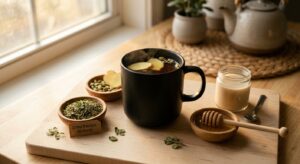
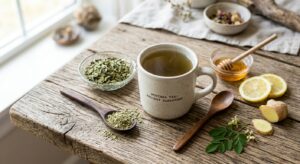
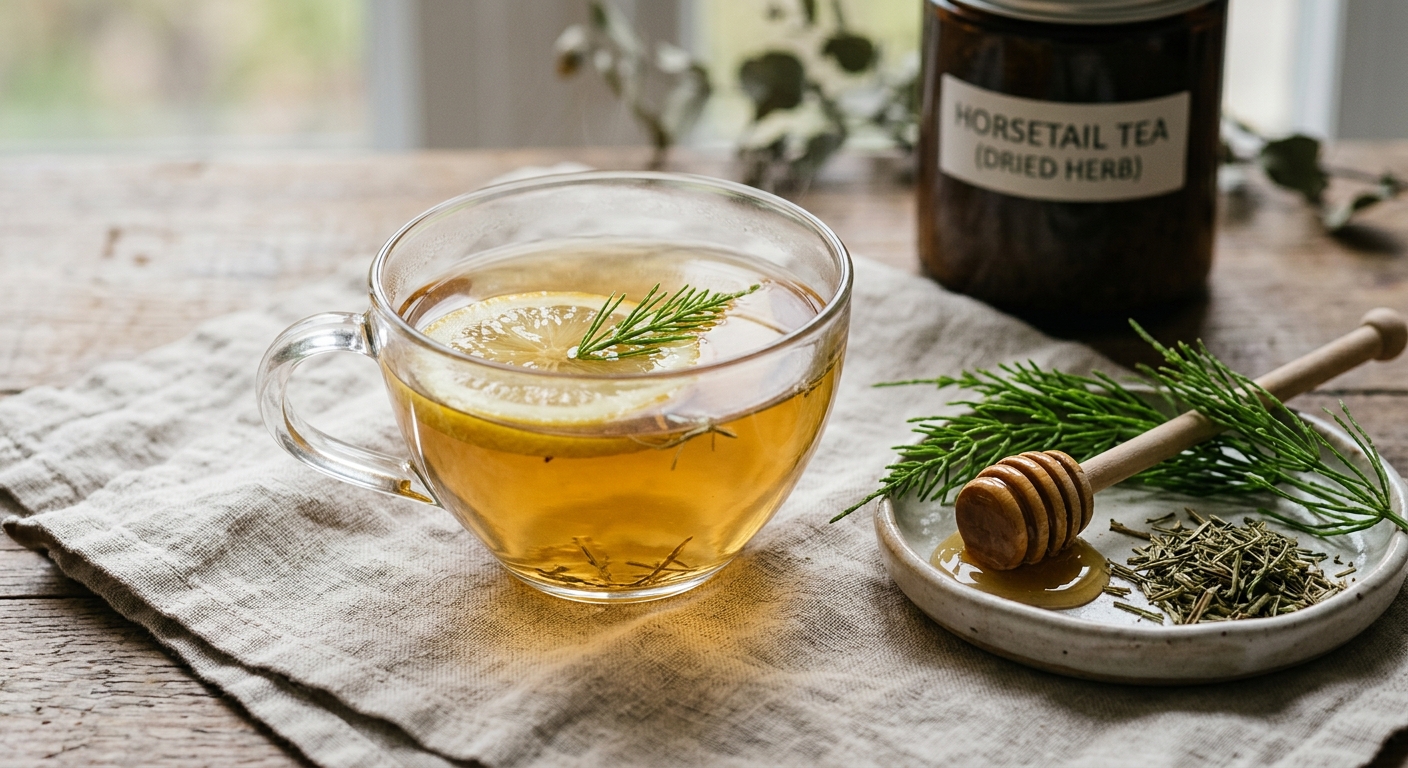
Brewed into a tea, horsetail has a subtly grassy, mildly astringent flavor with faint mineral undertones, earthy without being harsh, clean without being bland. The pale golden-green liquor looks delicate in the cup, but do not let that fool you. This is one of the most mineral-dense herbal infusions you can make, and with proper preparation it becomes a genuinely restorative daily ritual with roots stretching back to prehistory.
2
cups
Ingredients
- 2 tbspdried horsetail herb (Equisetum arvense)
- 480 mlwater (90°C / 194°F)
- —lemon slice to taste (optional, helps silica absorption)
- —raw honey to taste (optional)
How to Brew
Click on an item below to shop for the recommended items for this recipe on Amazon.
As an Amazon Associate, we earn from qualifying purchases.
- Heat your water to 88 to 93°C (190 to 199°F). If your kettle does not have temperature control, bring water to a full boil, then let it rest off the heat for 2 to 3 minutes before using.
- Place 1 tablespoon of dried horsetail herb per 240 ml of water into your tea infuser or directly into a teapot. The herb is fine-textured, so a fine-mesh infuser or a teapot with a built-in strainer works best.
- Pour the hot water over the herb and cover the vessel immediately with a lid or small plate. Covering is important because it traps volatile aromatic compounds and keeps the temperature stable throughout the steep.
- Steep for 10 to 15 minutes. If you are new to horsetail, start at 10 minutes for a lighter, more approachable cup. For a more mineral-forward infusion with greater therapeutic concentration, extend to 15 minutes.
- Strain carefully through a fine-mesh strainer into your mug, discarding the spent herb. Add a squeeze of fresh lemon juice if desired, as vitamin C from citrus has been shown to enhance silica bioavailability.
- Sip slowly while warm. Horsetail tea pairs well with a light snack or a handful of nuts, as food can ease absorption of the trace minerals it delivers.
- Measure 2 tablespoons of dried horsetail herb per 480 ml of cold, filtered water. The cold brew ratio is the same as hot brew because the longer steep compensates for the lower extraction temperature.
- Combine the herb and cold water in a glass jar with a tight-fitting lid. Glass is preferred over plastic because it does not absorb odors and keeps the brew tasting clean over the long steep.
- Stir gently to ensure the herb is fully submerged, then seal the jar. Allow it to sit at room temperature for the first 30 minutes to allow initial hydration of the plant material.
- Transfer the sealed jar to the refrigerator and allow to steep for 10 to 12 hours. Overnight steeping is the easiest approach. Do not exceed 14 hours, as prolonged refrigerator steeping can produce a slightly bitter, overly astringent result.
- When ready, strain the brew through a fine-mesh strainer or a cheesecloth-lined strainer into a clean jar or pitcher, pressing gently on the herb to extract residual liquid.
- Serve over ice in a tall glass. Add a thin slice of lemon or cucumber for a refreshing, mineral-forward drink. Cold-brewed horsetail keeps refrigerated for up to 48 hours.
- Add 2 tablespoons of dried horsetail herb to a small saucepan. Pour in 600 ml of cold, filtered water, starting with cold water so the herb can release its constituents gradually as the temperature climbs.
- Place the saucepan over medium heat and bring the water slowly to a light boil, watching carefully. As soon as you see a rolling boil, reduce the heat immediately to a low simmer so the liquid barely bubbles at the surface.
- Simmer uncovered for 20 to 30 minutes, stirring occasionally. You will notice the liquid reduce in volume and deepen slightly in color to a richer golden-green. This is normal and desirable.
- After simmering, remove the pan from heat and allow the decoction to cool slightly for 5 minutes. This rest period allows any remaining volatile compounds to settle back into the liquid rather than evaporating.
- Strain the decoction through a fine-mesh strainer or cheesecloth into a heat-safe mug or glass, pressing firmly on the spent herb to extract as much liquid as possible. You should yield roughly 400 ml from the original 600 ml.
- Taste the decoction before adding anything. It will be noticeably stronger, more astringent, and more mineral-forward than a standard infusion. A small amount of raw honey or a squeeze of lemon juice rounds out the flavor well. Sip up to one cup per day of the decoction, as it is significantly more concentrated than a standard infusion.
Health Benefits
Silica compounds in horsetail support the structural integrity of myelin sheaths around nerve fibers, which directly influences the speed and efficiency of nerve signal transmission. Several in vitro and animal studies suggest that flavonoids such as kaempferol in horsetail also reduce neuroinflammatory markers, creating conditions favorable for sustained mental clarity.
Horsetail is one of the richest botanical sources of bioavailable silica, a mineral essential for the enzymatic cross-linking of collagen fibers. Human studies, including a 2016 pilot trial published in the Archives of Dermatological Research, found that oral silica supplementation measurably improved hair tensile strength and skin elasticity, outcomes consistent with traditional claims for horsetail.
Horsetail has been used as a mild diuretic in European herbal medicine for centuries, and the European Medicines Agency formally recognizes its traditional use for minor urinary tract complaints and to increase urine output. Its potassium content helps offset potassium losses that sometimes accompany diuresis, making it gentler than synthetic diuretics.
Phenolic acids including caffeic acid and ferulic acid, alongside flavonoids kaempferol and luteolin, give horsetail significant free radical scavenging activity. A 2015 study in Food Chemistry demonstrated that Equisetum arvense extracts exhibited antioxidant capacity comparable to several well-known medicinal herbs, supporting its role as a protective tonic.
Silica acts as a cofactor in the synthesis of collagen and the deposition of calcium into bone matrix. Research published in Bone and Mineral Research has linked adequate dietary silica intake to higher bone mineral density in both men and premenopausal women, providing a biochemical basis for horsetail’s traditional use as a bone-strengthening herb.
🧪 Key Bioactive Compounds
The Science Behind Horsetail
The therapeutic reputation of horsetail tea rests primarily on its exceptional concentration of silica, specifically in the bioavailable form of monosilicic acid (Si(OH)4). Unlike the crystalline silica found in sand and rock, monosilicic acid is water soluble and readily absorbed through the gut wall into systemic circulation. Once in the bloodstream, it acts as a cofactor for enzymes responsible for cross-linking collagen and elastin fibers, the structural proteins that give connective tissue, blood vessels, cartilage, and nerve sheaths their tensile strength. This is the biochemical foundation behind horsetail’s use as a strengthening tonic, and it also explains its relevance to cognitive energy: a well-maintained myelin sheath around neural axons allows faster, more efficient nerve signal conduction, reducing the cognitive drag associated with demyelinating conditions and nutritional silica insufficiency.
The flavonoid fraction of horsetail, dominated by kaempferol, apigenin, and luteolin, contributes a second layer of bioactivity. These compounds cross the blood-brain barrier to varying degrees and interact with multiple receptor systems. Kaempferol has demonstrated inhibition of monoamine oxidase (MAO) in laboratory studies, an action associated with enhanced dopamine and serotonin availability and improved mood and motivational focus. Apigenin modulates GABA-A receptor subunits, producing an anxiolytic effect that reduces the background noise of stress-driven distraction without inducing sedation, a combination that supports calm, sustained attention. Caffeic acid and other phenolic acids contribute antioxidant activity that reduces reactive oxygen species accumulation in brain tissue, protecting mitochondrial function in neurons and supporting the metabolic substrate for mental endurance.
The mineral matrix of horsetail extends beyond silica to include meaningful quantities of potassium, manganese, magnesium, and calcium. Potassium is the dominant intracellular cation governing neuronal resting membrane potential. When potassium intake is adequate, neurons maintain a stable charge difference across their membranes, enabling rapid, consistent depolarization during signal transmission. Manganese is an essential cofactor for mitochondrial superoxide dismutase (MnSOD), the cell’s primary antioxidant enzyme inside the mitochondria. By supporting MnSOD activity, the manganese in horsetail tea helps preserve the efficiency of cellular energy production in both neurons and muscle tissue, contributing to the experience of steady, grounded vitality that traditional herbalists associated with regular horsetail use.
Brewing Tips
- Always source horsetail labeled specifically as Equisetum arvense. Other species in the Equisetum genus are not suitable for internal use and may be toxic at typical tea doses.
- Store dried horsetail in an airtight glass container away from direct sunlight. The herb’s silica content is stable, but its flavonoid antioxidants degrade with light and heat exposure, reducing therapeutic potency over time.
- If brewing a decoction, keep the simmer very gentle. A vigorous boil causes excessive evaporation and can concentrate the herb’s naturally occurring alkaloids to undesirable levels, making the tea harsher and potentially irritating.