Few herbal pairings feel as instinctively right as ginger and lemon. Ginger root (Zingiber officinale) has been used in Ayurvedic, Traditional Chinese, and Greek medicine for over 5,000 years, prized as a digestive fire-starter, warming circulatory tonic, and remedy for nausea. Ancient physicians called it the “universal medicine,” and it traveled the spice routes from South Asia to the Mediterranean precisely because it worked. Lemon, rich in vitamin C and citric acid, arrived as the perfect companion: brightening ginger’s earthy heat, amplifying its bioavailability, and adding its own gentle cleansing action on the digestive tract.
What makes this combination genuinely special is the synergy between its two key players. Ginger’s pungent gingerols stimulate digestive enzyme production and accelerate gastric emptying, while lemon’s citric acid primes the liver and encourages bile flow. The result is a tea that works before a meal to awaken digestion, during a meal to ease discomfort, or after a heavy plate to speed things along. It is also one of the most adaptable herbal teas you can brew: sharp and stimulating when hot, mellow and refreshing when cold, and deeply concentrated when simmered low and slow.
The flavor is unapologetically bold. Fresh ginger delivers a peppery, almost floral heat that builds gently on the palate, while lemon cuts through with a clean, tart brightness that keeps the whole cup lively. There is no bitterness here, no astringency to hide. Just two ingredients doing exactly what they have always done best: waking you up from the inside out.
2
cups
Ingredients
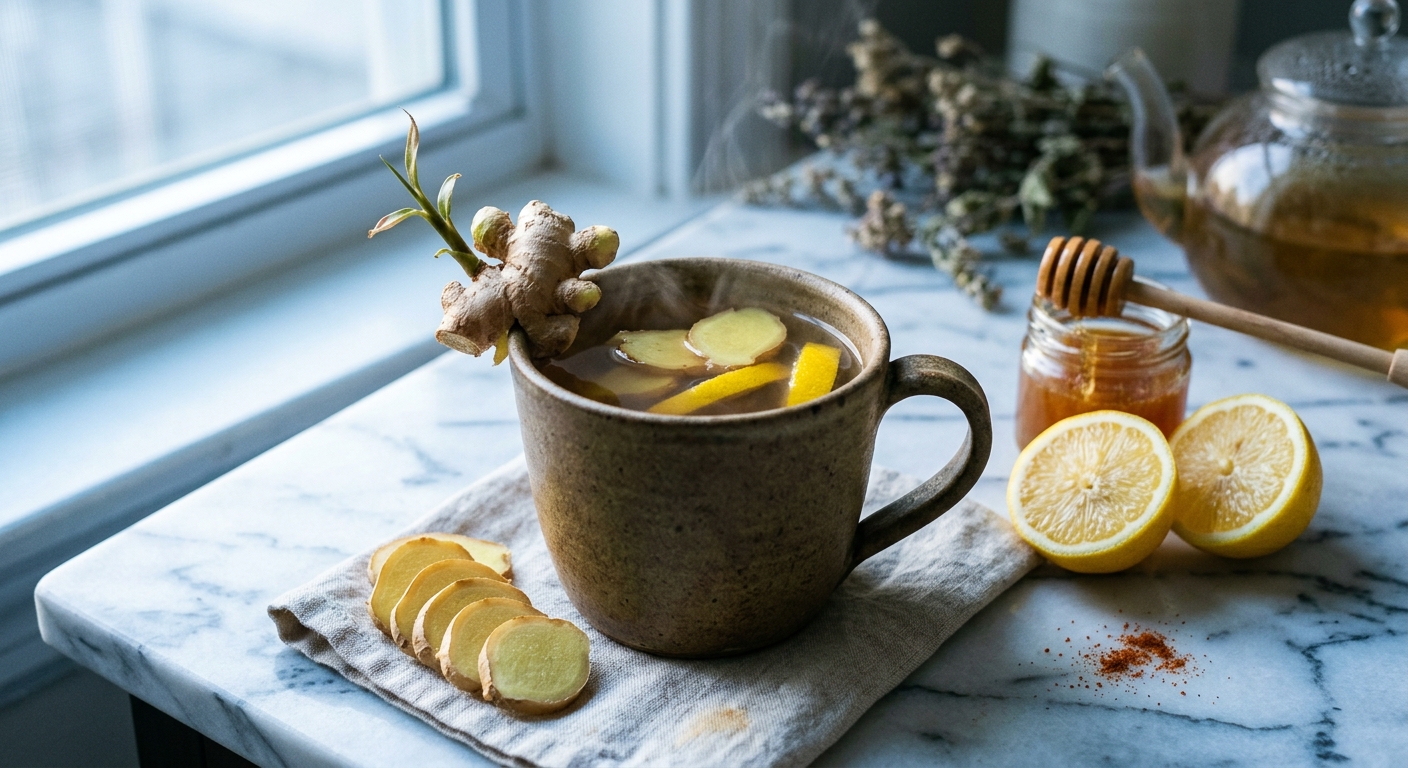
- 6 slicesfresh ginger root (each slice about 3mm thick, unpeeled or peeled)
- 1 wholelemon, juiced (approx. 30ml juice), plus 2 strips of zest
- 480 mlfiltered water
- —raw honey or manuka honey to taste (optional)
- —pinch of cayenne pepper for extra warmth (optional)
How to Brew
Click on an item below to shop for the recommended items for this recipe on Amazon.
As an Amazon Associate, we earn from qualifying purchases.
- Slice 6 rounds of fresh ginger, each about 3mm thick. You do not need to peel them if they are clean, but do scrub the skin well. Slightly bruise each slice with the flat of a knife to release more gingerols into the brew.
- Place the bruised ginger slices and 2 strips of lemon zest into a teapot or heatproof mug. Bring filtered water to a full boil, between 95 and 100°C. Ginger root is robust and benefits from near-boiling water to extract its active compounds fully.
- Pour the hot water directly over the ginger and zest. Cover the mug or pot with a lid or small plate to trap the volatile aromatic compounds that would otherwise escape as steam. Steep for 5 minutes for a lighter, floral warmth or up to 10 minutes for a more intense, peppery heat.
- Strain the tea through a fine mesh strainer into your cup. Squeeze in the juice of half a lemon per serving and stir well. Add raw honey now if desired, allowing it to dissolve fully in the hot liquid.
- Taste before serving. If the flavor is too sharp, dilute slightly with a splash of hot water. If you want more heat, let the ginger slices steep for a further 2 minutes before removing.
- Use slightly more ginger than you would for hot brew to compensate for the slower extraction at cold temperatures. Slice 8 to 10 rounds of fresh ginger per 480ml of water and bruise each piece gently with the flat of a knife.
- Place the ginger slices into a clean glass jar along with 3 strips of lemon zest. Do not add lemon juice yet, as prolonged cold contact with citric acid can slightly alter the flavor over many hours. Seal the jar with lemon juice added fresh at serving time for the brightest result.
- Pour room-temperature filtered water over the ginger and zest. Stir once to ensure everything is submerged, then seal the jar with a lid. Let it sit at room temperature for 1 hour, then transfer to the refrigerator.
- Allow to cold brew for a minimum of 8 hours and up to 12 hours overnight. The longer the steep, the more complex the flavor becomes, though beyond 14 hours the ginger can take on a slightly starchy, vegetal note.
- When ready to serve, strain the infusion through a fine mesh strainer into a glass filled with ice. Squeeze in fresh lemon juice, add honey or agave syrup, and stir well. Serve immediately for maximum freshness.
- For a decoction, use a larger piece of fresh ginger: roughly 30 to 40 grams, equivalent to a thumb-sized piece. Slice it into thin coins without peeling and add it to a small saucepan. Add a 5cm strip of lemon zest at this stage as well, since it can withstand sustained heat without turning bitter.
- Pour 600ml of cold filtered water into the saucepan with the ginger and zest. Starting in cold water helps draw out the compounds gradually as the temperature rises, which creates a fuller extraction than adding ginger to already-boiling water.
- Bring the water to a gentle simmer over medium heat, then reduce to low. Maintain a steady, gentle simmer with small bubbles breaking the surface, not a rolling boil, for 15 to 20 minutes. Cover the pan partially with a lid to reduce evaporation while still allowing some steam to escape.
- After simmering, remove from heat and allow to stand for 5 minutes. Strain through a fine mesh strainer, pressing the ginger slices gently with the back of a spoon to extract every last drop of the concentrated liquid.
- For a standard cup, dilute the concentrate with an equal volume of hot water. Add fresh lemon juice and honey to taste. The undiluted concentrate can be stored in the refrigerator in a sealed glass jar for up to 3 days and reheated as needed.
Health Benefits
Multiple randomized controlled trials confirm that ginger’s gingerols and shogaols act on serotonin receptors in the gut (particularly 5-HT3 receptors) to interrupt the nausea signal pathway. This makes ginger tea effective for morning sickness, post-operative nausea, and motion sickness without the drowsiness of antihistamine alternatives.
Ginger accelerates gastric emptying, meaning food moves more efficiently from the stomach into the small intestine, reducing the uncomfortable fullness and gas that cause bloating. Lemon’s citric acid simultaneously encourages bile flow from the gallbladder, improving fat digestion and overall digestive transit.
6-gingerol and 6-shogaol inhibit the enzymes cyclooxygenase (COX) and lipoxygenase (LOX) that produce inflammatory prostaglandins. Chronic low-grade gut inflammation is linked to IBS, leaky gut, and broader systemic inflammation, and regular ginger consumption has been shown in clinical studies to meaningfully reduce markers like CRP and TNF-alpha.
Lemon juice is a rich source of vitamin C, which supports white blood cell production and acts as a powerful antioxidant in mucosal tissues. Ginger’s phenolic compounds independently scavenge free radicals, and together they create a tea that supports immune readiness, particularly useful during cold and flu season.
Two clinical trials have found ginger supplementation to be as effective as ibuprofen at reducing primary dysmenorrhea (menstrual cramps) when taken at the onset of symptoms. This effect is attributed to ginger’s inhibition of prostaglandin synthesis, the same mechanism responsible for period pain.
🧪 Key Bioactive Compounds
The Science Behind Ginger
The digestive power of ginger and lemon tea is rooted in well-characterized biochemistry. Ginger’s most important active molecules are the gingerols, a family of phenolic compounds concentrated in fresh root. The most studied of these, 6-gingerol, works on multiple levels in the digestive system: it binds to vanilloid receptors (TRPV1) in the gut, stimulating smooth muscle motility; it suppresses the 5-HT3 serotonin receptors that trigger nausea signals; and it inhibits COX-1 and COX-2 enzymes responsible for producing inflammatory prostaglandins. When ginger is dried or heated, 6-gingerol dehydrates into 6-shogaol, which is two to three times more potent as an anti-inflammatory and antiemetic agent. This is one reason why a well-simmered ginger decoction often feels therapeutically stronger than a quick hot steep.
Lemon contributes its own distinct pharmacological layer. The citric acid in fresh lemon juice stimulates the production of digestive enzymes and promotes bile secretion from the gallbladder, improving the digestion of dietary fats. Vitamin C (ascorbic acid) is one of the most well-researched antioxidants in human nutrition, protecting gut epithelial cells from oxidative damage and supporting the integrity of the mucosal barrier. Importantly, vitamin C also significantly enhances the absorption of non-heme iron from plant foods, which is a meaningful benefit for those drinking this tea alongside a plant-based diet. The flavanone hesperidin, found primarily in lemon peel, adds a complementary anti-inflammatory action, helping to reduce oxidative stress in the gut lining over time.
The interaction between ginger and lemon is also pharmacokinetically interesting. The acidic environment created by lemon juice may help stabilize gingerols during brewing, slowing their conversion to shogaols and preserving a slightly different flavor and activity profile than a plain ginger decoction. Research published in food chemistry journals has also noted that citrus polyphenols can act synergistically with ginger’s phenolics to produce greater antioxidant capacity than either ingredient achieves independently, a phenomenon sometimes called polyphenol synergy. This is the science behind what traditional medicine practitioners have understood intuitively for millennia: these two plants simply work better together.
Brewing Tips
- Always use fresh ginger root over dried ginger powder for hot and cold brews. Fresh root contains a higher concentration of 6-gingerol, while dried powder is richer in 6-shogaol. Both are beneficial, but fresh root gives a cleaner, more vibrant flavor and better results for nausea specifically.
- Add lemon juice after steeping and off the heat, not during. Prolonged heating of lemon juice destroys a significant portion of its vitamin C content through oxidative degradation, and it can also create a slightly bitter, over-cooked citrus note. Squeeze fresh juice directly into your cup just before drinking.
- For the strongest digestive effect, drink a small cup of hot-brewed or decocted ginger and lemon tea 15 to 20 minutes before a large or rich meal. This timing allows ginger to prime gastric secretions and prepare the gut for efficient digestion, rather than simply soothing it after the fact.