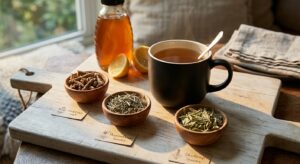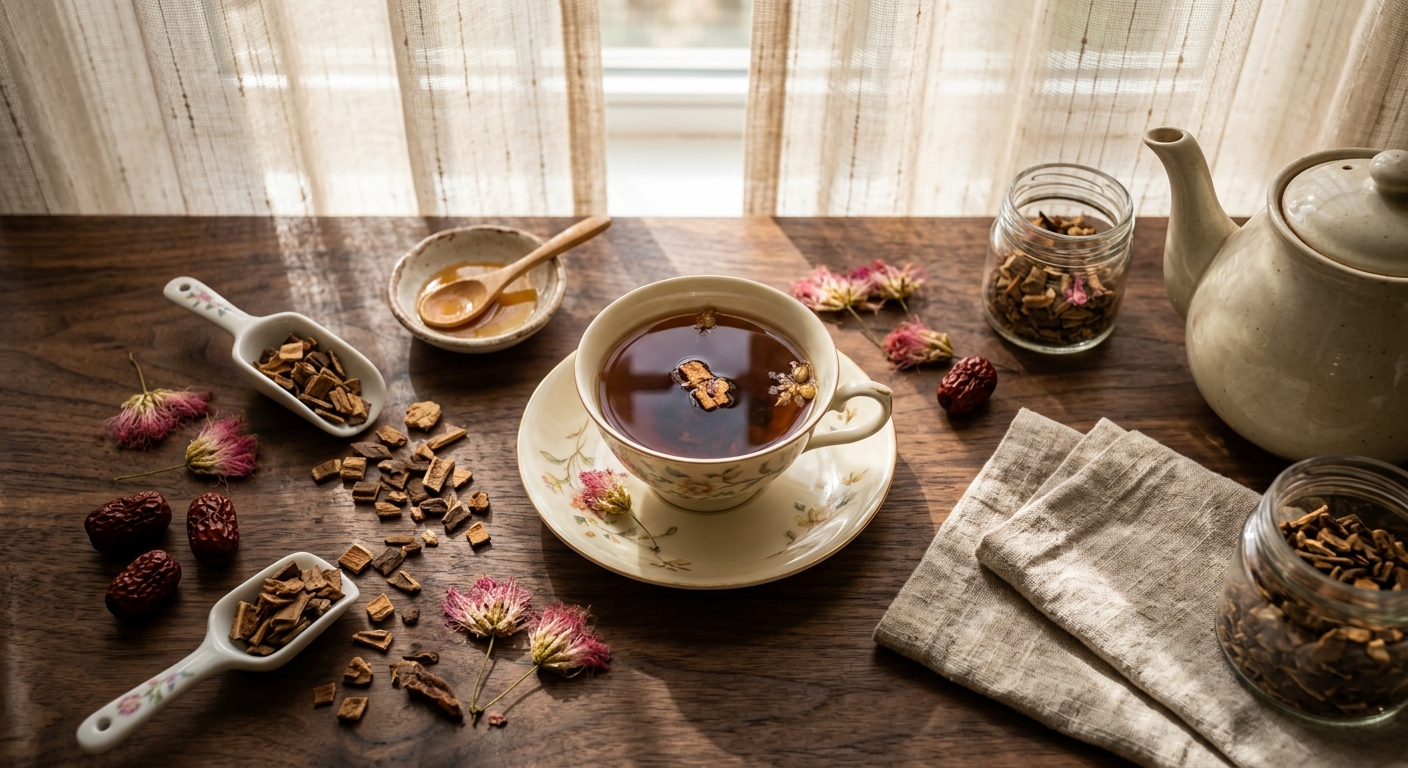
Known in Traditional Chinese Medicine as He Huan Pi, or the “bark of collective happiness,” Albizzia julibrissin has been prescribed by herbalists for more than two thousand years to lift the spirit and ease the heart. The tree itself is a vision of gentle beauty, with its feathery, fern-like leaves and soft pink powder-puff blossoms that open each summer evening. Ancient Chinese physicians observed that the tree’s leaves fold together at night, as if embracing, and concluded it was nature’s own symbol of emotional reunion and comfort. This poetic association translated directly into its clinical use as a remedy for grief, irritability, restless sleep, and what TCM practitioners call “constraint of the Shen,” meaning a troubled or unsettled spirit.
In TCM, He Huan Pi is classified as a heart and liver tonic that moves stagnant Qi while calming the mind. It was traditionally combined with other herbs in classic formulas to treat insomnia rooted in emotional turbulence rather than physical exhaustion, making it uniquely suited to the modern epidemic of anxiety-driven sleeplessness. Beyond East Asia, the tree’s range stretches from Iran to Japan, and herbalists across Persia, Korea, and Japan have independently developed traditions around its bark and flowers for similar emotional and nervous system complaints.
What sets Albizzia bark apart from more familiar sleep herbs like chamomile or valerian is its dual action on both mood and sleep simultaneously. Rather than acting purely as a sedative, it appears to gently recalibrate the emotional state, softening feelings of worry and sadness so that the body can find its way to rest naturally. Brewed as a tea, the bark yields a warm, subtly earthy, slightly astringent cup with a gentle sweetness that makes it surprisingly pleasant to drink on its own or blended with complementary herbs.
2
cups
Ingredients
- 2 tbspdried albizzia bark (He Huan Pi), broken into small pieces
- 500 mlwater (for hot decoction or cold brew)
- —raw honey or jujube dates to taste (optional)
- —a small slice of fresh ginger (optional, for warmth)
How to Brew
Click on an item below to shop for the recommended items for this recipe on Amazon.
As an Amazon Associate, we earn from qualifying purchases.
- Break or roughly crush 2 tablespoons of dried albizzia bark into small fragments using a mortar and pestle or by placing the bark in a cloth and tapping with a rolling pin. Smaller pieces extract far more efficiently than large strips.
- Bring 500 ml of filtered water to just below a full boil, around 90 to 95°C (194 to 203°F). Avoid a rolling boil, which can degrade some of the more delicate aromatic compounds in the bark.
- Place the broken bark pieces into a tea infuser, muslin bag, or directly into a small saucepan. Pour the hot water over the bark and cover with a lid to trap volatile compounds.
- Allow the bark to steep for 15 to 20 minutes. The longer the steep, the more earthy and slightly astringent the flavor becomes. Begin with 15 minutes if you are new to this herb.
- Strain the liquid through a fine mesh strainer into your mug. Add raw honey, a few jujube dates, or a thin slice of fresh ginger to round out the flavor and add complementary calming properties.
- Drink warm about 30 to 60 minutes before bedtime. Inhale the steam gently before each sip to enjoy the subtle woodsy aroma.
- Measure 2 to 3 tablespoons of dried albizzia bark and combine with 600 ml of cold filtered water in a small stainless steel or ceramic saucepan. Starting with cold water allows a more gradual extraction as the temperature rises.
- Place the saucepan over medium heat and bring the water slowly to a gentle boil, stirring once or twice. As soon as it reaches a full boil, reduce the heat immediately to a low simmer.
- Simmer uncovered for 25 to 35 minutes, allowing the liquid to reduce by roughly one third. The color will deepen to a rich amber-brown, and the aroma will become more pronounced and earthy.
- If combining with complementary herbs such as suan zao ren (sour jujube seed) or dried longan fruit in the TCM tradition, add them to the pot at the beginning with the bark so all ingredients decoct together.
- Remove the pot from heat and allow it to rest for 5 minutes. Strain the decoction through a fine mesh strainer, pressing the bark gently with a spoon to extract remaining liquid.
- Pour into a warmed ceramic cup and drink the full amount slowly over 20 to 30 minutes, ideally one hour before bed. A small amount of honey can be stirred in after straining if desired.
- Finely break or lightly crush 3 tablespoons of dried albizzia bark into small pieces. Because cold water extracts more slowly, using a slightly larger quantity and finer fragments helps ensure adequate extraction over the long steep time.
- Combine the broken bark with 600 ml of cold filtered water in a glass jar. Do not add hot water at any stage, as the cold extraction method relies entirely on time rather than heat.
- Stir well, then place a lid or piece of cloth secured with a rubber band over the jar. Leave the jar at room temperature for approximately 2 hours to begin the extraction process.
- Transfer the jar to the refrigerator and allow it to steep for a further 10 to 16 hours, making a total steep time of 12 to 18 hours. Overnight steeping works very well for this method.
- Strain the cold-brewed liquid through a fine mesh strainer or cheesecloth into a clean glass or pitcher. The resulting liquid will be a clear, medium amber with notably less astringency than a hot brew.
- Serve over ice or lightly warmed in a small saucepan, being careful not to boil the liquid, which would change the flavor profile you have developed. Add a small squeeze of raw honey or a few drops of rose water for a pleasant floral note.
Health Benefits
The triterpenoid saponins unique to albizzia bark, particularly the julibrosides, have demonstrated significant sedative effects in preclinical studies by modulating serotonergic signaling and enhancing GABAergic activity. TCM clinical practice consistently employs He Huan Pi for insomnia rooted in emotional unrest, differentiating it from herbs that simply sedate the body.
Multiple studies have found that albizzia bark extracts produce anxiolytic effects comparable to diazepam in animal models, without the same risk of dependence. The combination of quercetin-family flavonoids and julibrosides appears to work synergistically to ease nervousness, irritability, and the kind of circular thinking that keeps the mind from quieting at night.
Traditional Chinese Medicine has used He Huan Pi specifically for melancholy and grief for over two thousand years, a use that is now gaining scientific support. Preclinical research suggests albizzia bark extracts may influence monoamine neurotransmitters, including serotonin and dopamine, offering a potential mechanism for its mood-brightening reputation.
The flavonoid fraction of albizzia bark, including quercetin, isoquercitrin, and okanin, provides meaningful antioxidant and anti-inflammatory activity. Emerging research suggests these compounds may help protect neurons from oxidative stress, making the herb of interest for long-term nervous system health.
In TCM, He Huan Pi is used to address digestive complaints that arise from emotional constraint and Qi stagnation. The tannins in the bark soothe the gut lining, while the anxiolytic compounds may help interrupt the gut-brain stress cycle that commonly manifests as nausea, bloating, or cramping during periods of emotional tension.
🧪 Key Bioactive Compounds
The Science Behind Albizzia Bark
The most pharmacologically significant compounds in albizzia bark are its triterpenoid saponins, a group of compounds called julibrosides that are largely unique to the Albizia genus. Research published in peer-reviewed phytochemistry and pharmacology journals has demonstrated that julibroside extracts produce dose-dependent sedative and anxiolytic effects in rodent models, shortening sleep onset time and extending total sleep duration without the paradoxical rebound effects associated with pharmaceutical sedatives. The proposed mechanism involves modulation of serotonin reuptake and enhancement of GABA-A receptor activity, two of the central pathways targeted by the most widely prescribed sleep and anxiety medications.
Layered on top of the julibroside activity is a rich flavonoid fraction dominated by quercetin and its glycoside derivatives, including isoquercitrin. Quercetin has been studied extensively in its own right as an anxiolytic compound, with research suggesting it binds to benzodiazepine binding sites on GABA-A receptors, producing calming effects without the addictive potential of pharmaceutical benzodiazepines. The chalcone okanin adds further neuroprotective value by scavenging reactive oxygen species in neural tissue, a mechanism that may support long-term emotional resilience alongside the more immediate calming effects of the saponins and flavonoids.
From a TCM pharmacological perspective, the concept of He Huan Pi as a heart and liver herb aligns interestingly with modern findings. The liver is the primary site of neurotransmitter precursor metabolism, while the heart in TCM theory governs the Shen, or conscious spirit, a concept that maps broadly onto central nervous system regulation. The bark’s ability to influence both serotonergic and GABAergic pathways simultaneously suggests a plausible biochemical basis for its traditional dual action of lifting mood and quieting mental agitation, an effect that sets it apart from single-pathway sleep herbs and makes it particularly relevant for the kind of emotionally driven insomnia that is most prevalent today.
Brewing Tips
- Always break or crush the dried bark into small pieces before brewing. Albizzia bark is dense and fibrous, and whole strips will surrender very little of their active compounds even after a long steep.
- For the best therapeutic effect, brew and drink your albizzia bark tea consistently for at least two to three weeks. Unlike fast-acting pharmaceutical sleep aids, herbal bark preparations tend to build their effects gradually through cumulative use.
- Store dried albizzia bark in an airtight glass container away from light and moisture. Properly stored bark retains its potency for up to two years, while pre-ground or powdered bark loses volatiles quickly and is best used within six months.