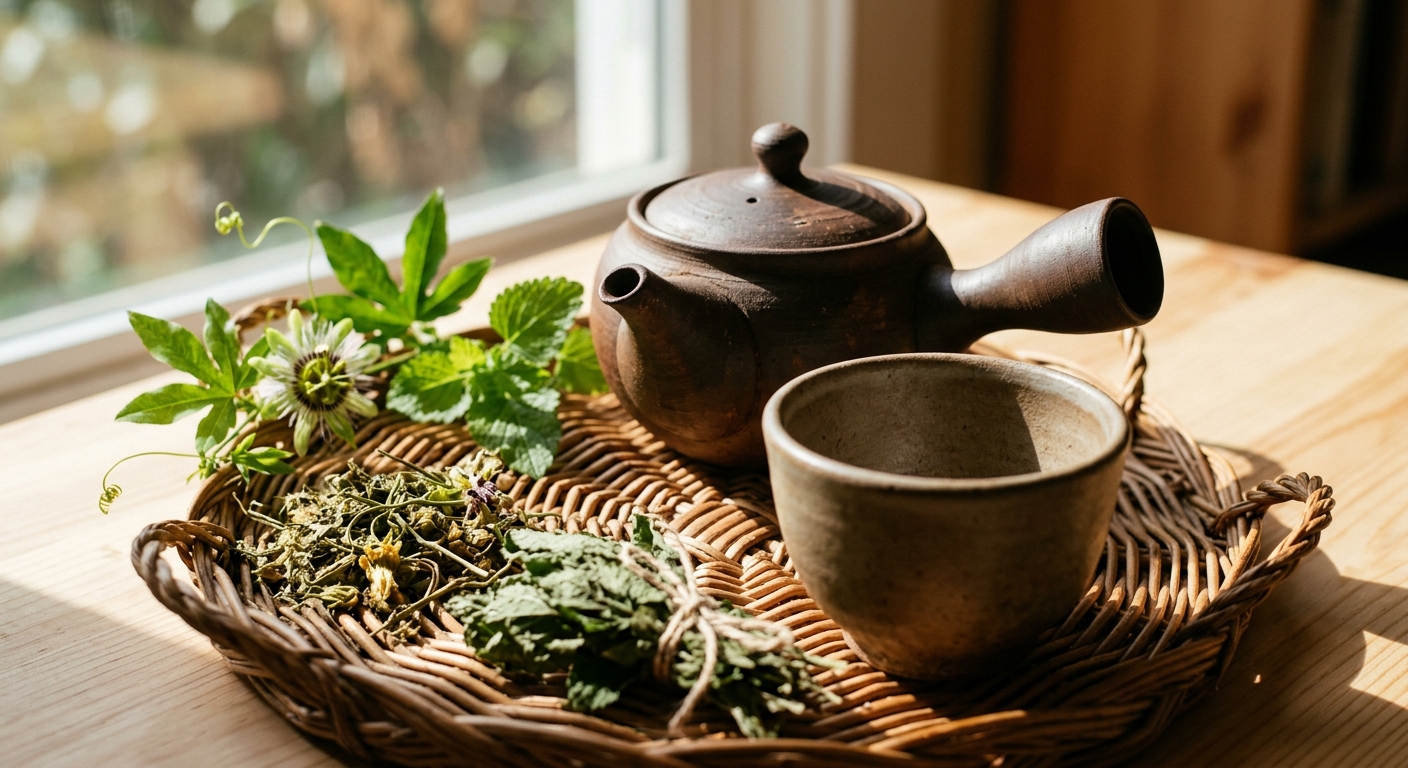
Long before sleep aids lined pharmacy shelves, herbalists across Europe and the Americas turned to the garden for relief from restless nights. Passionflower (Passiflora incarnata), a striking vine native to the southeastern United States and Central America, was used by Indigenous peoples including the Cherokee and Aztec as a calming nervine and treatment for insomnia. When Spanish missionaries encountered it in the 16th century, they named it for the Passion of Christ, seeing symbolic meaning in its elaborate bloom. It was later adopted into European herbal medicine, where it became a standard remedy for anxiety and sleeplessness well into the 20th century.
Lemon balm (Melissa officinalis), a fragrant member of the mint family, has its own storied past stretching back over 2,000 years. Ancient Greeks and Romans used it to lift the spirits and soothe the nerves, and medieval herbalist Paracelsus called it the “elixir of life.” In the 17th century, the Carmelite nuns of Paris produced a famous lemon balm tonic called Eau de Mélisse, used to calm anxiety and support sleep. Its name, Melissa, comes from the Greek word for honeybee, a nod to the herb’s intensely sweet, citrus-honeyed fragrance that pollinators find irresistible.
Together, passionflower and lemon balm form one of herbal medicine’s most celebrated sleep blends, combining gentle floral earthiness with bright lemony warmth in a cup that is as pleasant to drink as it is effective. Clinical research has begun to validate what traditional healers knew intuitively: this pairing addresses both the anxious mind and the tense body, working through separate but complementary biochemical pathways to produce a synergistic calming effect that neither herb achieves quite as well on its own.
2
cups
Ingredients
- 2 tspdried passionflower herb (aerial parts, crumbled)
- 2 tspdried lemon balm leaves
- 480 mlwater (90°C / 194°F)
- —raw honey or light agave nectar to taste (optional)
- —thin lemon slice for garnish (optional)
How to Brew
Click on an item below to shop for the recommended items for this recipe on Amazon.
As an Amazon Associate, we earn from qualifying purchases.
- Heat filtered water to approximately 90°C (194°F). If you do not have a temperature-controlled kettle, bring water to a full boil, remove from heat, and let it rest for 2 to 3 minutes before using.
- Combine 2 teaspoons of dried passionflower herb and 2 teaspoons of dried lemon balm leaves directly in a tea infuser, strainer basket, or French press. Lightly crumble the passionflower between your fingers as you add it to help release its active constituents.
- Place the infuser in your mug or teapot and pour 240 ml of hot water per serving over the herbs. Immediately cover the vessel with a small plate, lid, or saucer to prevent the volatile aromatic oils in the lemon balm from escaping as steam.
- Steep for a full 10 to 15 minutes. This blend benefits from longer extraction than many delicate florals. The color should deepen to a warm pale amber and the aroma will be noticeably present when you lift the cover.
- Remove the infuser and gently press it against the side of the cup with a spoon to express any remaining liquid and plant compounds.
- Sweeten with raw honey or light agave if desired, and garnish with a thin lemon slice. Drink 30 to 60 minutes before bedtime for best sleep-supporting effect.
- Add 3 teaspoons of dried passionflower herb and 3 teaspoons of dried lemon balm leaves to a clean glass jar. Increase the herb quantity by approximately 50 percent compared to hot brew to compensate for the less efficient cold extraction.
- Pour 500 ml of cool, filtered water over the herbs. There is no need to heat the water. Stir gently to ensure all plant material is submerged, using a long spoon or chopstick.
- Loosely cover the jar with a lid or a small plate and leave it at room temperature for the first hour to allow initial infusion to begin before refrigerating.
- Transfer the jar to the refrigerator and steep for 8 to 12 hours. Overnight is ideal, giving the flavors time to develop fully at low temperature.
- Strain the finished cold brew through a fine mesh strainer or cheesecloth into a clean jar or pitcher, pressing the herbs gently to extract all liquid.
- Pour over ice if desired, or serve chilled. Cold brew keeps well in the refrigerator for up to 48 hours. Add a few drops of honey stirred in warm water first if sweetening, as cold honey does not dissolve easily.
- In a large, clean glass jar with a tight-fitting lid, combine 4 teaspoons of dried passionflower herb and 4 teaspoons of dried lemon balm leaves. The increased ratio relative to hot brew accounts for the lower extraction temperature.
- Pour 700 ml of cool, filtered water over the herbs and secure the lid firmly.
- Place the jar in a sunny window ledge or outdoors in a spot that receives at least 2 hours of unobstructed direct sunlight. A south-facing spot works best. Tilt the jar gently once after the first hour to redistribute the herbs.
- Allow the tea to brew in the sun for 2 to 4 hours. The liquid will gradually turn a soft golden color and the aroma will be noticeably floral and lemony when you open the jar. Do not exceed 4 hours to avoid any risk of bacterial growth in warm standing water.
- Strain through a fine mesh strainer into a pitcher or individual glasses. The brew will be warm but not hot, with a delicate, lightly honeyed character.
- Serve immediately over ice for an afternoon calming ritual, or allow to cool fully and refrigerate for up to 24 hours. A sprig of fresh lemon balm placed in the glass makes a beautiful and aromatic garnish.
Health Benefits
A randomized, double-blind clinical trial published in Phytotherapy Research found that passionflower tea significantly improved subjective sleep quality compared to placebo. Lemon balm, studied in combination with other calming herbs, has been shown to reduce insomnia symptoms, with the two herbs working synergistically through GABA modulation to increase total sleep time and reduce nighttime waking.
Multiple clinical studies have demonstrated lemon balm’s anxiolytic effects, with one study in Nutrients showing significant reductions in anxiety and insomnia scores after just 15 days of use. Passionflower has been evaluated in clinical trials for generalized anxiety disorder, with results comparable to the pharmaceutical drug oxazepam but with fewer side effects.
Both herbs independently increase the availability or receptor sensitivity of gamma-aminobutyric acid (GABA), the brain’s primary inhibitory neurotransmitter. Rosmarinic acid in lemon balm inhibits GABA breakdown, while chrysin and vitexin in passionflower bind GABA-A receptors directly, creating a complementary, layered calming effect that is more robust than either herb alone.
Lemon balm has a well-documented antispasmodic effect on the gastrointestinal tract, and the European Medicines Agency has formally approved its use for mild digestive complaints including bloating, cramps, and nausea linked to nervous tension. Passionflower’s vitexin contributes additional smooth muscle relaxation, making this blend particularly useful for individuals whose anxiety manifests with gut symptoms.
Animal and human research suggests that rosmarinic acid in lemon balm can attenuate cortisol responses and reduce oxidative stress markers associated with chronic psychological stress. Combined with passionflower’s direct receptor activity, regular consumption of this blend may help blunt the physiological stress response over time, supporting long-term resilience alongside short-term relaxation.
🧪 Key Bioactive Compounds
The Science Behind Passionflower
The calming power of this blend comes down to one central neurotransmitter: gamma-aminobutyric acid, better known as GABA. GABA is the brain’s primary inhibitory chemical messenger, responsible for quieting overactive neural circuits and producing the physiological state we experience as relaxation. When GABA activity is low or GABA receptors are underresponsive, the result is anxiety, insomnia, and an inability to “switch off” the mind at night. What makes passionflower and lemon balm such a well-matched pair is that they elevate GABA signaling through two distinct mechanisms, producing a more complete and layered effect than either herb can achieve independently.
Passionflower’s principal active compounds, the flavonoids chrysin, vitexin, and orientin, act as positive allosteric modulators at the GABA-A receptor. In plain terms, they make the receptor more responsive to GABA, amplifying the calming signal without flooding the system artificially. This is mechanistically similar to how benzodiazepine drugs work, which is why passionflower has compared favorably to low-dose pharmaceutical anxiolytics in clinical trials, but without the risk of dependency or next-day cognitive impairment at normal herbal doses. Lemon balm, by contrast, targets GABA from the supply side. Its most pharmacologically significant compound, rosmarinic acid, is a potent inhibitor of GABA transaminase, the enzyme that breaks GABA down and clears it from synapses. By slowing GABA catabolism, rosmarinic acid effectively prolongs and deepens the calming signal already present in the brain.
Beyond GABA, lemon balm’s volatile terpenes, particularly the citral isomers geranial and neral, interact with the serotonin system and have shown mild inhibition of monoamine oxidase in laboratory studies, which may contribute to the mood-brightening effect many users notice even as the blend promotes physical relaxation and drowsiness. This dual action, calming without completely suppressing alertness, makes the tea well-suited as a pre-sleep wind-down ritual rather than a daytime sedative. Research published in peer-reviewed journals including Phytotherapy Research, Nutrients, and the Journal of Ethnopharmacology continues to support the traditional uses of both herbs, with human clinical trials demonstrating statistically significant improvements in sleep quality, anxiety scores, and stress biomarkers among participants who consumed standardized extracts of passionflower and lemon balm.
Brewing Tips
- Always cover your mug or teapot while the blend steeps. Lemon balm’s most fragrant, bioactive volatile oils evaporate quickly in steam, and trapping them inside the vessel ensures they return to your cup rather than disappearing into the air.
- Use dried herbs within 12 months of purchase and store them in airtight, opaque containers away from light and humidity. Passionflower loses its flavonoid potency relatively quickly once dried and exposed to air, so freshness matters more here than with many other herbs.
- If your passionflower tea tastes noticeably bitter, reduce your steep time by 2 to 3 minutes rather than reducing the herb quantity. The bitter compounds extract faster than the calming flavonoids at higher temperatures, so slightly cooler water around 88°C (190°F) and a covered steep will give you the full therapeutic benefit with a more pleasant flavor.