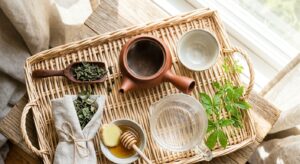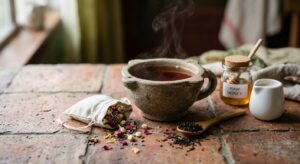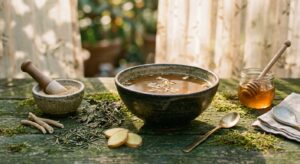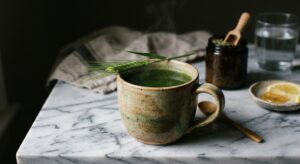
For centuries, healers across Asia, India, and the Mediterranean have turned to specific plants to sharpen the mind, steady scattered thoughts, and restore a sense of grounded calm. Long before the term ‘ADHD’ existed, practitioners of Ayurveda prescribed bacopa monnieri to children struggling with memory and focus, while Traditional Chinese Medicine relied on lion’s mane mushroom to nourish what they called ‘the spirit of the brain.’ These traditions were not guessing. They were observing, generation after generation, how certain plants genuinely shifted the way the mind worked.
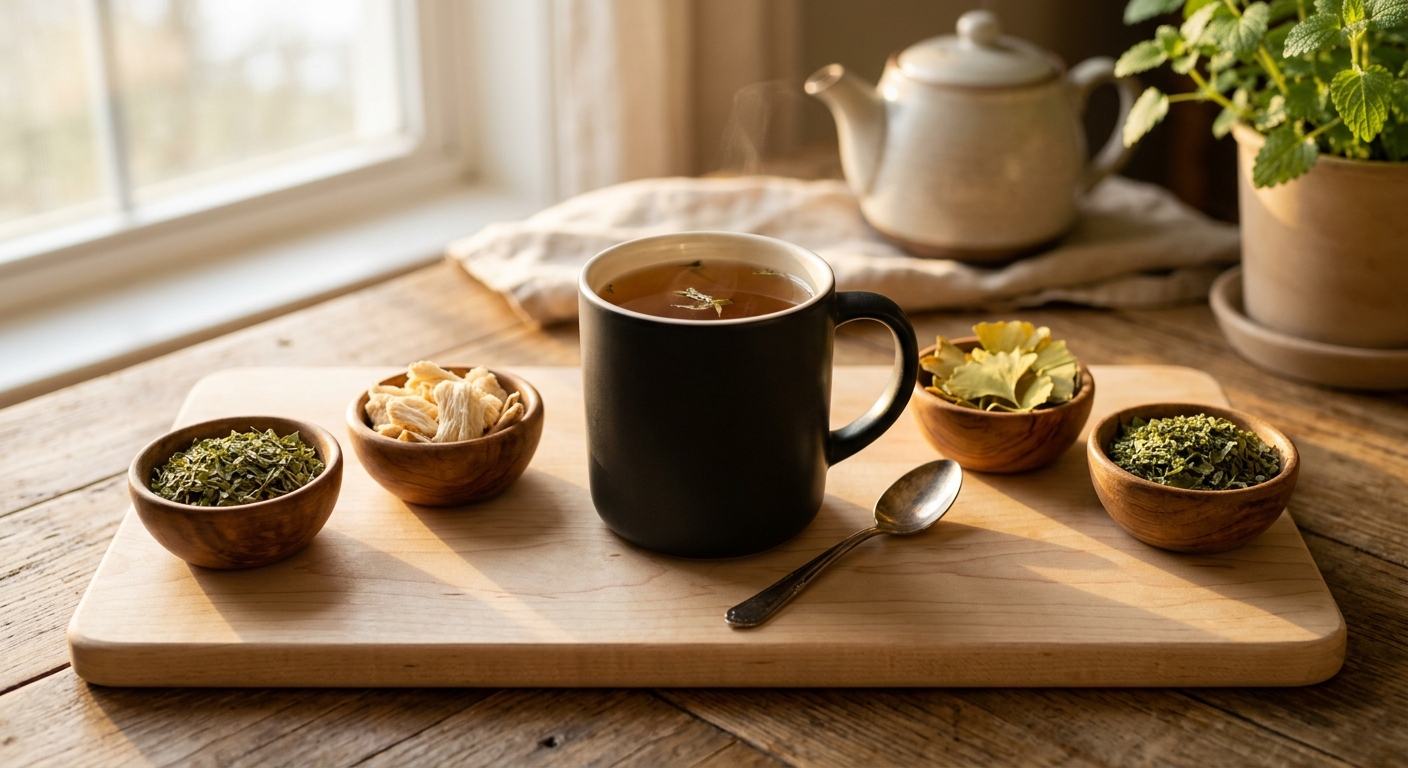
This ADHD support herbal tea blend brings together four complementary herbs: bacopa monnieri for memory consolidation and stress adaptation, lion’s mane mushroom for nerve growth factor stimulation, ginkgo biloba for cerebral circulation, and lemon balm to quiet the restless anxiety that so often accompanies attention difficulties. Together, they create a synergistic brew that targets multiple aspects of cognitive function without the jitteriness of stimulants or the crash that follows caffeine. It is a cup designed for the long game, supporting neurological health with each daily serving rather than delivering a short-term jolt.
It is worth noting that herbal teas are not a replacement for professional ADHD treatment or medication. They are a complementary tool, one that many people find genuinely useful alongside other strategies. The sensory ritual of brewing this tea, its earthy, slightly sweet aroma filling the kitchen, the warmth of the mug in your hands, can itself become a grounding mindfulness practice, which research increasingly links to improved attention regulation.
2
cups
Ingredients
- 1.5 tspdried bacopa monnieri (brahmi) leaves
- 1 tspdried lion’s mane mushroom powder or finely chopped dried pieces
- 1 tspdried ginkgo biloba leaves
- 1 tspdried lemon balm leaves
- 480 mlwater (95°C / 203°F)
- —raw honey or maple syrup to taste (optional)
- —a slice of fresh ginger (optional, for warmth and palatability)
How to Brew
Click on an item below to shop for the recommended items for this recipe on Amazon.
As an Amazon Associate, we earn from qualifying purchases.
- Bring 480 ml of filtered water to 90 to 95°C (194 to 203°F). If using a standard kettle, allow boiling water to rest for 60 to 90 seconds before pouring.
- Combine the bacopa monnieri, lion’s mane, ginkgo biloba, and lemon balm in a tea infuser, muslin bag, or teapot strainer. If using dried lion’s mane pieces rather than powder, lightly crush them between your fingers first to increase surface area.
- Place the infuser in your mug or teapot and pour the hot water directly over the herbs, ensuring full saturation of all plant material.
- Cover the mug with a small plate or lid to trap volatile aromatic compounds and prevent heat loss. Steep for 10 to 15 minutes. Taste at 10 minutes and continue steeping if you prefer a stronger, more medicinal brew.
- Remove the infuser and allow the tea to cool for 2 minutes. Sweeten with raw honey or maple syrup if desired. A thin slice of fresh ginger added to the infuser during steeping will soften the bitterness and add a warming note.
- Drink slowly and without distraction, treating the brewing and drinking as a brief mindfulness ritual to reinforce the calm focus this blend supports.
- Combine the full ingredient amounts (bacopa monnieri, lion’s mane, ginkgo biloba, and lemon balm) in a clean glass jar. Use the same ratios as the hot brew but scale up to 600 ml of cold filtered water to account for the less aggressive extraction at low temperatures.
- If using lion’s mane powder, whisk it briefly into 60 ml of the cold water first before adding to the jar. This prevents clumping and ensures even distribution throughout the cold brew.
- Stir the herb and water mixture gently to ensure all plant material is submerged. Seal the jar with a lid or cover with a small plate.
- Leave the jar at room temperature for the first 2 hours, then transfer to the refrigerator and continue steeping for a total of 10 to 14 hours (overnight is ideal).
- In the morning, strain the cold brew through a fine mesh strainer or cheesecloth into a pitcher or directly into two glasses filled with ice.
- Taste before sweetening. The cold brew will be noticeably smoother and more mellow than the hot version. Stir in honey dissolved in a small amount of warm water if sweetness is desired, as cold liquids do not dissolve honey easily.
- Triple the herb quantities: use 4.5 tsp bacopa monnieri, 3 tsp lion’s mane, 3 tsp ginkgo biloba, and 3 tsp lemon balm. Place all herbs in a small saucepan with 480 ml of filtered water.
- Bring the water to a gentle simmer at 95 to 100°C (203 to 212°F) over medium heat. Do not allow a rolling boil, as this can degrade some of the more volatile compounds in lemon balm and ginkgo.
- Reduce heat to the lowest setting and keep the brew at a low simmer with the lid slightly ajar for 20 to 25 minutes, stirring once or twice during this time.
- Remove from heat and allow to cool for 5 minutes with the lid fully on. Strain through a fine mesh strainer or cheesecloth, pressing the spent herbs gently to extract maximum liquid.
- Pour the concentrate into a clean glass jar and refrigerate. It will keep for up to 5 days. Each serving is approximately 80 ml of concentrate diluted with 160 ml of hot or cold water, yielding a standard mug-sized serving.
- Label the jar with the date and taste a diluted serving before adding any sweetener, as the concentrate will be intensely earthy and slightly bitter but should be well-balanced once diluted.
Health Benefits
Bacopa monnieri has been studied in multiple randomized controlled trials showing improved attention, cognitive processing speed, and working memory in both children and adults after consistent use over 8 to 12 weeks. Its bacosides are believed to modulate acetylcholine activity, a key neurotransmitter in the brain’s attention network.
Lemon balm’s rosmarinic acid gently elevates GABA levels and modulates serotonin receptors, reducing the anxious restlessness commonly experienced alongside attention difficulties. Unlike sedative herbs such as valerian, lemon balm at normal tea doses does not cause drowsiness, making it suitable for daytime use.
Ginkgo biloba is one of the most well-studied herbs for cerebrovascular health. Its ginkgolides improve microcirculation in the prefrontal cortex, the region most responsible for executive function, planning, and impulse control, all areas frequently affected in ADHD.
Lion’s mane mushroom’s hericenones and erinacines are among the very few natural compounds shown to stimulate NGF synthesis in the brain. NGF promotes the health of cholinergic neurons, supports myelination, and may play a role in improving the neurological substrate underlying attention regulation over time.
Bacopa acts as a mild adaptogen, helping the brain recover from the mental exhaustion that often accompanies sustained effort for those with attention difficulties. Studies have shown reduced reaction time errors and improved cognitive endurance in subjects taking bacopa during mentally demanding tasks.
🧪 Key Bioactive Compounds
The Science Behind Bacopa Monnieri
The science behind this blend centers on multiple complementary mechanisms that together address several neurological factors associated with attention difficulties. Bacopa monnieri’s bacosides work primarily by modulating synaptic transmission in the hippocampus and prefrontal cortex. Research published in journals including Neuropsychopharmacology and the Journal of Alternative and Complementary Medicine has shown that bacosides enhance the activity of tryptophan hydroxylase and dopamine beta-hydroxylase, enzymes involved in serotonin and norepinephrine synthesis. These neurotransmitters are central to the brain’s attention regulation circuitry, precisely the pathways that ADHD medications target through different mechanisms.
Lion’s mane mushroom brings a uniquely neurotropic dimension to this blend. Its small molecular weight compounds, hericenones from the fruiting body and erinacines from the mycelium, are notable in neuroscience research for their ability to cross the blood-brain barrier and directly stimulate NGF and BDNF (Brain-Derived Neurotrophic Factor) production. A 2009 double-blind, placebo-controlled trial published in Phytotherapy Research found significant cognitive improvement in adults with mild cognitive impairment after 16 weeks of lion’s mane supplementation, with benefits reversing after cessation. While ADHD and cognitive impairment are distinct conditions, the underlying importance of NGF and BDNF in maintaining healthy prefrontal cortex function is relevant to both.
Ginkgo biloba’s contribution is primarily vascular and neuroprotective. Its standardized extracts, designated EGb 761 in clinical trials, have been shown in a 2014 meta-analysis in the Journal of Psychiatric Research to significantly reduce ADHD symptoms in children when used as a standalone treatment compared to placebo, though with smaller effect sizes than conventional stimulant medications. The bilobalide component’s ability to protect neuronal mitochondria is particularly significant: mitochondrial dysfunction in neurons impairs the sustained energy production that attentive cognitive work requires. Lemon balm’s rosmarinic acid completes the formula by addressing the anxious restlessness that often accompanies attention difficulties, modulating GABA availability through enzyme inhibition and providing a calming counterbalance to the more stimulating cognitive effects of the other herbs.
Brewing Tips
- Bacopa monnieri’s benefits are cumulative and depend on consistent daily consumption. Brew a concentrate at the start of each week to make it easy to maintain the habit without daily preparation.
- If the earthiness of lion’s mane and ginkgo is too pronounced, add half a teaspoon of dried peppermint or a small cinnamon stick to your infuser. Both improve palatability significantly without reducing the therapeutic value of the core herbs.
- Drink this tea in the morning or early afternoon rather than in the evening. While lemon balm is mildly calming rather than sedating, creating an association between this tea and focused daytime activity reinforces its use as part of a cognitive support routine.