As we age, the desire to stay sharp, remember names, and think clearly becomes one of life’s quiet priorities. For centuries, herbalists across China, Europe, and the Americas have turned to specific plants and fungi to nourish the aging brain. Ginkgo biloba, one of the oldest living tree species on Earth, has been used in Traditional Chinese Medicine for over 2,000 years to support circulation and cognitive function. Rosemary, revered in ancient Greece as a symbol of remembrance, was worn by students during examinations and placed near the elderly to honor memory. Lion’s mane mushroom, long prized in East Asian wellness traditions, has only recently captured the attention of neuroscientists for its remarkable potential to support nerve growth and brain health.
This blend brings these three time-honored allies together in a single, nourishing cup. Ginkgo improves blood flow to the brain, rosemary delivers a burst of aromatic compounds linked to mental clarity, and lion’s mane contributes beta-glucans and hericenones that may stimulate the production of nerve growth factor (NGF). The result is a tea that tastes like a walk through a forest clearing, earthy and herbaceous with a faint piney warmth, and that supports the kind of steady, sustained mental presence that many seniors and older adults seek in their daily wellness routine.
Whether you are managing the early signs of age-related cognitive decline, supporting a loved one through that journey, or simply investing in long-term brain health, this blend offers a gentle, evidence-informed place to start. It works beautifully as a morning ritual to replace or complement coffee, or as a midday reset to clear mental fog. The herbs in this blend are complementary rather than competing, each working through distinct mechanisms so that together they support circulation, neurological resilience, and mental energy in a way no single herb could achieve alone.
2
cups
Ingredients
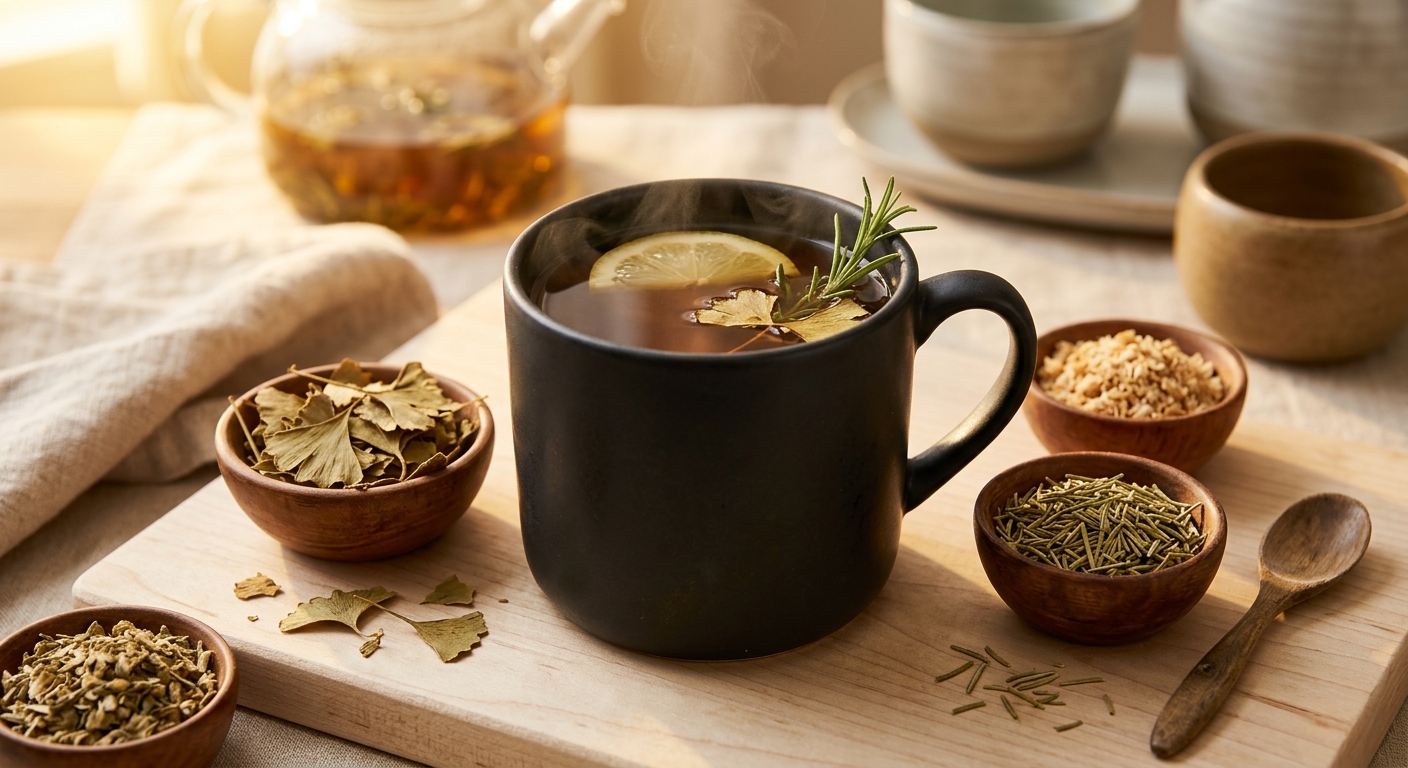
- 2 tspdried ginkgo biloba leaves
- 1 tspdried rosemary leaves
- 1 tspdried lion’s mane mushroom powder or finely crumbled dried lion’s mane
- 480 mlwater (90 to 95°C / 194 to 203°F)
- —raw honey or maple syrup to taste (optional)
- —a thin slice of fresh lemon (optional, brightens the flavor and adds vitamin C)
How to Brew
Click on an item below to shop for the recommended items for this recipe on Amazon.
As an Amazon Associate, we earn from qualifying purchases.
- Measure 2 teaspoons of dried ginkgo biloba leaves, 1 teaspoon of dried rosemary, and 1 teaspoon of lion’s mane (powder or crumbled dried) into a tea infuser or heatproof teapot.
- Heat 480 ml of filtered water to 90 to 95°C (194 to 203°F). If using an electric kettle without temperature control, bring water to a boil and allow it to rest for 2 to 3 minutes before pouring.
- Pour the hot water directly over the herbs and cover the vessel with a lid or small saucer to trap volatile aromatic compounds, particularly the camphor and 1,8-cineole from the rosemary that contribute to its cognitive effects.
- Steep for 10 to 12 minutes. The brew should deepen to a warm amber-green. Taste at 10 minutes and extend by 1 to 2 minutes if you prefer a stronger, more medicinal cup.
- Remove the infuser or strain the tea through a fine mesh strainer into your mug. If using lion’s mane powder, stir or whisk briefly before drinking to ensure even distribution.
- Add raw honey or a thin lemon slice if desired, and drink warm within 15 minutes for the fullest aromatic benefit.
- Combine 2 teaspoons of dried ginkgo biloba leaves, 1 teaspoon of dried rosemary, and 1 teaspoon of lion’s mane powder into a clean glass jar. Use slightly cooler filtered water (filtered tap water at room temperature is ideal) rather than hot water.
- Pour 500 ml of room-temperature filtered water over the herbs. Stir gently with a long spoon to ensure all the dried material is saturated and no dry pockets remain, especially important with lion’s mane powder which can clump.
- Cover the jar tightly with a lid and place it in the refrigerator. Allow the blend to cold steep for 10 to 14 hours, or overnight. Avoid going beyond 16 hours as the cold brew can develop an overly astringent quality from the ginkgo.
- In the morning, strain the cold brew through a fine mesh strainer lined with a small square of cheesecloth to catch any lion’s mane sediment. Pour over ice or drink chilled straight from the jar.
- Sweeten lightly with a small amount of agave syrup or maple syrup if desired, both of which dissolve more easily in cold liquid than raw honey. Serve within 24 hours for best flavor and potency.
- Combine 4 teaspoons of dried ginkgo biloba leaves, 2 teaspoons of dried rosemary, and 2 teaspoons of lion’s mane powder or crumbled dried lion’s mane into a small saucepan. This is a double-strength ratio designed to yield a concentrate.
- Add 480 ml of cold filtered water to the saucepan. Bring the mixture slowly to a near-boil at 95 to 100°C (203 to 212°F) over medium heat. Once you see active steam and small bubbles forming, reduce the heat to a gentle simmer.
- Simmer uncovered for 20 to 25 minutes, stirring occasionally. The liquid will reduce by roughly 25 percent and deepen to a rich, murky amber-green. This extended low heat extraction is particularly effective at drawing out the beta-glucans from lion’s mane.
- Remove from heat and allow the concentrate to cool for 5 minutes, then strain through a fine mesh strainer into a clean glass jar or heatproof pitcher. Press the spent herbs gently with the back of a spoon to extract the remaining liquid.
- To serve, dilute the concentrate at a 1:1 ratio with hot water for a warm cup, or with cold water and ice for a chilled serving. Adjust the ratio to taste. Add honey and lemon as desired.
- Seal the jar and refrigerate. The concentrate will keep for up to 4 days. Shake or stir gently before each use as lion’s mane compounds may settle.
Health Benefits
Ginkgo biloba’s ginkgolide and bilobalide compounds enhance cerebral blood flow and reduce oxidative stress in the hippocampus, the brain’s memory center. Multiple randomized controlled trials, including a large European multicenter study, have found that standardized ginkgo extract (EGb 761) significantly improved memory performance in older adults with mild cognitive impairment.
Rosemary’s 1,8-cineole inhibits acetylcholinesterase, the enzyme that breaks down acetylcholine, a neurotransmitter central to attention and working memory. Research published in Therapeutic Advances in Psychopharmacology found that even ambient exposure to rosemary aroma significantly improved speed and accuracy on cognitive tasks in older adults.
Lion’s mane mushroom is the only known natural food source of hericenones and erinacines, compounds that stimulate NGF synthesis. A double-blind placebo-controlled trial published in Phytotherapy Research demonstrated that older adults who consumed lion’s mane for 16 weeks showed significant improvements on the Revised Hasegawa Dementia Scale compared to placebo.
Chronic low-grade neuroinflammation is a primary driver of age-related cognitive decline. Rosmarinic acid in rosemary and the flavonoid glycosides in ginkgo both demonstrate significant anti-inflammatory activity in brain tissue, suppressing pro-inflammatory cytokines such as IL-6 and TNF-alpha in preclinical studies.
The brain consumes roughly 20 percent of the body’s oxygen despite being only 2 percent of body weight, making it highly vulnerable to free radical damage. Bilobalide from ginkgo and rosmarinic acid from rosemary both demonstrate measurable neuroprotective antioxidant activity, helping preserve mitochondrial function in aging neurons.
🧪 Key Bioactive Compounds
The Science Behind Ginkgo Biloba
The cognitive support offered by this blend rests on three distinct but complementary mechanisms. Ginkgo biloba works primarily through enhanced cerebrovascular circulation and neuroprotection. Its terpene lactones, particularly ginkgolide B and bilobalide, improve the viscosity of blood in the brain’s microvasculature and protect neurons from glutamate-mediated excitotoxicity, a process where overstimulated nerve cells are damaged or destroyed. Its flavonoid glycosides, including quercetin-3-glucoside and kaempferol derivatives, further reduce oxidative damage to cell membranes in brain tissue. The German Commission E and the European Medicines Agency have both formally recognized standardized ginkgo extract for the symptomatic treatment of mild to moderate cognitive impairment.
Rosemary contributes through a dual mechanism that is both acute and cumulative. In the short term, inhaling the aroma of rosemary during brewing delivers 1,8-cineole through the olfactory epithelium directly into the bloodstream, where it crosses the blood-brain barrier rapidly and inhibits acetylcholinesterase. This means that simply smelling the brewing tea has measurable cognitive effects, confirmed in a 2012 study by Moss and colleagues at Northumbria University. Over time, the rosmarinic acid and carnosic acid in rosemary act as potent antioxidants that reduce the chronic neuroinflammation underlying many forms of age-related cognitive decline. Rosmarinic acid in particular has been shown to inhibit aggregation of amyloid-beta peptides in laboratory models, the same peptides that form plaques in Alzheimer’s disease.
Lion’s mane mushroom operates through a uniquely structural mechanism. Its hericenones (found in the fruiting body) and erinacines (found in the mycelium) are small enough to cross the blood-brain barrier and stimulate the synthesis of nerve growth factor (NGF), a protein essential for the growth, maintenance, and survival of neurons. NGF is particularly critical in the hippocampus and basal forebrain, regions most vulnerable to age-related atrophy. A 2009 randomized controlled trial by Mori and colleagues and a 2023 study published in the Journal of Alzheimer’s Disease both demonstrated significant improvements in cognitive test scores in older adults consuming lion’s mane for 16 weeks or more, with effects reversing after supplementation ceased, suggesting an ongoing relationship between intake and benefit rather than a one-time fix. Together, these three ingredients create a layered, synergistic approach to cognitive support that operates through circulation, neurochemistry, and neuroplasticity simultaneously.
Brewing Tips
- Source your ginkgo biloba leaves from a reputable supplier and look for leaves that are verified free of ginkgolic acid, a naturally occurring allergen in fresh or poorly processed ginkgo that is removed in quality dried preparations. Standardized dried leaf from a certified herbalist supplier is preferable for regular use.
- Lion’s mane powder dissolves more readily than crumbled dried pieces and produces a more evenly distributed brew. If using crumbled dried mushroom, give the steeped tea a brief whisk before straining to help release the water-soluble beta-glucans into the liquid.
- For seniors or anyone new to ginkgo biloba tea, start with half the recommended amount of ginkgo (1 teaspoon instead of 2) for the first two weeks to assess tolerance before moving to the full dose. The herb’s circulatory effects can occasionally cause mild headache or digestive sensitivity in the first days of use.