Deep in the temperate forests of Japan, China, and North America, a magnificent fungus grows at the base of ancient oak and maple trees, its frilly, overlapping fronds cascading like a hen settling into her nest. Known as Grifola frondosa, maitake has been treasured in East Asian herbalism for centuries, its name translating poetically from Japanese as “dancing mushroom.” Legend holds that foragers who discovered a wild maitake patch would dance with joy, both because of the mushroom’s rarity and because of its extraordinary worth as both food and medicine. In feudal Japan, maitake was so prized it was traded weight-for-weight with silver.
Traditional Chinese and Japanese medicine has long classified maitake as an adaptogen and immune tonic, used to support vitality, build resistance to illness, and nourish the body during periods of stress or recovery. Unlike many bitter medicinal herbs, maitake offers a genuinely pleasant culinary flavor, earthy and woodsy with a mild savoriness that makes it one of the most approachable medicinal mushroom teas available. Healers in these traditions brewed it as a long, slow decoction, extracting its deeply held compounds into a nourishing broth-like tea meant to be sipped daily as a wellness practice rather than a quick remedy.
Today, maitake has attracted significant scientific attention for its beta-glucan content, particularly a fraction known as D-fraction, which has been the subject of clinical research in Japan relating to immune modulation and cellular health. Whether you are drawn to maitake for its rich forest flavor, its storied history in plant medicine, or its impressive phytochemical profile, this tea offers a grounding, warming ritual that connects modern wellness practices to centuries of botanical wisdom. Brewing maitake at home is simple, deeply satisfying, and one of the most potent daily additions you can make to an immunity-focused herbal routine.
2
cups
Ingredients
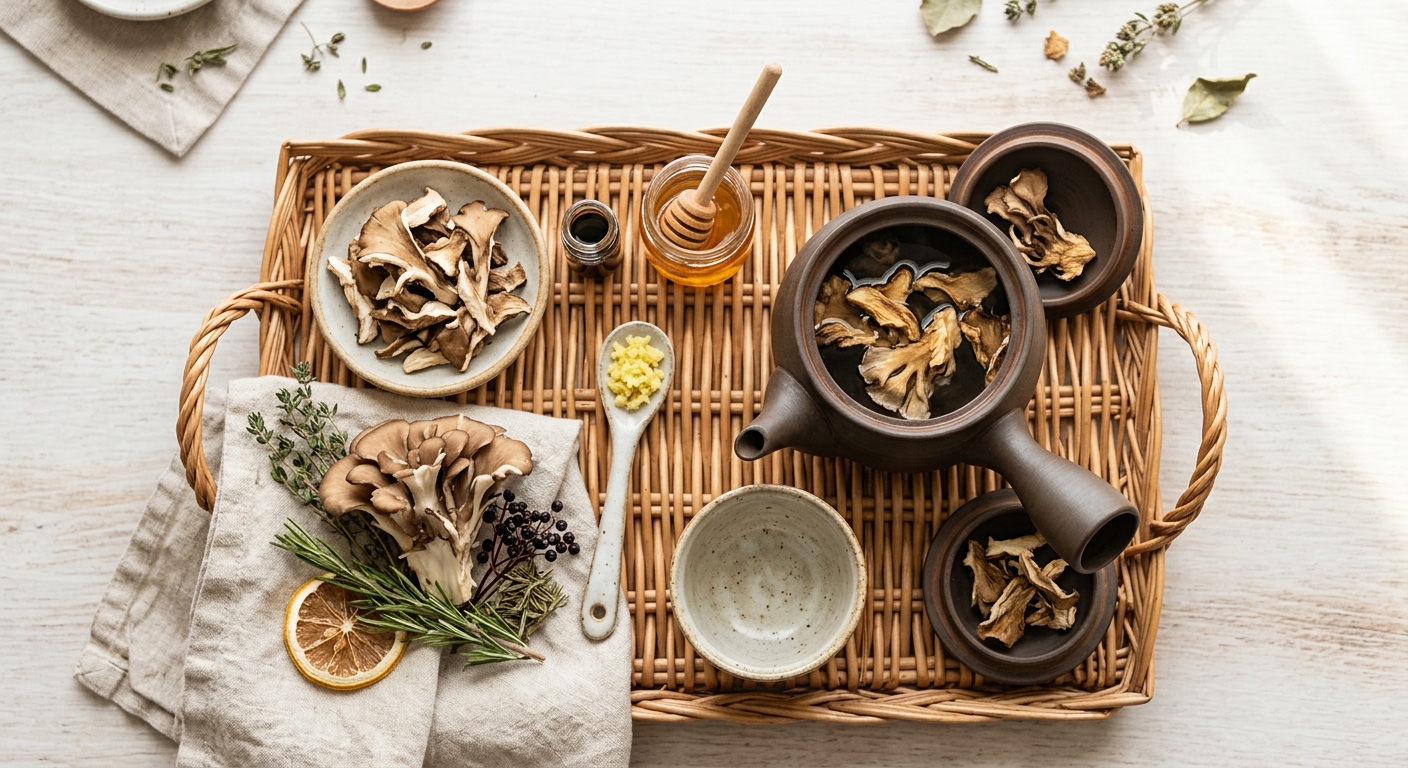
- 10 gdried maitake mushroom (sliced or broken into pieces)
- 600 mlwater (for hot decoction or hot brew)
- 1 tspfresh ginger, grated (optional, for warmth)
- —raw honey or a splash of tamari to taste (optional)
- —lemon slice for serving (optional)
How to Brew
Click on an item below to shop for the recommended items for this recipe on Amazon.
As an Amazon Associate, we earn from qualifying purchases.
- Break or slice 10 g of dried maitake into small, roughly thumb-sized pieces to maximize surface area. The more surface exposed to water, the more beta-glucans and flavor compounds will be released.
- Heat filtered water to 90 to 95°C (194 to 203°F) using an electric kettle. Avoid a full rolling boil, as sustained boiling can degrade some of the more delicate polysaccharide fractions.
- Place the maitake pieces into a heat-safe teapot or saucepan. Pour 600 ml of hot water directly over the mushroom pieces, ensuring all pieces are fully submerged.
- Cover the vessel tightly with a lid to trap volatile aromatic compounds and maintain temperature. Allow the mushroom to steep for 20 to 30 minutes. The longer you steep, the deeper and more savory the flavor becomes.
- Strain the liquid through a fine mesh strainer into two mugs. Press gently on the mushroom pieces with the back of a spoon to extract every last drop of liquid.
- Add grated ginger, a slice of lemon, or a small drizzle of raw honey if desired. Sip slowly and enjoy warm. The spent mushroom pieces can be reserved and used once more for a second, lighter brew.
- Place 12 g of dried maitake pieces into a clean glass jar. Use slightly more mushroom than the hot brew method, as cold water extracts compounds more slowly and less aggressively than hot water.
- Pour 700 ml of cold, filtered water over the mushroom pieces. Stir gently to ensure all pieces are fully submerged. If any pieces float, weigh them down with a small clean spoon laid across the top before sealing.
- Seal the jar with a lid and leave it at room temperature for the first 1 to 2 hours to allow the mushroom to begin hydrating. Then transfer the jar to the refrigerator.
- Allow the mushroom to cold brew in the refrigerator for 12 to 18 hours, or overnight. The resulting liquid will be a lighter amber color than the hot brew, with a delicate, subtly sweet earthiness.
- Strain through a fine mesh strainer lined with a coffee filter to achieve a crystal-clear, smooth brew. Pour over ice into two tall glasses.
- Garnish with a sprig of fresh mint or a thin slice of cucumber for a refreshing immunity tonic. Cold brew maitake tea will keep refrigerated for up to 48 hours in a sealed container.
- Place 15 g of dried maitake pieces in a small saucepan. Add 800 ml of cold, filtered water and allow the mushroom to soak for 10 minutes before heating. This pre-soak begins hydration and helps the mushroom release compounds more readily during simmering.
- Bring the water and mushroom to a full boil over medium-high heat, then immediately reduce the heat to maintain a gentle, steady simmer. You should see small, lazy bubbles breaking the surface rather than a vigorous boil.
- Simmer uncovered for 35 to 45 minutes, allowing the liquid to reduce by roughly one-third. The broth will deepen in color from pale amber to a rich, dark chestnut. Add optional grated ginger in the final 10 minutes for additional anti-inflammatory support.
- Check the liquid level periodically. If it reduces too quickly, add small amounts of hot water to maintain at least 400 ml of liquid through the end of cooking.
- Remove from heat and allow the decoction to cool for 5 minutes. Strain through a fine mesh strainer into two mugs, pressing the spent mushroom pieces firmly to extract all remaining liquid.
- Taste the decoction before adding anything. It should be deeply savory, warming, and complex. Balance with a small amount of raw honey if desired, or drink it as-is as a restorative broth-style tea. The spent mushroom pieces can be chopped and added to soups or stir-fries.
Health Benefits
Maitake’s D-Fraction beta-glucans bind to receptors on macrophages and natural killer cells, upregulating immune surveillance and helping the body identify and respond to pathogens more efficiently. Multiple Japanese clinical studies have found measurable improvements in immune cell activity following regular maitake supplementation.
Maitake is one of the richest known dietary sources of ergothioneine, a powerful antioxidant that accumulates in tissues throughout the body and protects cells from free radical damage. Regular consumption may help reduce systemic oxidative stress, which underlies many chronic inflammatory conditions.
The SX-Fraction found in maitake has been studied in both animal and preliminary human trials for its ability to improve insulin receptor sensitivity and support healthy post-meal glucose levels, making maitake tea a potentially supportive daily drink for metabolic wellness.
Classified as an adaptogen in both Traditional Chinese Medicine and modern functional medicine, maitake helps the body maintain homeostasis during physical and emotional stress by supporting adrenal function and regulating cortisol-related immune suppression.
Eritadenine, a compound unique to medicinal mushrooms including maitake, has been shown in animal studies to inhibit an enzyme involved in cholesterol synthesis, helping to reduce circulating LDL levels and support overall heart health when consumed regularly.
🧪 Key Bioactive Compounds
The Science Behind Maitake Mushroom
The immune-supportive reputation of maitake mushroom is not simply rooted in tradition – it is backed by a growing body of pharmacological research centered on its exceptional beta-glucan content. Beta-glucans are long-chain polysaccharides found in the cell walls of fungi, and maitake’s particular beta-1,3/1,6-linked glucan fraction, commercially known as D-Fraction, has been the subject of clinical investigations in Japan since the 1980s. These molecules work by binding to specific receptors on the surface of immune cells, including macrophages, dendritic cells, and natural killer cells, triggering a cascade of responses that prime the immune system for faster and more coordinated action against pathogens and abnormal cells. A 2013 randomized crossover study published in the Journal of the American College of Nutrition confirmed that maitake D-Fraction significantly enhanced the functional activity of immune cells in healthy postmenopausal women, demonstrating that these effects extend beyond laboratory models into real human physiology.
Alongside its polysaccharide compounds, maitake contains ergothioneine, an unusual sulfur-containing amino acid that mammals cannot synthesize on their own and must obtain through diet. Ergothioneine is concentrated in tissues throughout the body, particularly in mitochondria-rich organs like the liver and kidneys, where it acts as a potent antioxidant scavenger. Unlike many antioxidants, ergothioneine is remarkably stable and is not rapidly degraded by cooking or brewing, meaning a significant portion survives the tea-making process. Researchers have proposed that ergothioneine may play a protective role in reducing inflammation-associated cellular damage, and epidemiological data suggests that populations with higher mushroom consumption tend to have elevated ergothioneine levels alongside markers of lower oxidative stress.
The SX-Fraction of maitake, a proteoglycan complex distinct from D-Fraction, has attracted attention in metabolic health research for its apparent ability to enhance insulin receptor sensitivity. In a small human pilot study published in 2002, researchers observed statistically significant improvements in fasting blood glucose and insulin levels among participants supplementing with maitake SX-Fraction over a 30-day period. While larger controlled trials are still needed, these findings align with maitake’s traditional classification as a metabolic tonic and suggest that daily maitake tea consumption may offer benefits that extend well beyond immune support, touching on blood sugar regulation, cardiovascular health through eritadenine activity, and cellular resilience through its antioxidant compounds working in concert.
Brewing Tips
- Source your dried maitake from a reputable supplier that tests for heavy metals and verifies species identity, as mushroom quality varies enormously between suppliers and the potency of your tea depends directly on the quality of the dried material.
- Do not discard the spent mushroom pieces after brewing. They retain dietary fiber and residual nutrients, and can be chopped finely and stirred into miso soup, risotto, or stir-fries for an added nutritional boost.
- For maximum beta-glucan extraction in any brewing method, always cover your vessel during steeping. Beta-glucans are water-soluble but their extraction is temperature-sensitive, and keeping the heat contained in the vessel helps drive deeper extraction throughout the steep.