Long before nootropics became a wellness buzzword, herbalists across Asia and Europe were reaching for the same plants to sharpen the mind and sustain mental endurance. Green tea has been the companion of Zen monks and Confucian scholars for over a thousand years, valued not just for its gentle caffeine lift but for the rare amino acid L-theanine, which smooths that energy into something clean and focused. Ginkgo biloba, one of the oldest tree species on Earth, has been used in Traditional Chinese Medicine for millennia to support circulation to the brain and preserve cognitive vitality. Together, these two form the backbone of a tea that respects both tradition and science.
Lion’s mane mushroom, the shaggy white fungus revered in Japanese and Chinese herbalism as the “mountain priest mushroom,” brings a third dimension to this blend. Its hericenones and erinacines are among the only natural compounds known to stimulate the synthesis of Nerve Growth Factor (NGF), a protein that supports the growth, maintenance, and survival of neurons. In culinary and medicinal traditions alike, lion’s mane was reserved for monks and nobility, believed to bestow mental fortitude and spiritual clarity. Steeped into a tea, it contributes a subtle umami warmth that grounds the brighter, vegetal notes of the green tea and the faintly resinous character of the ginkgo.
What makes this blend genuinely different from a cup of coffee or a commercial energy drink is the concept of calm focus. There is no spike, no crash, no racing heart. Instead, the interplay of L-theanine and caffeine creates a state of relaxed alertness that neuroscientists recognize as a distinct and highly productive mode of cognition. Add the circulatory support of ginkgo and the neuroprotective signaling of lion’s mane, and you have a tea built not just for a productive afternoon, but for long-term brain health. Brew it when you need to write, create, solve, or simply show up fully present.
2
cups
Ingredients
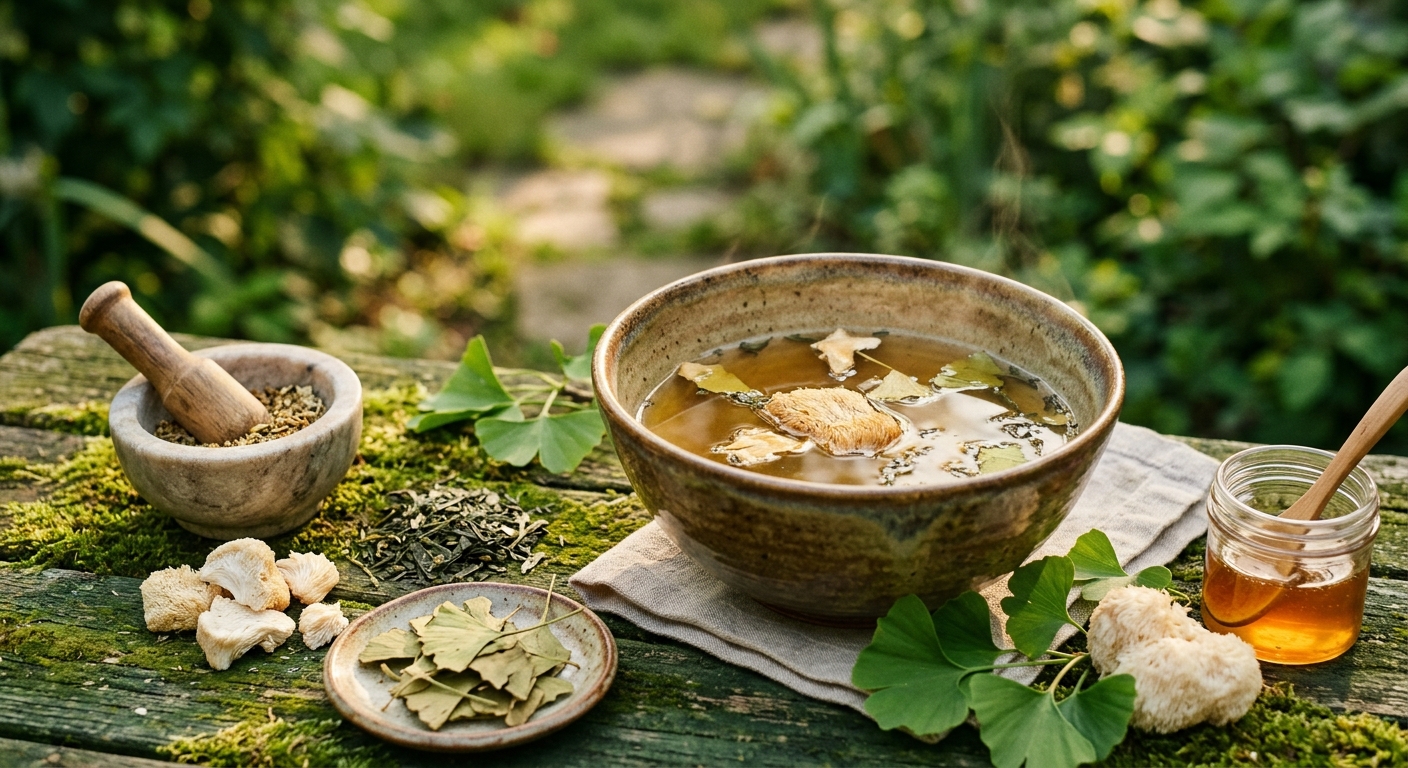
- 2 tspdried lion’s mane mushroom pieces or powder
- 1 tsploose-leaf green tea (sencha or dragonwell)
- 0.5 tspdried ginkgo biloba leaf
- 480 mlwater (80°C / 176°F)
- —raw honey or maple syrup to taste (optional)
- —a few drops of lemon juice (optional, brightens flavor)
How to Brew
Click on an item below to shop for the recommended items for this recipe on Amazon.
As an Amazon Associate, we earn from qualifying purchases.
- Heat filtered water to exactly 80°C (176°F). If you do not have a temperature-controlled kettle, bring water to a full boil then let it rest uncovered for 4 to 5 minutes before using.
- Add the dried lion’s mane mushroom pieces (or powder), ginkgo biloba leaf, and loose-leaf green tea to a tea infuser, mesh strainer, or teapot with a built-in filter. Place it in your mug or teapot.
- Pour the 80°C water slowly over the herbs, making sure all the material is fully saturated. Cover the mug or teapot with a lid or small saucer to trap volatile aromatic compounds and maintain temperature.
- Steep for 4 minutes for a lighter, more delicate cup. Steep up to 6 minutes for deeper earthiness and more pronounced lion’s mane flavor. Do not exceed 7 minutes or the green tea will become noticeably astringent.
- Remove the infuser and press the herbs gently with the back of a spoon to release any remaining liquid. Taste the tea before adding any sweetener, as the clean finish often needs nothing extra.
- Add the dried lion’s mane mushroom pieces, ginkgo biloba leaf, and loose-leaf green tea to a clean glass jar or cold brew pitcher. Use slightly more herb than the standard hot brew ratio: 2.5 teaspoons of lion’s mane, 1.5 teaspoons of green tea, and 0.5 teaspoon of ginkgo for every 480 ml of water.
- Pour cold, filtered water (room temperature is fine) over the herbs. Stir gently to ensure everything is submerged. Do not use hot water, as the goal is a slow, cold extraction that preserves the delicate green tea aromatics and reduces bitterness.
- Seal the jar or pitcher and leave it at room temperature for 30 minutes to allow the initial extraction to begin, then transfer it to the refrigerator.
- Steep in the refrigerator for 8 to 10 hours. Overnight is ideal. After the steeping window, taste the brew. It should be soft, slightly sweet, and earthy. If you want a bolder flavor, steep for up to 12 hours.
- Strain the herbs through a fine-mesh strainer or cheesecloth into a second jar or pitcher. Serve over ice with a squeeze of lemon or a drizzle of raw honey. The cold brew will keep refrigerated for up to 48 hours.
- Triple the standard herb ratio: use 6 teaspoons of lion’s mane mushroom, 3 teaspoons of green tea, and 1.5 teaspoons of ginkgo biloba leaf per 480 ml of water. This produces a concentrate that will be diluted 1:1 or 1:2 before drinking.
- Heat filtered water to 80°C (176°F). Pour over the herbs in a teapot or French press, making sure all the material is thoroughly saturated.
- Steep for 7 to 8 minutes, covered. The longer steep at this temperature is acceptable here because the final dilution will soften any astringency.
- Press the French press plunger slowly and fully, or press the herbs firmly with the back of a spoon before straining through a fine-mesh strainer. This releases the beta-glucan-rich liquid from the lion’s mane mushroom.
- Allow the concentrate to cool to room temperature, then transfer to a sealed glass jar. Refrigerate for up to 5 days. To serve, dilute one part concentrate with one to two parts hot water, sparkling water, or oat milk. Add honey or lemon to taste.
Health Benefits
The L-theanine and caffeine combination in green tea has been studied in multiple randomized controlled trials and consistently improves accuracy on sustained attention tasks, working memory performance, and mental switching speed compared to caffeine alone. The combination produces a distinct mode of calm, goal-directed cognition.
Preclinical and early human trials indicate that the hericenones and erinacines in lion’s mane mushroom stimulate NGF production in the brain, a process critical for maintaining existing neurons and forming new synaptic connections. A 2009 double-blind trial published in Phytotherapy Research found significant improvements in cognitive function scores among older adults who consumed lion’s mane daily for 16 weeks.
Ginkgo biloba’s ginkgolides and bilobalide have been shown in multiple clinical studies to improve microcirculation and blood flow to the brain, which is directly linked to sharper short-term memory, faster processing speed, and reduced mental fatigue. This makes ginkgo particularly effective for cognitive performance under stress or during periods of intense mental work.
L-theanine promotes alpha-wave brain activity and modulates serotonin and dopamine levels, reducing the psychological component of stress that fragments focus. Studies show it lowers subjective feelings of mental fatigue following cognitively demanding tasks, extending the productive window of concentration.
Green tea catechins (particularly EGCG), ginkgo flavonoids, and the beta-glucans in lion’s mane all exhibit significant antioxidant activity. The brain is especially vulnerable to oxidative damage due to its high oxygen consumption, and regular consumption of antioxidant-rich botanicals is associated with reduced cognitive decline over time.
🧪 Key Bioactive Compounds
The Science Behind Lion’S Mane Mushroom
The cognitive benefits of this blend are rooted in complementary but distinct biological mechanisms, which is what makes the combination more interesting than any single ingredient alone. L-theanine and caffeine are perhaps the most studied natural nootropic pairing in the literature. L-theanine promotes alpha brain wave oscillations, the same pattern associated with wakeful relaxation and creative flow states seen in meditators. When paired with the adenosine-blocking action of caffeine, the result is heightened alertness without the cortisol spike and peripheral vasoconstriction that straight caffeine produces. Multiple double-blind crossover studies have demonstrated that this combination improves accuracy on demanding attention tasks, reduces the number of errors on working memory tests, and extends the duration of focused cognition significantly more than either compound in isolation.
Lion’s mane mushroom operates on a completely different timescale and pathway. Its active compounds, hericenones from the fruiting body and erinacines from the mycelium, are among the very few natural substances capable of stimulating the production of Nerve Growth Factor, a neurotrophin that governs the growth, maintenance, and survival of cholinergic neurons in the basal forebrain. These are precisely the neurons most affected in age-related cognitive decline and neurodegenerative disease. Early human trials have shown measurable improvements in cognitive function scores with consistent supplementation over 8 to 16 weeks, and animal models show enhanced hippocampal neurogenesis, the process by which new neurons form in the memory center of the brain. This is not a quick-acting stimulant but a slow, structural investment in brain resilience.
Ginkgo biloba bridges the immediate and long-term effects through its dual role as a cerebrovascular agent and neuroprotective antioxidant. Its unique terpene lactones, including ginkgolides A, B, and C, inhibit platelet-activating factor, a compound involved in blood clot formation and inflammatory signaling in the brain. This action improves microcirculation and increases oxygen and glucose delivery to active neural tissue. Bilobalide, another ginkgo-specific compound, protects neurons from apoptosis triggered by oxidative stress and mitochondrial dysfunction. Together, these mechanisms mean that with regular use, ginkgo supports not just sharper thinking in the moment but the long-term structural integrity of the cognitive networks that make sustained focus possible.
Brewing Tips
- Source your lion’s mane as a whole dried fruiting body or sliced pieces rather than powder when possible. Powder oxidizes faster and can include filler mycelium substrate that contributes less of the active hericenones. A reputable supplier will clearly label whether the product is fruiting body, mycelium, or a blend.
- Use water that has been filtered or left to sit uncovered for a few minutes if you are on municipal water. Chlorine in tap water can suppress some of the delicate aromatic compounds in green tea and alter the flavor profile noticeably.
- If you are new to lion’s mane tea, start with a smaller amount, around one teaspoon per cup, for the first week. Some individuals experience vivid dreams or mild digestive adjustment as the gut microbiome responds to the beta-glucan content. This typically resolves quickly and is not a cause for concern.