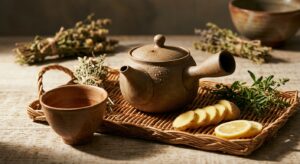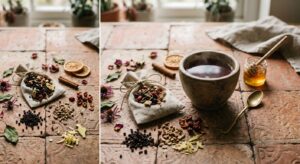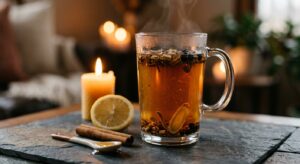
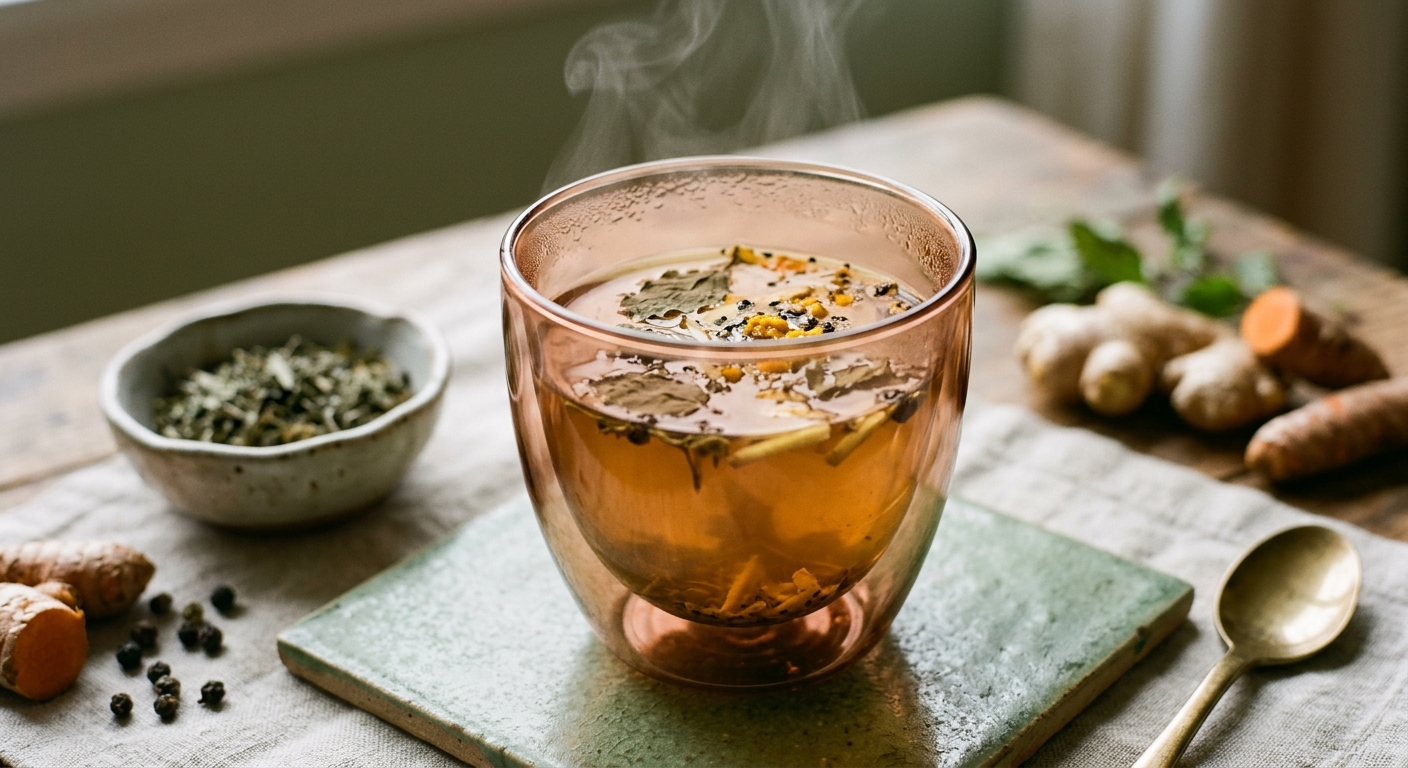
Long before laboratory-synthesized supplements lined pharmacy shelves, Ayurvedic healers in ancient India were crafting precise herbal formulas to strengthen the body’s vital force, known as ojas. This Ayurvedic Immunity Tea draws from that tradition, weaving together four foundational herbs that appear repeatedly across classical Ayurvedic texts: tulsi (holy basil), fresh ginger, turmeric, and black pepper. Each ingredient was chosen not only for its individual properties but for the way these plants work synergistically, amplifying each other’s effects in ways that modern science is only beginning to verify.
Tulsi, revered as the ‘Queen of Herbs’ in India, holds a sacred place in Hindu households, where it is grown in courtyards and offered in daily worship. In the Ayurvedic system, it is classified as a rasayana, a rejuvenating tonic that builds long-term vitality and adapts to the body’s needs. Ginger, or shunthi in Sanskrit, has been called the ‘universal medicine’ in Ayurveda for its ability to kindle digestive fire and clear respiratory congestion. Turmeric provides the golden color and earthy warmth that gives this tea its visual beauty, while black pepper unlocks turmeric’s most potent compound, piperine dramatically increasing the bioavailability of curcumin by up to 2,000 percent.
What makes this tea special is the balance it strikes between potency and pleasure. It is warming without being harsh, complex without being medicinal in a clinical sense. The aroma alone, a swirl of spiced earth, green basil, and bright ginger, signals to your nervous system that something nourishing is coming. Brewed as a morning ritual or taken at the first sign of a cold, this tea is both a sensory experience and a therapeutic practice, a perfect example of Ayurveda’s core philosophy that food and herbs are medicine consumed with intention.
2
cups
Ingredients
- 2 tspdried tulsi (holy basil) leaves
- 1 tspfresh ginger, finely grated or thinly sliced
- 0.5 tspground turmeric or 1 tsp fresh turmeric, grated
- 4 wholeblack peppercorns, lightly crushed
- 480 mlfiltered water
- —raw honey or jaggery to taste (optional)
- —a squeeze of fresh lemon juice (optional)
How to Brew
Click on an item below to shop for the recommended items for this recipe on Amazon.
As an Amazon Associate, we earn from qualifying purchases.
- Pour 480 ml of filtered water into a small saucepan and bring it to a gentle simmer over medium heat. You are aiming for small bubbles rising steadily, not a vigorous rolling boil.
- Add the crushed black peppercorns and grated or sliced ginger directly to the simmering water. Allow these to simmer for 3 to 4 minutes to begin extracting their active compounds into the liquid.
- Add the ground turmeric or grated fresh turmeric and stir well to combine. Continue to simmer for another 2 minutes. The water should deepen to a rich golden color.
- Remove the saucepan from heat and immediately add the dried tulsi leaves. Cover the pan with a lid and allow the tulsi to steep off the heat for 5 to 7 minutes. Covering is essential to trap the aromatic volatile oils that give tulsi its therapeutic potency.
- Strain the tea through a fine mesh strainer into two warmed mugs. Add raw honey or jaggery to taste, and finish with a squeeze of fresh lemon if desired. Stir and serve immediately while the tea is fragrant and warm.
- Combine the dried tulsi leaves, thinly sliced ginger, ground turmeric, and lightly crushed black peppercorns in a clean glass jar. Because cold water extracts more slowly, increase the tulsi to 3 teaspoons and the ginger to 1.5 teaspoons to compensate for the lower extraction rate.
- Pour 480 ml of room-temperature filtered water over the herbs. Stir briefly with a long spoon to ensure the turmeric is dispersed and not clumping at the surface.
- Place a loose lid or a cloth cover secured with a rubber band over the jar. Let the jar rest at room temperature for 1 hour, then transfer it to the refrigerator and steep for a further 9 to 11 hours, or overnight.
- In the morning, remove the jar from the refrigerator and give it a vigorous shake or stir, as turmeric will have settled during the long steep. Strain the tea through a fine mesh strainer or cheesecloth into two glasses filled with ice.
- Sweeten with a small amount of liquid honey (which dissolves more easily in cold liquid than solid jaggery). Add a slice of fresh lemon or lime for brightness. Consume within 48 hours and keep refrigerated.
- Combine 600 ml of filtered water with the crushed black peppercorns, grated ginger, and turmeric in a small saucepan. Bring the mixture to a full rolling boil over medium-high heat.
- Once boiling, reduce the heat to a gentle simmer and cook uncovered for 15 to 18 minutes, allowing the liquid to reduce by roughly one third. This concentration process extracts deep levels of gingerols from the ginger and curcuminoids from the turmeric.
- Add the dried tulsi leaves and any optional additions such as 2 cloves, a small cinnamon stick, or 2 cardamom pods crushed. These additions are common in traditional kadha recipes and enhance the immune-supporting properties. Stir, cover the pan, and remove it from the heat.
- Allow the covered decoction to steep off the heat for 5 minutes so the tulsi’s volatile oils infuse into the concentrated liquid without being destroyed by prolonged boiling.
- Strain through a fine mesh strainer into small cups or a heatproof glass, pressing the herbs gently with the back of a spoon to extract the remaining liquid. The yield should be approximately 240 to 300 ml, serving two small 120 to 150 ml portions. Sweeten lightly with jaggery or honey and sip slowly while warm.
Health Benefits
Tulsi has been shown in clinical trials to significantly increase natural killer cell and T-helper cell activity, supporting both innate and adaptive immunity. Combined with curcumin’s NF-kB inhibition and ginger’s macrophage activation, this blend addresses immune function from multiple biological pathways simultaneously.
Curcumin and 6-gingerol are among the most well-studied natural anti-inflammatory compounds, both inhibiting pro-inflammatory cytokines including TNF-alpha and interleukin-6. Regular consumption of this tea may help reduce the low-grade chronic inflammation that underlies many modern chronic diseases.
Tulsi has a long Ayurvedic history as a remedy for respiratory congestion, coughs, and bronchitis, and modern studies confirm its bronchodilator and antimicrobial effects on common respiratory pathogens. Ginger further supports this by relaxing smooth muscle in the airways and helping to clear mucus.
Tulsi is clinically classified as an adaptogen, meaning it helps the body maintain homeostasis under physical and psychological stress. A randomized controlled trial published in the Journal of Ayurveda and Integrative Medicine found that standardized tulsi extract significantly reduced stress scores and improved cognitive function in healthy adults.
A significant portion of the immune system resides in the gut, and both ginger and black pepper actively support gastrointestinal health. Ginger promotes gastric motility and reduces intestinal inflammation, while piperine enhances the absorption of multiple nutrients, ensuring the body can extract maximum immune-supporting value from food and herbs.
🧪 Key Bioactive Compounds
The Science Behind Tulsi (Holy Basil)
The synergy within this tea is not accidental. It mirrors what Ayurvedic physicians observed empirically over millennia: that certain herbs and spices combined are more effective than any single ingredient alone. Modern pharmacology has confirmed this phenomenon most dramatically in the relationship between curcumin and piperine. Curcumin, the principal curcuminoid in turmeric, is notoriously difficult for the human body to absorb in isolation because it is rapidly metabolized and conjugated in the gut and liver. Piperine, the alkaloid responsible for black pepper’s heat, inhibits these metabolic enzymes and intestinal efflux transporters, keeping curcumin in its active form long enough to reach systemic circulation. The landmark 1998 study by Shoba et al. demonstrated that 20 mg of piperine taken alongside curcumin increased its serum bioavailability by 2,000 percent in human subjects, transforming what would otherwise be a poorly absorbed pigment into a clinically meaningful dose.
Tulsi’s immunological activity has been investigated in a growing body of clinical research. Its primary bioactive constituents include eugenol, rosmarinic acid, ursolic acid, and ocimumosides A and B, the last of which are unique adaptogenic compounds that directly modulate the hypothalamic-pituitary-adrenal axis. A 2012 randomized controlled trial found that daily tulsi extract supplementation significantly improved markers of immune function, including increases in interferon-gamma, interleukin-4, and natural killer cell activity, compared to placebo. The herb’s antiviral properties have also been demonstrated against several respiratory pathogens including influenza A, suggesting a mechanistic basis for its traditional use during cold and flu season.
Ginger’s active compound 6-gingerol is converted to 6-shogaol when ginger is dried or heated, and both forms have demonstrated significant immunomodulatory and anti-inflammatory activity. Research published in the Journal of Ethnopharmacology confirmed that ginger extract suppresses the production of pro-inflammatory cytokines including TNF-alpha, IL-1-beta, and IL-6, the very cytokines that drive the uncomfortable symptoms of the common cold and respiratory infections. Ginger also activates macrophages, the frontline immune cells that identify and engulf pathogens, providing a direct mechanism for its immune-supportive role. When these four ingredients are combined, they address immunity at multiple levels simultaneously: modulating the adaptive immune response via tulsi, reducing the inflammatory cascade via curcumin and gingerol, enhancing absorption via piperine, and providing broad-spectrum antimicrobial coverage across the blend.
Brewing Tips
- Always crush or grind the black peppercorns just before brewing rather than using pre-ground pepper. Freshly cracked pepper contains significantly higher concentrations of piperine, the compound that activates curcumin’s bioavailability.
- If using fresh turmeric root instead of ground powder, grate it finely rather than slicing it. The greater surface area from grating dramatically increases the curcuminoids released into the water during brewing.
- Avoid adding honey while the water is still boiling. Ayurvedic tradition and some modern research suggest that heating honey above 40°C (104°F) may degrade its enzymatic and antimicrobial properties. Let the tea cool slightly before sweetening.