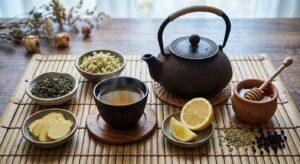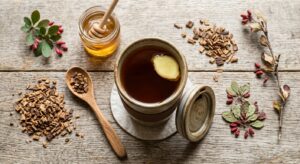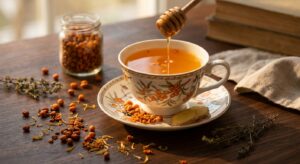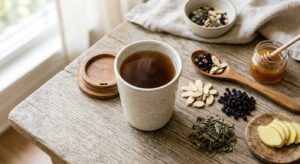
Deep in the shaded hardwood forests of the eastern United States and Canada, goldenseal (Hydrastis canadensis) grows quietly among the leaf litter, its small white flower and vivid red fruit belying the potent medicine held within its knotted golden roots. For centuries, Indigenous peoples of the Cherokee, Iroquois, and other nations used this plant as a dye, a wound healer, and a remedy for digestive ailments, eye infections, and respiratory complaints. European settlers quickly adopted it into their own traditions, and by the nineteenth century goldenseal had become a cornerstone of the American Eclectic movement, prescribed for everything from mucous membrane inflammation to malarial fevers.
The root’s unmistakable deep yellow color comes from berberine, an isoquinoline alkaloid that modern science has extensively studied for its antimicrobial, anti-inflammatory, and immune-modulating properties. This same compound gives goldenseal its intensely bitter, distinctly earthy flavor, which is not a flaw but a functional feature: in traditional herbalism, bitterness itself is considered a signal that a plant is working on the digestive system, stimulating bile production, and readying the body’s mucous membranes for defense. When brewed as a tea, goldenseal delivers these compounds in a form that is easily absorbed and direct-acting on the throat, sinuses, and upper digestive tract.
It is worth noting that goldenseal is now considered a threatened or at-risk plant in much of its native range, due to overharvesting and habitat loss. For this reason, responsible sourcing matters enormously. Look for organically cultivated goldenseal rather than wildcrafted, and consider combining it with its alkaloid-sharing companion herb, Oregon grape root (Mahonia aquifolium), which contains similar concentrations of berberine and can be used as a sustainable alternative or complementary addition. When you brew a cup of goldenseal tea, you are participating in one of North America’s oldest healing traditions, and tending that tradition well means tending the plant itself.
2
cups
Ingredients
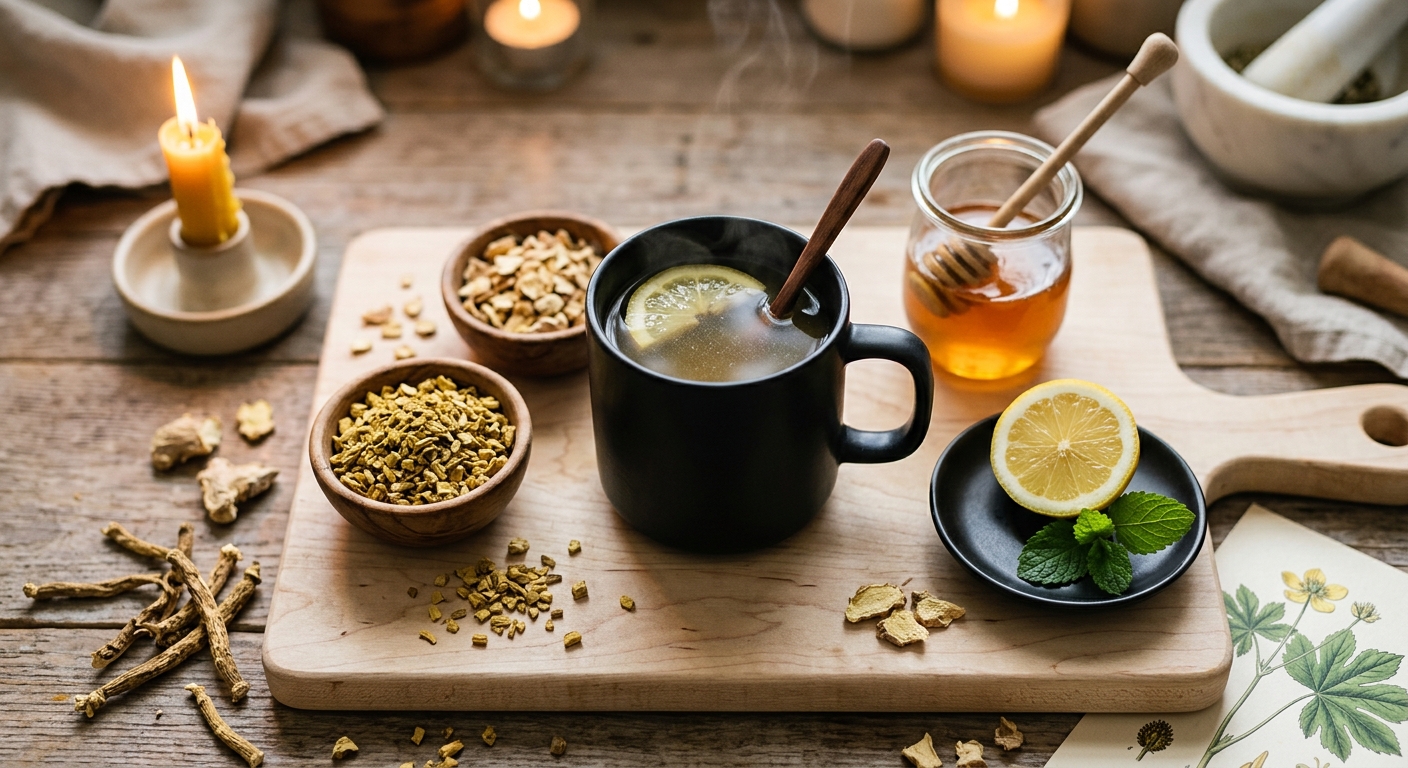
- 1 tspdried goldenseal root or rhizome, finely chopped or ground
- 480 mlwater (90°C / 194°F)
- —raw honey to taste (helps temper bitterness)
- —fresh lemon slice (optional, brightens the flavor)
- —1/4 tsp dried ginger root (optional, warming complement)
How to Brew
Click on an item below to shop for the recommended items for this recipe on Amazon.
As an Amazon Associate, we earn from qualifying purchases.
- Measure 1 teaspoon of dried, finely chopped or ground goldenseal root per 240 ml of water. For two servings, use 2 teaspoons in 480 ml of water.
- Bring filtered water to 90 to 95°C (194 to 203°F). Avoid a rolling boil, which can degrade some of the more volatile aromatic compounds. An electric kettle with a temperature setting works best.
- Place the goldenseal root in a fine mesh stainless steel infuser or a small muslin bag inside your mug or teapot. Pour the hot water directly over the root to ensure even extraction.
- Cover the mug or teapot with a lid or small plate to trap the steam and volatile compounds. Steep for 10 to 15 minutes. The longer end of the range produces a stronger, more medicinally active brew.
- Remove the infuser and press gently to extract any remaining liquid from the root material. The tea will be a vivid golden to amber color.
- Add raw honey and a squeeze of fresh lemon to taste. Drink slowly while warm, ideally on an empty stomach or between meals for best absorption of the alkaloids.
- Measure 2 teaspoons of dried goldenseal root per 480 ml of cold, filtered water. The higher ratio compensates for the less aggressive extraction at low temperatures.
- Combine the goldenseal root and cold water in a clean glass jar with a tight-fitting lid. Stir once to ensure all root material is submerged.
- Allow the jar to sit at room temperature for 1 to 2 hours, then transfer to the refrigerator. Let it steep for a total of 12 to 16 hours, or overnight.
- The following morning, strain the tea through a fine mesh strainer lined with cheesecloth to catch all fine root particles. The resulting liquid will be a translucent golden yellow, noticeably clearer and milder than the hot-brewed version.
- Pour over a glass of ice or enjoy straight from the refrigerator. Stir in a small amount of raw honey if desired. Consume within 48 hours and keep refrigerated.
- Place 1 tablespoon of dried, roughly chopped goldenseal root into a small stainless steel or enamel saucepan. Do not use aluminum cookware, as the alkaloids may react with the metal.
- Add 600 ml of cold filtered water to the saucepan. Starting with cold water and bringing it up to temperature slowly allows for a more thorough and even extraction of the root’s active compounds.
- Bring the water to a gentle simmer over medium-low heat, approximately 85 to 90°C (185 to 194°F). Do not allow it to reach a vigorous, rolling boil. Adjust the heat as needed to maintain a gentle, steady simmer.
- Simmer uncovered for 20 to 25 minutes. The liquid will reduce somewhat and deepen to a rich, dark amber color. Stir occasionally to prevent any root material from settling and scorching on the bottom.
- Remove from heat and allow to cool for 5 minutes. Strain through a fine mesh strainer lined with cheesecloth into a heatproof mug or jar, pressing the root firmly to extract every drop of liquid.
- Yield will be approximately 400 ml after reduction. This strong decoction can be divided into two servings of about 200 ml each. Add raw honey, a slice of ginger, or a small amount of licorice root to moderate the intense bitterness. Drink one serving in the morning and one in the evening, and do not exceed this amount.
Health Benefits
Berberine has been shown in multiple in vitro and animal studies to stimulate macrophage activity and increase the production of tumor necrosis factor-alpha, enhancing the body’s early immune response. Traditional Eclectic practitioners used goldenseal specifically at the onset of colds and upper respiratory infections, a use that aligns closely with berberine’s demonstrated immunomodulatory mechanisms.
Both berberine and hydrastine have demonstrated activity against common pathogens including Staphylococcus aureus, Streptococcus pyogenes, and Candida albicans in laboratory settings. Because tea delivers these compounds directly to the mucosal surfaces of the throat and upper digestive tract, goldenseal tea is particularly suited to addressing localized infections and inflammation in these areas.
Goldenseal has a long history in both Native American and Eclectic herbalism as a remedy for gastritis, diarrhea, and intestinal infections. Berberine’s ability to inhibit the adhesion of pathogens like H. pylori to gut epithelium, combined with hydrastine’s astringent effect on irritated mucosal tissue, makes this herb a well-rounded digestive anti-inflammatory.
Hydrastine’s vasoconstrictive and astringent properties help tone swollen, inflamed mucous membranes in the sinuses and nasal passages, reducing secretion and relieving congestion. This is likely the mechanism behind goldenseal’s widespread traditional use as a nasal wash and decongestant herb.
The combined presence of berberine, canadine, and chlorogenic acid gives goldenseal a layered antioxidant profile. Berberine in particular has been shown to inhibit NF-kB signaling, one of the central pathways through which chronic inflammation is perpetuated, offering systemic anti-inflammatory benefit beyond its direct antimicrobial activity.
🧪 Key Bioactive Compounds
The Science Behind Goldenseal
The central bioactive compound in goldenseal is berberine, an isoquinoline alkaloid that has been the subject of hundreds of peer-reviewed studies over the past three decades. Berberine exerts its antimicrobial effects through several mechanisms: it intercalates into bacterial DNA, disrupts cell membrane integrity, and inhibits the synthesis of bacterial proteins. Crucially, it also blocks the efflux pumps that many drug-resistant bacteria use to expel antibiotics, which has led researchers to investigate berberine as a potential adjunct to conventional antibiotic therapy. In immune cells, berberine stimulates the activity of macrophages and natural killer cells while simultaneously downregulating the production of pro-inflammatory cytokines via inhibition of the NF-kB pathway, giving it a dual role as both an immune stimulant and an inflammation modulator.
Hydrastine, the second major alkaloid in goldenseal, contributes pharmacological effects that complement berberine’s action in a clinically meaningful way. As an astringent, hydrastine causes the contraction of inflamed mucosal tissue, reducing the weeping and hypersecretion associated with sinusitis, rhinitis, and gastritis. Its mild vasoconstrictive properties help reduce local blood flow to inflamed tissues, which is why goldenseal has historically been applied topically as well as consumed internally. Canadine, also known as tetrahydroberberine, adds a mild antispasmodic effect and has been studied for its dopaminergic and serotonergic activity, suggesting a broader range of neurological interactions that remain an active area of research.
An important consideration when brewing goldenseal tea is the aqueous solubility of its alkaloids. Berberine is moderately water-soluble and extracts well in hot water over a prolonged steep, which is why a 10-to-15-minute infusion or a 20-to-25-minute decoction is recommended over a quick steep. Cold water extracts berberine more slowly but does so effectively over 12 to 16 hours, yielding a preparation with a gentler flavor but a comparable alkaloid profile. The addition of a mildly acidic ingredient such as lemon juice can slightly increase alkaloid solubility and bioavailability, providing a practical as well as flavor-based reason to add citrus to your cup. Tannins in the plant material may also bind to some alkaloids during brewing, which is one reason why drinking goldenseal tea on an empty stomach is traditionally recommended to maximize absorption through the gut wall.
Brewing Tips
- Source only certified organically cultivated goldenseal, never wildcrafted, to protect the endangered wild population and ensure you are getting a product free from heavy metal contamination from forest soils.
- If the bitterness is truly unpalatable, try blending 1 part goldenseal with 2 parts peppermint or licorice root before brewing: licorice in particular contains glycyrrhizin, which is intensely sweet and effectively masks the harsh alkaloid bitterness without reducing medicinal potency.
- Store dried goldenseal root in an airtight amber glass container away from light and heat. Berberine degrades with prolonged exposure to UV light, and improperly stored root can lose potency significantly within a few months.