The journey through breastfeeding is deeply personal, and so is the decision to wean. Whether you are ready to stop nursing after months or years, the physical process of reducing milk supply can be uncomfortable, sometimes leading to engorgement, tenderness, and emotional shifts. For generations, herbalists and midwives across Europe, the Middle East, and Asia have turned to specific plants known as antigalactagogues, herbs that gently reduce prolactin activity and signal the body to slow milk production. Weaning tea draws on this long tradition, combining the most trusted herbs in a single warming cup.
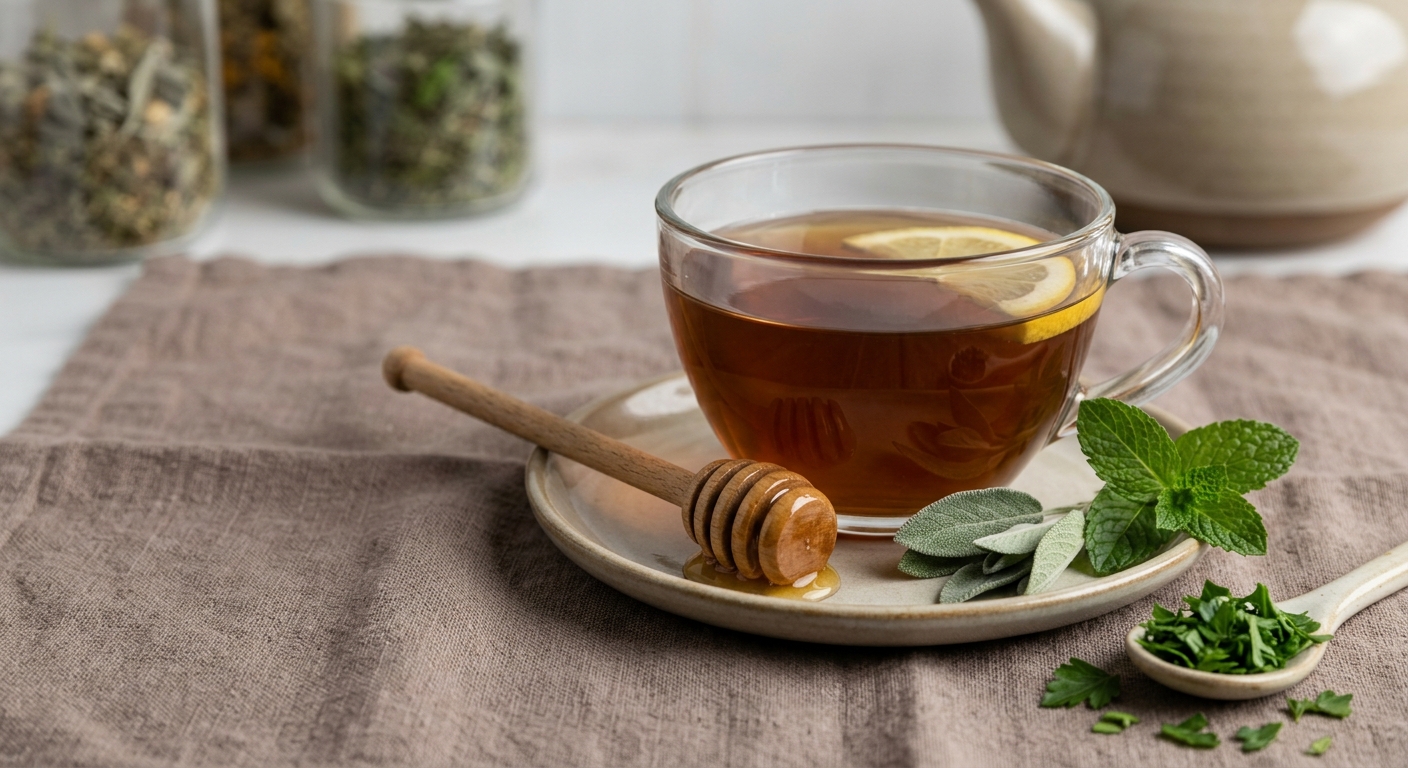
The three pillars of a classic weaning tea are sage, peppermint, and parsley. Sage (Salvia officinalis) has been prescribed by European herbalists since at least the 16th century specifically to dry up milk after weaning, a use documented in John Gerard’s 1597 Herball. Peppermint contains menthol, which has long been applied topically to reduce milk supply, and when consumed as a strong tea it provides a complementary internal effect. Parsley (Petroselinum crispum) is rich in apiol and myristicin, compounds believed to lower prolactin levels. Together these three herbs create a blend that is greater than the sum of its parts.
Beyond the functional purpose, weaning tea offers something equally important: a ritual of self-care during a transition that can stir a complex mix of relief, grief, and pride. The act of preparing and sipping a warm, aromatic cup gives you a moment to honor what your body has done and to gently invite the next chapter. The flavor is bright and herbaceous, with the earthy warmth of sage balanced by the cooling lift of peppermint and the faintly green, almost grassy note of parsley. It is a purposeful tea, brewed with intention.
2
cups
Ingredients
- 2 tspdried sage leaves (Salvia officinalis)
- 1 tspdried peppermint leaves
- 1 tspfresh flat-leaf parsley, finely chopped (or 0.5 tsp dried)
- 480 mlwater (95°C / 203°F)
- —a thin slice of lemon (optional, to brighten flavor)
- —raw honey to taste (optional, use sparingly)
How to Brew
Click on an item below to shop for the recommended items for this recipe on Amazon.
As an Amazon Associate, we earn from qualifying purchases.
- Bring filtered water to 95°C (203°F), just below a rolling boil. If using an electric kettle without temperature control, bring to a full boil then let it rest for 30 seconds.
- Add the dried sage, peppermint, and parsley to a tea infuser or directly into a small teapot. For two servings, use 2 teaspoons sage, 1 teaspoon peppermint, and 1 teaspoon fresh parsley (or 0.5 teaspoon dried).
- Pour the hot water over the herbs and immediately place a lid or small saucer over the cup or teapot. This traps the volatile oils, particularly the menthol and thujone, that would otherwise escape as steam.
- Steep for 10 to 15 minutes. The longer end of this range produces a stronger, more medicinally concentrated cup. Start with 10 minutes if this is your first time.
- Strain the herbs thoroughly using a fine mesh strainer. Press the herbs gently with the back of a spoon to extract the last of the infusion.
- Add a slice of lemon if desired to cut the earthiness of the sage. Sip slowly while warm, up to 2 to 3 cups per day during the weaning process.
- Prepare a clean glass jar. Combine 3 teaspoons dried sage, 1.5 teaspoons dried peppermint, and 1.5 teaspoons fresh chopped parsley (or 0.75 teaspoon dried) per 480 ml of cold, filtered water. The ratio is slightly higher than the hot brew to compensate for the slower cold extraction.
- Add the herbs directly to the jar or use a large loose-leaf cold brew infuser bag. Pour cold, filtered water over the herbs, ensuring all plant material is fully submerged. Stir gently to combine.
- Seal the jar with a lid and leave at room temperature for the first 30 minutes to allow the volatile oils to begin releasing, then transfer to the refrigerator.
- Cold brew for 8 to 12 hours. Overnight is ideal. Do not exceed 14 hours as the parsley can take on an overly bitter note.
- Strain through a fine mesh strainer or cheesecloth into a clean pitcher or bottle. Press the spent herbs to extract as much liquid as possible.
- Serve over ice or chilled. The cold brew keeps in the refrigerator for up to 48 hours. Drink 1 to 2 servings per day. Add a squeeze of lemon or a few cucumber slices for a more refreshing taste profile.
- Combine 3 tablespoons dried sage, 1.5 tablespoons dried peppermint, and 1.5 tablespoons fresh parsley (or 2 teaspoons dried) with 480 ml of cold filtered water in a small saucepan. This higher ratio produces a concentrated extract.
- Bring the water to a gentle rolling boil over medium heat, then immediately reduce to a low simmer. Simmer uncovered for 20 minutes, allowing the water to reduce by roughly one quarter. The liquid will deepen to a rich, dark olive-green.
- Remove the saucepan from heat. Place a lid on the pan and allow the herbs to steep for an additional 10 minutes off the heat. This second stage draws out delicate volatile compounds that the simmering phase may have driven off.
- Strain the concentrate through a fine mesh strainer lined with cheesecloth into a clean glass jar or bottle. Press the herbs firmly to extract every drop. You should have approximately 300 to 360 ml of concentrate.
- Allow the concentrate to cool completely before sealing and refrigerating. It will keep safely for up to 5 days in the refrigerator.
- To serve, dilute one part concentrate with one to two parts hot or cold water depending on your preference. A standard serving is approximately 60 to 80 ml of concentrate diluted into 180 ml of water. Drink 1 to 2 servings per day during active weaning.
Health Benefits
Sage contains thujone and other volatile compounds that appear to reduce prolactin activity, the hormone responsible for milk production. Traditional use across European midwifery dating back centuries is supported by modern herbalists and preliminary clinical observations, though large-scale randomized trials remain limited.
The anti-inflammatory compounds in sage and peppermint, particularly rosmarinic acid and ursolic acid, may help reduce breast tissue inflammation and tenderness. Applying cooled peppermint tea compresses alongside drinking the blend can provide additional topical relief.
Parsley’s apiol content has long been associated with influence over reproductive hormones, potentially aiding the body’s transition as prolactin decreases and estrogen begins to normalize. This hormonal shift can also stabilize mood during what is often an emotionally complex transition.
During weaning, the risk of blocked ducts and mastitis increases. The combination of rosmarinic acid, 1,8-cineole, and ursolic acid across the three herbs in this blend provides meaningful antioxidant and antimicrobial support, helping to protect breast tissue during the transition.
While not a pharmacological benefit in the traditional sense, the ritual of preparing and sipping a purposeful herbal tea is well-supported by mind-body research as a way to reduce stress, mark transitions, and invoke a sense of self-care. Weaning is emotionally significant for many mothers, and a daily tea ritual provides a grounding anchor during this shift.
🧪 Key Bioactive Compounds
The Science Behind Sage
The science behind weaning tea centers primarily on its effects on prolactin, the pituitary hormone that drives breast milk production. Sage (Salvia officinalis) contains thujone, a monoterpene ketone and volatile oil constituent that animal studies and traditional pharmacological reviews suggest may inhibit prolactin secretion from the anterior pituitary gland. While peer-reviewed clinical trials on sage as a galactofuge (milk-reducing agent) in humans remain sparse, the compound’s interaction with hormone pathways is consistent with centuries of empirical midwifery practice. Sage also contains rosmarinic acid and ursolic acid, both of which exhibit meaningful anti-inflammatory and antioxidant activity, providing a secondary layer of support for breast tissue under the stress of engorgement.
Peppermint’s contribution is primarily through menthol, its dominant volatile compound. A notable 1997 study published in the Journal of Human Lactation examined topical peppermint application for nipple soreness, but folk traditions and herbalists have long documented internal consumption of strong peppermint tea as contributing to supply reduction. The proposed mechanism involves menthol’s interaction with hormone-sensitive tissue receptors, though the precise pathway is not yet fully elucidated. What is well established is menthol’s potent anti-inflammatory and analgesic activity, explaining the symptomatic relief many weaning mothers report when drinking this blend regularly.
Parsley brings apiol and myristicin to the formula, two phenylpropanoid compounds with a documented history in reproductive herbalism. Apiol has been studied for its emmenagogue properties, which reflect its ability to influence hormonal pathways in reproductive tissue. In the context of lactation, this is theorized to translate into a modest prolactin-suppressing effect when parsley is consumed in medicinal quantities, far beyond what you would eat in a salad. The synergy of these three botanicals creates a multi-pathway approach to lactation suppression: thujone targeting pituitary output, menthol acting on tissue receptors, and apiol influencing broader hormonal signaling. This complementary action is why traditional herbalists have used exactly this combination for centuries rather than any single herb alone.
Brewing Tips
- Begin drinking weaning tea gradually, starting with one cup per day, and observe how your body responds before increasing to two or three cups. Suppressing milk too quickly can increase the risk of blocked ducts or mastitis, so a gentle, consistent approach is far preferable to aggressive overuse.
- Freshly chopped flat-leaf parsley is noticeably more effective than dried parsley in this blend. If you have fresh parsley available, use a generous tablespoon finely chopped per serving and add it directly to the infuser alongside the dried sage and peppermint.
- If you experience significant breast engorgement during weaning regardless of the tea, apply a cooled compress made from the strained spent herbs wrapped in a clean muslin cloth directly to the breast for 10 to 15 minutes. The residual menthol and anti-inflammatory compounds offer meaningful topical relief.