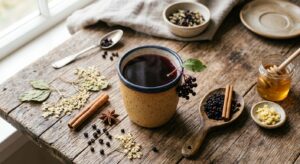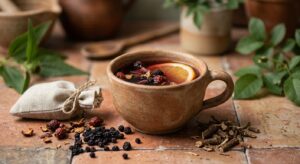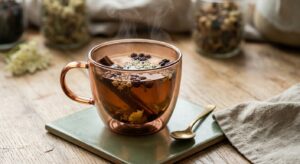
Every September, classrooms become petri dishes. Backpacks come home carrying more than homework, and within weeks, the familiar cycle of sniffles, sore throats, and sick days begins. For generations, herbalists have reached for the same three allies when the school year starts: elderberry for its potent antiviral flavonoids, echinacea for its immune-stimulating polysaccharides, and ginger for its fiery anti-inflammatory warmth. Together, they form one of the most time-honored and research-supported immune blends in plant medicine.
Elderberry, or Sambucus nigra, has been used in European folk medicine since at least the Middle Ages, when Hippocrates called the elder tree his “medicine chest.” Echinacea was the most widely used medicinal plant among the Indigenous peoples of the Great Plains, employed for everything from toothaches to rattlesnake bites, and later adopted by Eclectic physicians in 19th-century America as a cornerstone cold remedy. Ginger, with roots in Ayurvedic and Traditional Chinese Medicine spanning over 5,000 years, rounds out the blend with digestive support and a natural warming effect that encourages circulation and sweating to help the body clear pathogens.
This tea is earthy, pleasantly tart, and spiced with just enough ginger heat to feel medicinal without being harsh. A drizzle of raw honey softens the bite and adds its own antimicrobial properties to the cup. Whether you brew it hot on a chilly morning before the school run, or cold-brew a pitcher to keep in the fridge for after-school sipping, this blend is a genuinely practical tool for keeping your household healthier through the season ahead.
2
cups
Ingredients
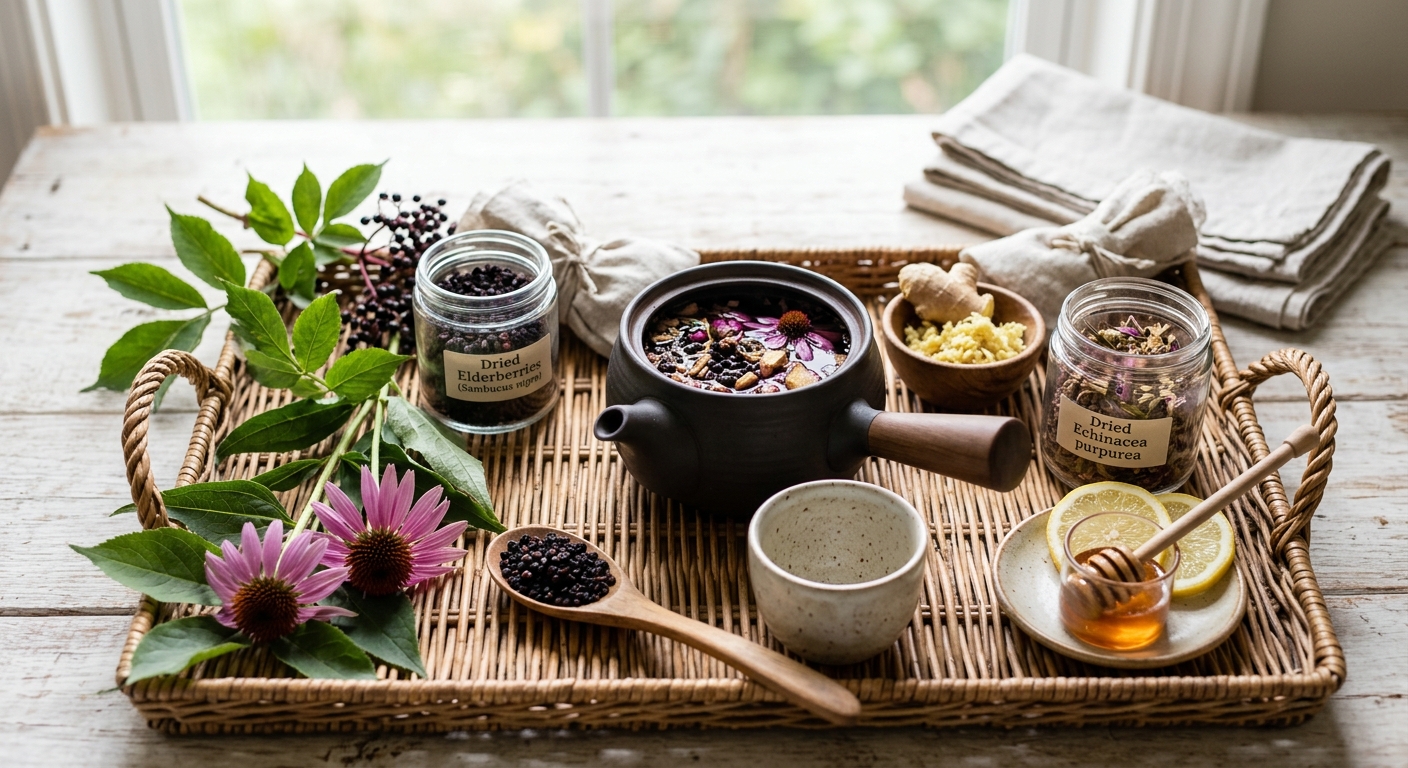
- 2 tbspdried elderberries (Sambucus nigra)
- 1 tbspdried echinacea root or purpurea herb
- 1 tspfreshly grated or dried ginger root
- 500 mlwater (filtered, for hot brew)
- 1 tspraw honey per cup (optional)
- —lemon slice to serve (optional)
How to Brew
Click on an item below to shop for the recommended items for this recipe on Amazon.
As an Amazon Associate, we earn from qualifying purchases.
- Add the dried elderberries and echinacea root to a small saucepan with 500ml of cold filtered water. Do not add the ginger yet.
- Bring the water to a full rolling boil over medium-high heat, then immediately reduce the heat to a gentle simmer.
- Add the grated or dried ginger root. Cover the saucepan with a lid to trap volatile aromatic compounds and simmer for 15 to 20 minutes. The liquid will darken to a deep purple-burgundy color.
- Remove from heat and allow the decoction to rest, still covered, for 5 minutes. This resting period lets the temperature drop slightly and allows further passive extraction.
- Strain through a fine-mesh sieve or cheesecloth into two mugs, pressing the spent herbs gently with a spoon to extract all remaining liquid.
- Stir in raw honey once the tea has cooled slightly below 60°C (140°F) to preserve honey’s active enzymes. Serve with a lemon slice if desired.
- Lightly crush the dried elderberries using the back of a spoon or a mortar and pestle to break the skin and help release anthocyanins into the cold water more efficiently.
- Combine the crushed elderberries, echinacea herb (preferably the aerial parts or dried flowers rather than root for cold brew), and sliced fresh ginger in a glass jar or pitcher.
- Pour 600ml of cold filtered water over the herbs. The higher water volume compared to hot brew compensates for the slightly lower extraction efficiency of cold water.
- Stir gently, cover the jar with a lid or cloth, and leave at room temperature for 2 hours, then transfer to the refrigerator.
- Allow to cold brew overnight, or for a minimum of 10 hours. The brew will turn a beautiful translucent deep violet.
- Strain through a fine-mesh sieve into glasses filled with ice. Sweeten with a small amount of honey stirred in until dissolved, or use a honey simple syrup for easier mixing. Consume within 3 days.
- Combine 4 tablespoons of dried elderberries, 2 tablespoons of echinacea root, 2 teaspoons of ginger, and 1 litre of cold filtered water in a medium saucepan. You may also add a cinnamon stick and 3 whole cloves for additional antimicrobial depth and flavor.
- Bring to a full boil over medium-high heat, then reduce to a steady active simmer, leaving the lid slightly ajar to allow steam to escape. This is intentional: you are reducing the liquid volume by roughly half.
- Simmer for 30 to 45 minutes, stirring occasionally and monitoring the liquid level. When the volume has reduced to approximately 500ml, remove from heat.
- Cool to room temperature (around 40°C / 104°F), then strain through a fine-mesh sieve or cheesecloth into a clean glass jar, pressing the spent herbs firmly to extract maximum liquid.
- Stir in 3 to 4 tablespoons of raw honey while the concentrate is still warm (but not hot) to help preserve and sweeten the batch. Optionally add a splash of brandy (1 to 2 tablespoons) as a traditional preservative for an adult version.
- Seal the jar and store in the refrigerator. To serve, add 60 to 80ml of concentrate to a mug and top with 180 to 200ml of hot water, or pour over ice and dilute with cold water.
Health Benefits
A 2016 randomized controlled trial published in Nutrients found that elderberry supplementation reduced the duration of colds in air travelers by an average of two days. Separate meta-analyses of echinacea trials have found consistent, if modest, reductions in cold duration and severity when taken at first sign of symptoms.
Echinacea’s alkylamides and polysaccharides activate macrophages and natural killer (NK) cells, the first-responder cells of the innate immune system that identify and destroy infected cells before adaptive immunity is fully engaged. This is particularly valuable during the early days of a respiratory infection.
Elderberry’s anthocyanins, particularly cyanidin-3-glucoside and cyanidin-3-sambubioside, have been shown in multiple studies to prevent viral particles from entering and replicating within host cells by blocking the viral attachment proteins used by influenza and other enveloped viruses.
Ginger’s gingerols and shogaols inhibit COX-2 and 5-LOX enzymes, reducing the production of inflammatory prostaglandins and leukotrienes responsible for the swelling, congestion, and sore throat discomfort associated with upper respiratory infections.
The combined anthocyanins of elderberry, quercetin, and caffeic acid derivatives from echinacea deliver a significant antioxidant load that helps neutralize reactive oxygen species generated during immune activation, protecting healthy cells from collateral inflammatory damage.
🧪 Key Bioactive Compounds
The Science Behind Elderberry
The immunological activity of this three-herb blend operates through complementary and partially overlapping mechanisms, which is precisely why the combination is more effective than any single ingredient alone. Elderberry’s anthocyanins, primarily cyanidin-3-glucoside and cyanidin-3-sambubioside, work at the point of viral entry. These compounds physically bind to and deform the hemagglutinin surface proteins that influenza viruses use to attach to respiratory epithelial cells, essentially cloaking the cell surface from viral recognition. A landmark 2009 in vitro study by Roschek et al. published in Phytochemistry confirmed this mechanism and identified the specific flavonoids responsible. Separately, elderberry extracts have been shown to stimulate the production of cytokines including interleukin-6 (IL-6), interleukin-8 (IL-8), and tumor necrosis factor-alpha (TNF-alpha) at low concentrations, enhancing the signaling that coordinates an effective immune response.
Echinacea contributes a distinct and complementary layer of immunomodulation. Its lipophilic alkylamides interact with cannabinoid receptor type 2 (CB2), which is expressed on immune cells throughout the body. This interaction does not produce any psychoactive effect, but it does modulate the activity of macrophages, dendritic cells, and natural killer cells. A 2015 systematic review and meta-analysis in Evidence-Based Complementary and Alternative Medicine, analyzing 24 randomized controlled trials, found that echinacea preparations reduced the odds of developing a cold by 35% and reduced the duration of colds by 1.4 days. The hydrophilic polysaccharide fractions of echinacea, including arabinogalactans, further stimulate interferon production, a class of signaling proteins that trigger antiviral defense states in nearby uninfected cells.
Ginger’s contribution is primarily anti-inflammatory and symptom-modifying. The gingerols and their heat-converted counterparts, the shogaols, inhibit cyclooxygenase-2 (COX-2) and 5-lipoxygenase (5-LOX), two key enzymes in the arachidonic acid cascade that produces the prostaglandins and leukotrienes responsible for fever, pain, and mucous membrane swelling. A 2013 study in the Journal of Ethnopharmacology demonstrated that fresh ginger extract significantly inhibited the attachment of human respiratory syncytial virus (RSV) to respiratory cells, suggesting a direct antiviral action in addition to its anti-inflammatory effects. The combination of these three herbs creates a blend that addresses immunity from three angles: blocking viral entry, activating immune surveillance cells, and reducing the inflammatory tissue damage that causes the worst cold symptoms.
Brewing Tips
- Use dried elderberries specifically labeled as Sambucus nigra for culinary or medicinal use, and never use raw or fresh elderberries straight from the garden, as unprocessed berries contain cyanogenic compounds that can cause nausea.
- For echinacea, the root form (E. angustifolia or E. purpurea root) is best suited to the decoction and concentrate methods, while the dried aerial parts and flowers of E. purpurea work better in the cold brew, as their more delicate alkylamides extract efficiently in cold water without the astringency that root decoction can produce.
- Start drinking this tea at the very first sign of a cold, scratchy throat, or exposure, rather than waiting until symptoms are fully established. Both elderberry and echinacea show the greatest clinical benefit when taken proactively or at the very earliest onset of infection.
- For school-age children (ages 4 and up), dilute the finished tea to half strength by adding extra hot water or ice, and sweeten generously with honey to make it more palatable. Always consult a pediatrician before introducing medicinal herbal teas to young children.