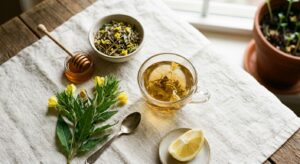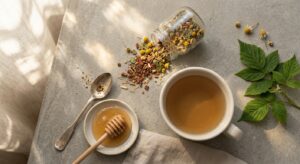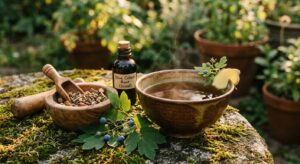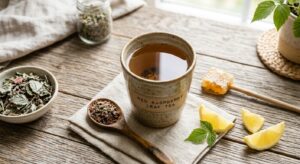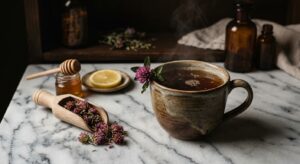
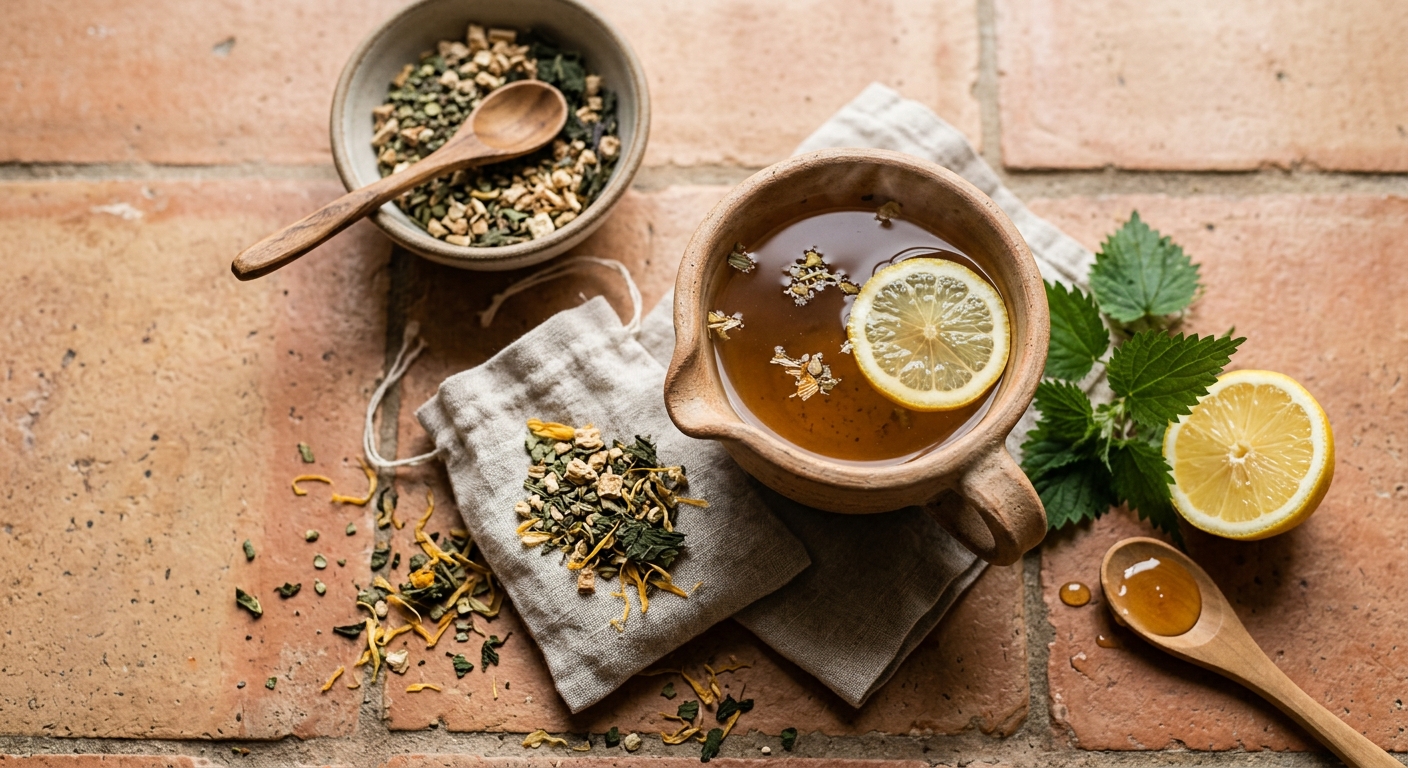
Kidney stones affect roughly one in ten people over a lifetime, and women are increasingly joining men in this painful statistic. While diet, hydration, and genetics all play a role, herbal traditions from South America, Asia, and Europe have long turned to specific plants to support the kidneys, encourage healthy urine flow, and discourage the mineral buildup that leads to stone formation. This tea draws on that deep well of botanical wisdom, combining three powerfully complementary herbs into a single, purposeful cup.
Chanca piedra, whose name translates literally from Spanish as “stone breaker,” has been used for centuries in Ayurvedic and Amazonian folk medicine as a primary remedy for kidney and gallbladder stones. Hydrangea root, a staple in Native American herbalism and later popularized by Eclectic physicians in 19th-century America, was prized for its ability to soothe irritated kidney tissue and support the passage of gravel. Nettle leaf rounds out the blend as a gentle diuretic and mineral-rich tonic that promotes steady urinary flow without irritating the tract lining. Together, these three herbs create a synergistic formula that addresses kidney stone prevention from multiple angles.
What makes this blend genuinely useful is consistency. Kidney stone prevention is not a one-cup fix but a daily practice of hydration and targeted herbal support. Brewed as a warm morning ritual or a refreshing cold infusion on summer afternoons, this tea makes staying hydrated both purposeful and pleasurable. Its flavor is earthy and gently grassy with a subtle bitterness from the chanca piedra, softened nicely by the mineral warmth of nettle. A little lemon juice added before drinking not only brightens the flavor but contributes citric acid, one of the most well-documented dietary factors in calcium oxalate stone prevention.
2
cups
Ingredients
- 1 tspdried chanca piedra (Phyllanthus niruri) herb
- 1 tspdried hydrangea root (Hydrangea arborescens), coarsely ground
- 1 tspdried nettle leaf (Urtica dioica)
- 480 mlwater (100°C / 212°F for decoction base)
- 1 tspfresh lemon juice
- —raw honey or a few drops of liquid stevia to taste (optional)
How to Brew
Click on an item below to shop for the recommended items for this recipe on Amazon.
As an Amazon Associate, we earn from qualifying purchases.
- Add the coarsely ground hydrangea root to a small saucepan with 480 ml of cold water. Bring to a full boil, then reduce heat to a gentle simmer and hold for 10 minutes. This decoction process draws out the deep-acting compounds from the woody root tissue.
- Remove the saucepan from heat and allow the decoction to cool for 2 to 3 minutes until it drops to approximately 90°C (194°F). This protects the more volatile and heat-sensitive compounds in the chanca piedra and nettle.
- Add the dried chanca piedra and dried nettle leaf directly to the saucepan or transfer to a pre-warmed teapot with an infuser. Cover immediately to trap aromatic compounds and steep for an additional 8 to 10 minutes.
- Strain the tea through a fine-mesh strainer into two mugs, pressing the herbs gently to release remaining liquid. Stir in fresh lemon juice and sweeten lightly if desired. Drink while warm, ideally in the morning alongside a full glass of additional water.
- Combine the dried chanca piedra and dried nettle leaf in a clean glass jar. Because hydrangea root requires heat to extract its active compounds efficiently, skip or lightly pre-simmer the root: bring the hydrangea root and 480 ml of water to a boil for 5 minutes, then let the liquid cool completely to room temperature before proceeding.
- Pour the cooled hydrangea decoction over the chanca piedra and nettle in the glass jar. If skipping the decoction step, simply use 480 ml of room-temperature filtered water and understand the root extraction will be lighter.
- Seal the jar and leave it on the counter for 1 hour to begin the extraction at room temperature, then transfer to the refrigerator. Steep for 10 to 12 hours or overnight.
- The following morning, strain the cold brew through a fine-mesh strainer into a bottle or pitcher. Stir in fresh lemon juice. Sip throughout the day in 120 to 180 ml portions rather than all at once to maximize continuous urinary support. Store in the refrigerator and consume within 48 hours.
- Combine 3 tsp dried chanca piedra, 3 tsp coarsely ground hydrangea root, and 3 tsp dried nettle leaf in a medium saucepan. Add 720 ml of cold filtered water. Soaking the herbs in the cold water for 20 minutes before applying heat helps release initial water-soluble compounds and improves extraction efficiency.
- Place the saucepan over medium-high heat and bring to a boil, stirring once. As soon as a full boil is reached, reduce heat to the lowest simmer possible. Cover with a tight-fitting lid and simmer for 25 to 30 minutes. Check occasionally and add a small splash of water if the liquid reduces below roughly 500 ml.
- Remove from heat and allow to rest, still covered, for 10 minutes. Strain through a fine-mesh strainer lined with cheesecloth into a clean glass jar, pressing the spent herbs firmly to extract every drop of the concentrate.
- Allow the concentrate to cool fully before sealing the jar. Store in the refrigerator. To serve, combine approximately 60 to 80 ml of concentrate with 180 ml of hot or cold water and the juice of half a lemon. This yields approximately 6 to 8 servings from a single weekly batch, supporting consistent daily use.
Health Benefits
Phyllanthin and other lignans in chanca piedra have been shown in clinical trials to reduce the aggregation of calcium oxalate crystals, the most common component of kidney stones, by interfering with the surface chemistry that allows crystals to bind together and grow.
Both nettle leaf and chanca piedra exert gentle diuretic effects by improving glomerular filtration rates and reducing tubular reabsorption of water. Greater urine volume dilutes stone-forming minerals and reduces the likelihood of supersaturation in the renal pelvis.
Geraniin, an ellagitannin in chanca piedra, has demonstrated smooth muscle relaxant properties on the ureter in animal studies, which may help smaller stones and gravel pass with less pain and resistance. This is consistent with the herb’s centuries-long traditional use as a literal stone-breaker.
Quercetin and scopoletin provide meaningful anti-inflammatory action in kidney and urinary tract tissue. Chronic low-grade inflammation in the nephrons is increasingly associated with stone recurrence, and these compounds may help interrupt that cycle.
When prepared with fresh lemon juice as directed, this tea delivers a useful dose of citric acid, which raises urinary citrate levels. Citrate is a natural inhibitor of calcium stone formation and is a cornerstone of conventional dietary advice for stone prevention, particularly in women who tend toward lower citrate excretion.
🧪 Key Bioactive Compounds
The Science Behind Chanca Piedra
The scientific interest in chanca piedra (Phyllanthus niruri) has grown considerably over the past two decades, driven in part by a landmark 1999 clinical study published in the Journal of Urology that found the herb significantly reduced urinary calcium and oxalate levels in patients with calcium oxalate stones. The primary mechanism appears to involve the lignan phyllanthin and its ability to interfere with the nucleation and aggregation phases of crystal formation. In simpler terms, these compounds make it harder for tiny mineral particles to clump together into larger, problematic stones. Subsequent in vitro studies have confirmed that aqueous extracts of Phyllanthus niruri decrease the size and number of calcium oxalate crystals grown under laboratory conditions that mimic human urine composition.
Nettle leaf (Urtica dioica) contributes to this formula through a different but complementary mechanism. Its flavonoids, particularly quercetin and hyperoside, exert anti-inflammatory effects on the renal tubule cells and reduce oxidative stress in the kidney environment. Because oxidative damage to tubule cells is now recognized as an important early step in the adhesion of calcium oxalate crystals to the kidney wall, antioxidant-rich herbs like nettle may help prevent the cellular conditions that allow stones to take hold. Nettle is also a reliable gentle diuretic, with studies confirming increased urine output following regular consumption, which is arguably the single most important dietary strategy in stone prevention.
Hydrangea root (Hydrangea arborescens) is perhaps the least studied of the three herbs in modern literature, yet its historical use is compelling and the few phytochemical analyses available suggest real pharmacological activity. Scopoletin, a coumarin identified in the root, has demonstrated anti-inflammatory and antispasmodic effects in research models. The alkaloid fraction of the root, long credited by 19th-century Eclectic physicians for its soothing effect on what they called “renal gravel,” warrants further clinical investigation. When these three herbs are combined with the citrate provided by lemon juice, the result is a multi-mechanism approach that addresses crystal formation, inflammation, urine volume, and mineral chemistry simultaneously, reflecting a sophisticated herbal strategy that holds genuine promise as a complementary preventive tool.
Brewing Tips
- Always use filtered or low-mineral water when brewing this tea. Hard tap water with high calcium or magnesium content can contribute to the very mineral load you are trying to reduce, and it also affects the extraction of delicate compounds from the herbs.
- Grind hydrangea root only to a coarse consistency rather than a fine powder. Fine powder produces a cloudy, difficult-to-strain brew and can introduce too much tannin bitterness. A rough grind opens the root enough for efficient extraction while keeping the liquid clear and palatable.
- Track your fluid intake on days you drink this tea. The goal of kidney stone prevention through herbal support is most effective when total daily fluid intake keeps urine a pale straw color. Use this tea as one portion of your hydration plan, not your only source of fluids for the day.