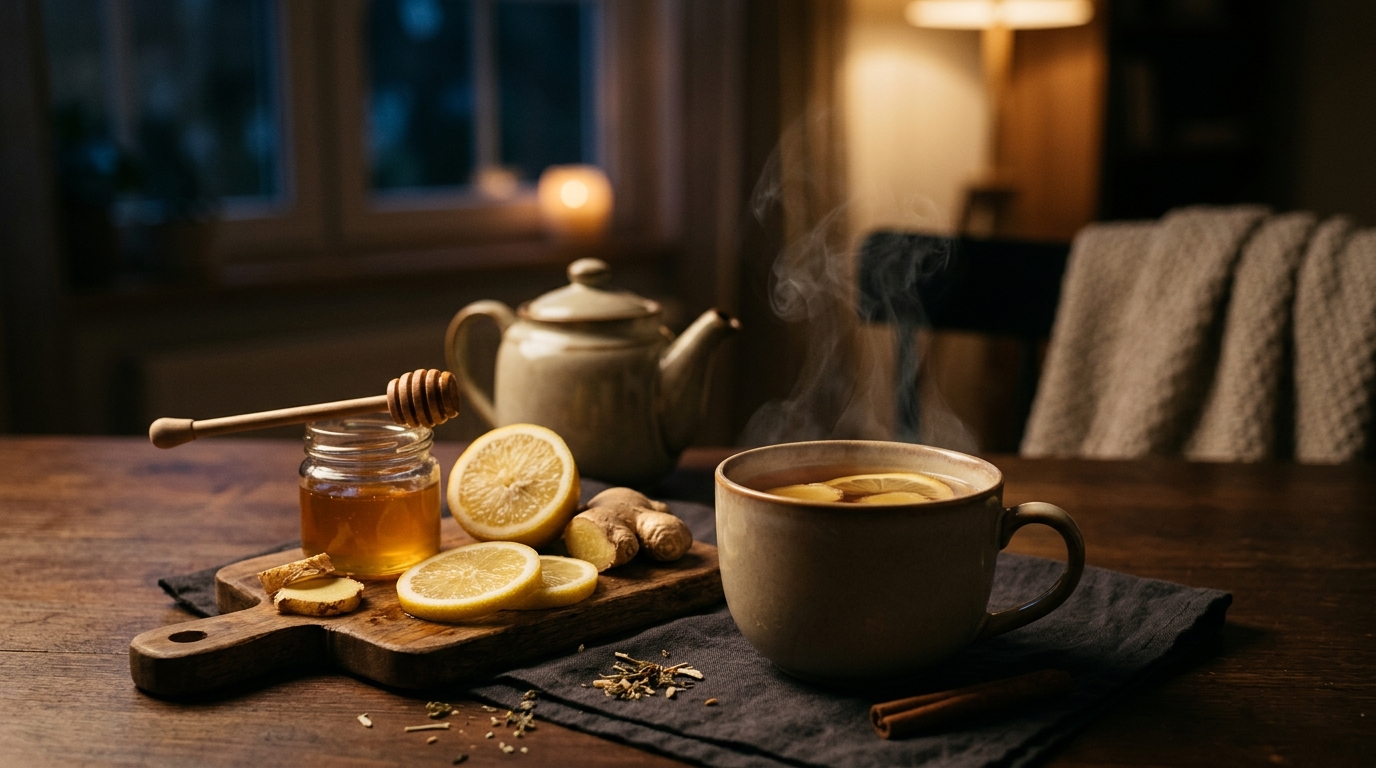
Few remedies cross as many kitchens and centuries as ginger with lemon and honey. Fresh ginger root (Zingiber officinale) has been prized for over two thousand years in Ayurveda, Traditional Chinese Medicine, and the folk herbalism of the Mediterranean. Chinese practitioners considered it a warming herb that could drive out the early chill of a cold, while Ayurvedic texts called it vishwabhesaj, the universal medicine. Sailors carried it to settle their stomachs, and Victorian households brewed it by the pot when winter coughs came calling.
Lemon and honey joined the pairing for good reasons of their own. Honey has been used as a throat-coating, cough-calming sweetener since ancient Egypt, and modern trials have found it can ease nighttime cough in children over one year old. Lemon brings vitamin C, a lively acidity that cuts through congestion-heavy dullness, and a clean aroma that makes the whole cup feel restorative. Together the three form a small trinity: ginger warms, lemon brightens, honey soothes.
This guide frames the tea as an evening ritual rather than a daytime pick-me-up. When you feel that first tickle in the throat or a creeping heaviness behind the eyes, a slow cup of hot ginger tea before bed gives you something to do with your hands, steam for your sinuses, and a gentle cue to wind down early. It will not cure a cold, but it can make the early hours of one far more comfortable.
2
cups
Ingredients
- 40 gfresh ginger root, thinly sliced (about a 5 cm / 2 inch piece)
- 500 mlwater (just off the boil, 95°C / 203°F)
- 2 tbspfresh lemon juice
- 2 tspraw honey, or to taste
- —1 strip of lemon peel (optional, for aroma)
- —1 pinch of ground turmeric or a small cinnamon stick (optional)
How to Brew
Click on an item below to shop for the recommended items for this recipe on Amazon.
As an Amazon Associate, we earn from qualifying purchases.
- Scrub the ginger well under running water. There is no need to peel organic ginger, as much of the aroma lives just beneath the skin. Slice it into thin coins about 2 mm thick to expose plenty of surface area.
- Bring fresh water to a boil, then let it rest for about a minute so it drops to roughly 95°C (203°F). Water straight from a rolling boil can dull the lemon later and make the ginger taste harsher.
- Place the ginger slices (and the lemon peel strip or cinnamon stick, if using) in a teapot or heatproof jug, and pour the hot water over them. Cover with a lid or saucer to trap the volatile oils.
- Steep for 10 to 15 minutes. Closer to 10 gives a gentle, aromatic cup; closer to 15 gives a fiery, throat-tingling brew suited to a stronger cold.
- Strain into two mugs and let the tea cool for 2 to 3 minutes until comfortably drinkable. This step matters, because honey stirred into boiling liquid loses some of its delicate aroma.
- Stir in the lemon juice and honey, tasting as you go. Sip slowly while the steam is still rising, breathing in the aroma between sips.
- Wash the ginger and slice it very thinly, or grate it coarsely. Cold water extracts more slowly, so the extra surface area makes a real difference. Use about 50 g (a slightly larger piece) for 500 ml of water.
- Add the ginger and the strip of lemon peel to a clean glass jar. Pour in 500 ml of cool filtered water, leaving the lemon juice and honey out for now, since prolonged soaking turns lemon bitter.
- Seal the jar, give it a gentle shake, and refrigerate for 8 to 12 hours, or overnight. A longer soak pulls out more ginger character without the sharp bite of a hot extraction.
- Strain the concentrate through a fine mesh sieve into a clean jug, pressing lightly on the ginger to release the last of the liquid.
- To serve, stir the honey into a small splash of warm water until dissolved (honey clumps in cold liquid), then add it with the fresh lemon juice. Pour over ice or drink chilled.
- Store the strained, unsweetened cold brew in the fridge for up to 3 days. Add lemon juice and honey only to the amount you are drinking.
- Slice 50 g of unpeeled ginger into thin coins, or crush them lightly with the flat of a knife to break the fibers and release more oils.
- Add the ginger to a small saucepan with 600 ml of cold water. Starting with cold water allows the flavor to build slowly as the pot heats.
- Bring to a gentle boil over medium heat, then lower the heat so the surface barely trembles. Cover with a lid and simmer for 15 to 20 minutes. The liquid should reduce slightly and turn a deep golden color.
- Add the cinnamon stick or pinch of turmeric during the last 5 minutes of simmering, if using, so their flavors stay distinct instead of muddy.
- Remove from the heat and let the pot rest, covered, for 5 minutes. Strain into mugs through a fine sieve.
- Let the tea cool for a couple of minutes, then stir in the lemon juice and honey. Because this version is much stronger, you may want a little extra honey to balance the heat.
Health Benefits
Honey forms a protective, demulcent film over irritated throat tissue, while ginger’s gingerols have anti-inflammatory activity that may reduce the scratchy, raw feeling of an early cold.
Clinical studies, mostly in children over one year old, have found honey to be as effective as or better than some over-the-counter cough suppressants for nighttime cough. A warm cup before bed is a practical way to use it.
Inhaling the steam of hot ginger tea can help loosen nasal secretions, and ginger’s warming quality traditionally encourages gentle perspiration, a classic folk approach to the first chill of a cold.
Ginger has strong evidence as an antinausea remedy, which is helpful when a cold brings queasiness, reduced appetite, or the upset stomach that sometimes follows medication.
Ginger phenolics and lemon’s vitamin C and flavonoids offer antioxidant protection, and vitamin C is well established as a contributor to normal immune function, though it will not prevent a cold on its own.
🧪 Key Bioactive Compounds
The Science Behind Ginger
The warming sensation of ginger comes from a family of phenolic compounds called gingerols, with 6-gingerol the most abundant in fresh root. These molecules activate TRPV1 receptors, the same heat-sensing channels triggered by capsaicin in chili peppers, which explains the tingling, peppery feel in your throat. Beyond sensation, gingerols inhibit enzymes in the inflammatory cascade, including cyclooxygenase, which is one plausible reason ginger is traditionally used for sore throats and body aches. When ginger is simmered or dried, gingerols dehydrate into shogaols, which are more pungent and, in laboratory work, show stronger anti-inflammatory and antioxidant effects. This is why the simmered decoction tastes fiercer than the cold brew.
Honey’s role is more than flavor. It is a viscous, hyperosmolar liquid that coats the throat and may reduce the cough reflex, and it contains small amounts of antimicrobial compounds including hydrogen peroxide and, in some varieties, methylglyoxal. A Cochrane review concluded that honey probably relieves cough symptoms more than no treatment and may be comparable to some common cough medicines, although the evidence is of moderate quality and applies chiefly to children over one year of age. Adding it after the tea has cooled slightly preserves more of its delicate aromatic and enzymatic character.
Lemon contributes vitamin C and flavonoids such as hesperidin and eriocitrin. Vitamin C supports immune cell function, and regular intake may modestly shorten the duration of colds in some people, but taking it once the cold has begun has shown limited effect in trials. The honest framing is that this tea is a comfort and symptom-support ritual: it hydrates, warms, soothes, and encourages rest, which remain among the most reliable tools for getting through an early cold.
Brewing Tips
- Use fresh ginger rather than powder. The volatile oils and gingerols are far more vibrant in the fresh root, and the flavor is cleaner.
- Add honey and lemon after the tea has cooled for a couple of minutes. Very hot liquid dulls honey’s aroma and can make lemon taste flat.
- Keep a knob of ginger in the freezer. Frozen ginger grates easily without peeling and can go straight into the pot for a quick brew.
- Drink the tea slowly and breathe in the steam between sips. The inhaled vapor is part of the benefit for a stuffy nose.
- Make a double batch of the decoction and refrigerate the strained concentrate for up to 3 days. Reheat gently and add fresh lemon and honey each time.