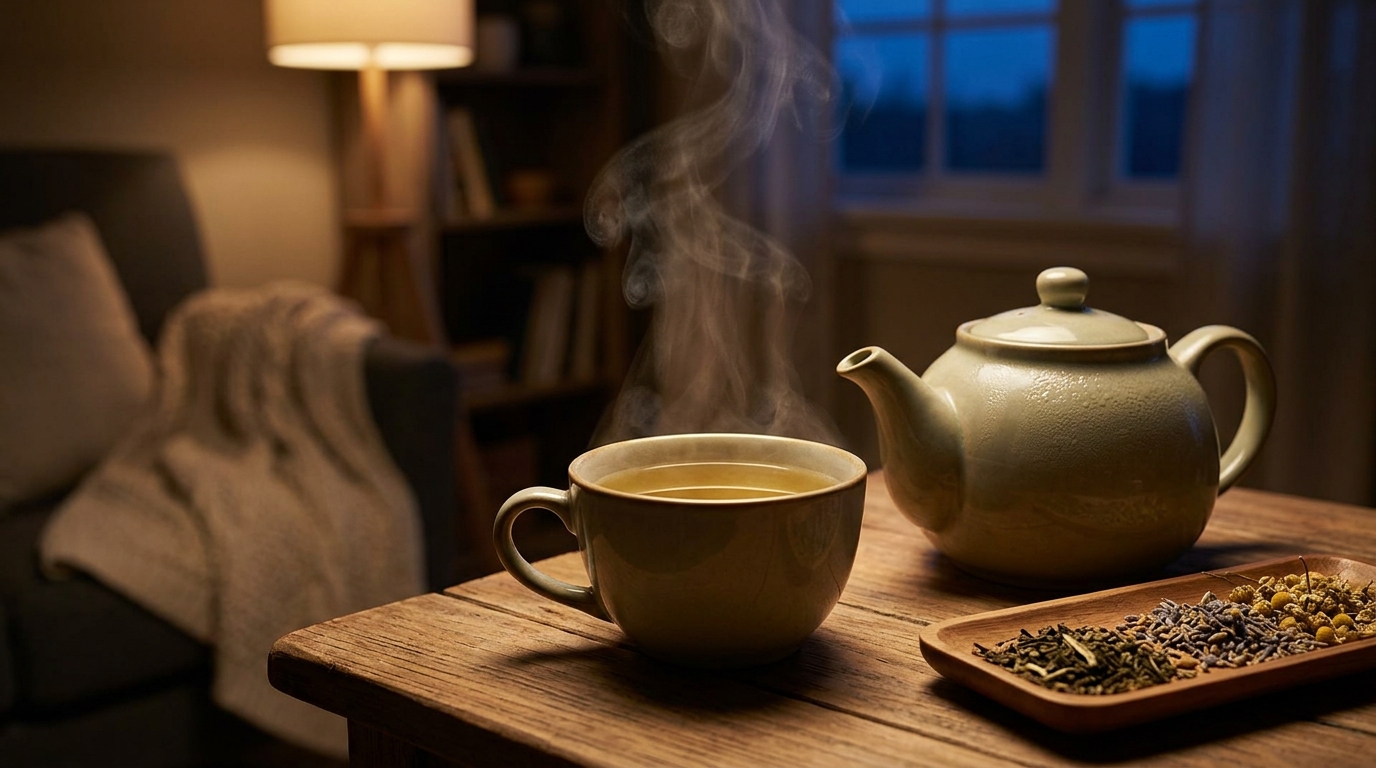
Green tea (Camellia sinensis) has been cultivated in China for well over a thousand years, first as a medicinal drink for monks and scholars and later as a daily ritual across Asia. Buddhist monks famously drank it to stay alert during long meditation sessions, valuing a wakefulness that felt steady and unhurried rather than frantic. That quality comes from the leaf’s unusual chemistry: caffeine travels alongside L-theanine, an amino acid that softens the edge of stimulation.
The challenge with an evening cup is caffeine. A low caffeine approach solves this in two ways. First, choose a leaf style that is naturally lower in caffeine, such as Kukicha (twig tea), Hojicha (roasted green tea), or a late-harvest bancha. Second, use a short steep and cooler water to extract less caffeine while keeping the theanine and gentle flavor. Hojicha in particular is roasted at high heat, which drives off a portion of the caffeine and creates a toasty, caramel-like cup.
This blend rounds out the green tea with lemon balm and a touch of spearmint. Lemon balm (Melissa officinalis) has a long history in European folk medicine as a mood-lifting, nerve-calming herb, while spearmint adds brightness and digestive comfort. Together they create an evening cup that supports quiet concentration for reading, journaling, or finishing a last task, without pushing you toward a sleepless night.
2
cups
Ingredients
- 2 tsplow caffeine green tea (hojicha or kukicha)
- 1 tspdried lemon balm leaf
- 1 tspdried spearmint leaf
- 480 mlwater (75°C / 167°F for hot brew)
- —a thin slice of lemon or a small drizzle of honey (optional)
How to Brew
Click on an item below to shop for the recommended items for this recipe on Amazon.
As an Amazon Associate, we earn from qualifying purchases.
- Measure the green tea, lemon balm, and spearmint into a tea infuser or the bottom of a warmed teapot, using about 1 tsp of tea and 1 tsp of the herb mix per cup.
- Heat fresh water to about 75 to 80°C (167 to 176°F). If you lack a temperature kettle, bring water to a boil and let it rest for about 3 minutes before pouring.
- Pour the water over the leaves and herbs, cover the cup or pot to hold in the aromatic oils from the lemon balm and mint, and start a timer.
- Steep for 2 to 3 minutes only. Taste at 2 minutes, since the tea should be smooth and toasty rather than grassy and sharp.
- Remove the infuser promptly to stop extraction. Sip slowly while it is warm, adding lemon or a little honey if you like.
- Add 3 tsp of the green tea and 2 tsp of the lemon balm and spearmint mix to a clean glass jar or pitcher.
- Pour in 1 liter of cold, filtered water and stir once so all the leaves are submerged.
- Cover and place in the refrigerator. Let it steep for 6 to 8 hours or overnight, giving the jar a gentle swirl once if you pass by.
- Strain through a fine mesh strainer into a second jar, pressing lightly on the leaves to release remaining liquid.
- Serve over ice or chilled straight from the jar. Drink within 24 hours for the best flavor and freshness.
- Fill a heatproof pitcher or tall glass about halfway with ice cubes, then place a sieve or infuser basket on top.
- Add 2 tsp of the green tea and 1.5 tsp of the lemon balm and spearmint mix for about 240 ml of finished tea, which is stronger than a hot cup to account for ice dilution.
- Heat water to 80°C (176°F) and pour about 120 ml slowly over the leaves, letting it drip through onto the ice below.
- Steep for 2 minutes only, then lift out the infuser and stir the tea and ice together until fully chilled.
- Top up with cold water if desired, garnish with a lemon wheel or fresh mint sprig, and serve right away.
Health Benefits
The pairing of L-theanine with a small amount of caffeine has been shown in small human trials to improve attention and reduce distraction without the anxiety often caused by caffeine alone.
Lemon balm has been studied for reducing feelings of stress and improving calmness, and L-theanine is associated with a relaxed mental state, making this blend suitable for winding down productively.
Green tea catechins such as EGCG have strong antioxidant activity in laboratory and observational research, supporting general cardiovascular and cellular health when tea is consumed regularly.
Spearmint and lemon balm have traditional and modest clinical support for easing bloating and mild stomach discomfort, which is welcome after an evening meal.
A short, cool steep of roasted or twig-style green tea delivers meaningfully less caffeine than a standard cup, helping you enjoy tea later in the day with less impact on sleep for most people.
🧪 Key Bioactive Compounds
The Science Behind Green Tea
The signature of green tea’s mental effect is the interaction between caffeine and L-theanine. Caffeine promotes alertness by blocking adenosine receptors, while L-theanine, an amino acid almost unique to tea, influences neurotransmitters such as GABA, serotonin, and dopamine and increases alpha wave activity associated with relaxed attention. Small controlled studies suggest the combination improves accuracy and focus on demanding tasks while reducing self-reported jitteriness compared with caffeine alone.
Caffeine content depends heavily on leaf type and preparation. Hojicha, which is roasted at high temperature, and kukicha, made largely from stems and twigs, tend to contain less caffeine than young spring leaf teas like sencha or matcha. Brewing with cooler water for a shorter time extracts less caffeine and fewer bitter catechins, while cold brewing yields a particularly mild, naturally sweet cup that retains theanine well.
Lemon balm and spearmint contribute their own supportive chemistry. Rosmarinic acid and volatile oils such as citronellal in lemon balm have been linked in preliminary human research to improved calmness and mood, and menthol-type compounds in spearmint ease digestive muscle tension. While more large-scale trials are needed, the traditional use of these herbs aligns with the modest evidence, supporting this blend as a thoughtful, low-risk evening option.
Brewing Tips
- Choose hojicha or kukicha for the lowest caffeine, and avoid matcha or young spring sencha for evening cups.
- Never steep longer than 3 minutes in the evening; longer steeping increases both caffeine and bitterness.
- Drink this blend at least 2 to 3 hours before bed to keep sleep undisturbed, and finish your last cup earlier if you are caffeine sensitive.
- Store dried tea and herbs in an airtight, opaque container away from heat and light to protect delicate aromatic oils.