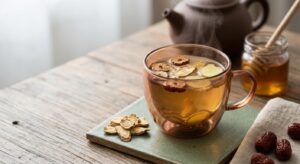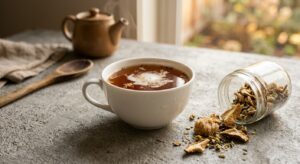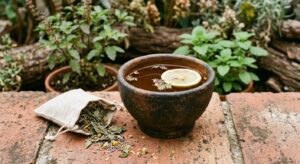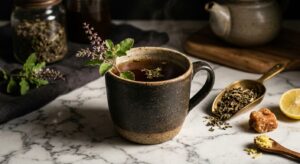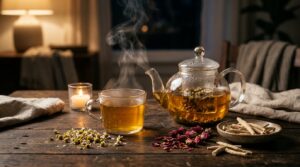
Skullcap (Scutellaria lateriflora) is a North American mint-family herb with a long record in Eclectic and Western herbal medicine. In the 18th and 19th centuries it was called “mad-dog weed” after a mistaken belief that it treated rabies, but its more lasting reputation is as a nervine, an herb that calms and nourishes the nervous system. Herbalists traditionally reached for skullcap when a person felt wired, frazzled, or unable to switch off, especially when tension showed up as restlessness or a tight, overworked mind.
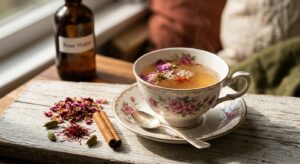
Roses (Rosa damascena and Rosa gallica) have been steeped, distilled, and scattered through ritual for thousands of years, from Persian and Ottoman tea houses to the apothecaries of medieval Europe. Dried rose petals bring a gentle astringency, a honeyed perfume, and a long tradition as a heart-soothing, mood-lifting herb. Where skullcap quiets the mind, rose softens the emotional edges of the day.
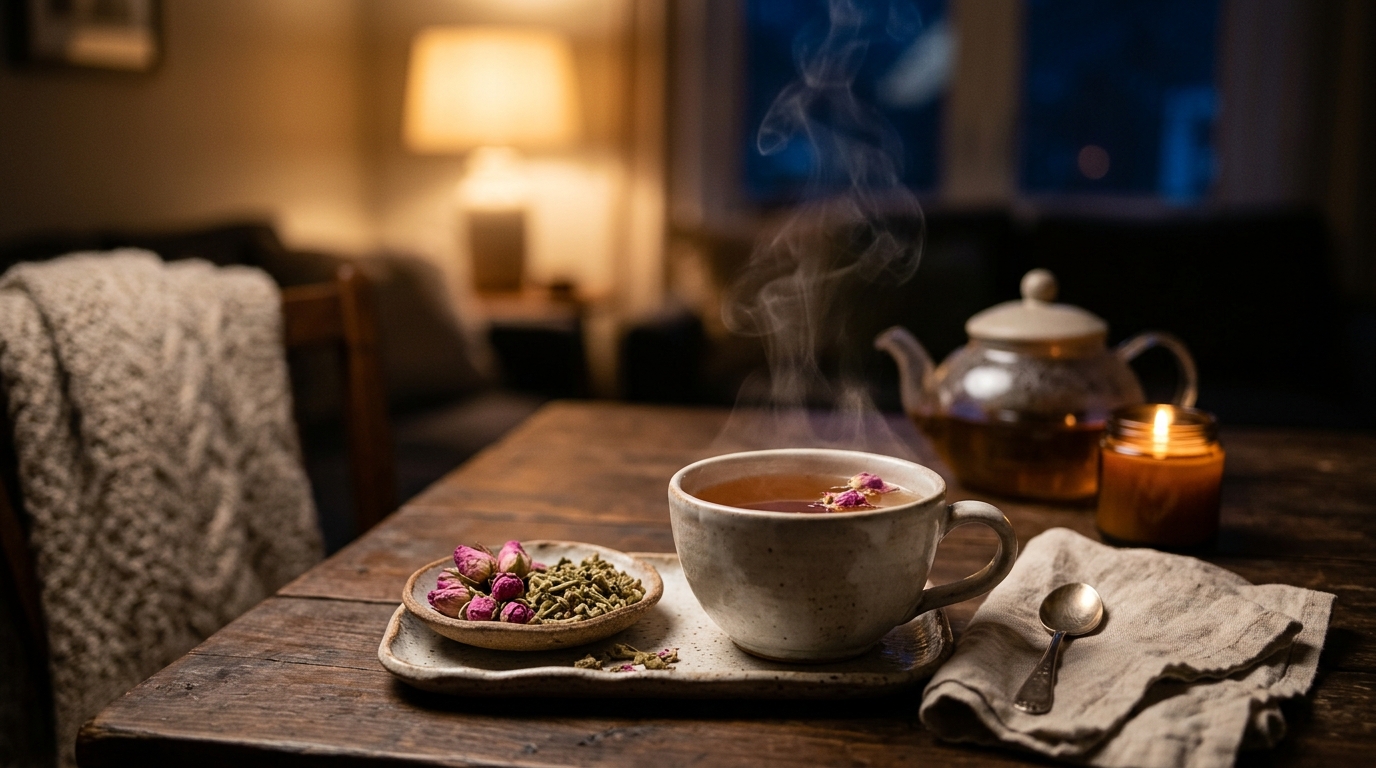
Combined, they make a fittingly quiet evening ritual. Skullcap brings a mildly bitter, green, grassy backbone, and rose rounds it into something fragrant and approachable. This is not a heavy sedative tea. It is a soft landing, best sipped slowly in low light, as a signal to your body that the day is done.
2
cups
Ingredients
- 2 tspdried skullcap (aerial parts)
- 1 tbspdried rose petals (culinary grade)
- 480 mlwater (90°C / 194°F)
- —raw honey or a few drops of vanilla to taste (optional)
- —a strip of lemon peel (optional)
How to Brew
Click on an item below to shop for the recommended items for this recipe on Amazon.
As an Amazon Associate, we earn from qualifying purchases.
- Bring fresh water to a boil, then let it rest for 2 to 3 minutes until it reaches about 90°C (194°F).
- Place the dried skullcap and rose petals in a teapot or the bottom of a large mug, or load them into a loose-leaf infuser basket.
- Pour the hot water over the herbs, making sure all the plant material is submerged.
- Cover immediately with a lid or saucer to hold in the volatile aromatics, and steep for 6 to 8 minutes. Closer to 6 gives a lighter, floral cup; 8 brings out more of skullcap’s green bitterness.
- Strain, then sweeten lightly with honey if you like. Sip slowly, ideally 30 to 60 minutes before bed.
- Combine 2 tablespoons of skullcap and 2 tablespoons of rose petals in a clean glass jar. Use a slightly higher herb-to-water ratio than hot brew, since cold water extracts more slowly.
- Pour in 1 liter of cold, filtered water and stir gently so every petal is wet.
- Seal the jar and place it in the refrigerator for 8 to 12 hours, or overnight.
- Strain through a fine mesh sieve or muslin cloth into a clean pitcher, pressing lightly on the herbs.
- Serve over ice with a lemon peel twist. Drink within 24 to 36 hours, as cold-brewed herbal teas spoil faster than hot ones.
- Place 3 tablespoons of dried skullcap and 1 tablespoon of rose petals in a heatproof quart jar or French press.
- Pour 500 ml of just-boiled water over the herbs, stir once, and seal the lid tightly.
- Leave on the counter to steep and cool for 4 to 8 hours, or overnight, keeping it covered the whole time.
- Strain well, squeezing the herbs gently to release the remaining liquid.
- Warm a single serving in a small saucepan over low heat for 1 to 2 minutes only. Do not let it simmer, which dulls the rose aroma.
Health Benefits
Skullcap has been used traditionally as a nervine for restlessness and overthinking. Its flavonoids, especially baicalin, appear to modulate GABA-A receptors, which may explain the calming effect seen in animal studies and small human trials.
While not a strong sedative, skullcap’s relaxing action and the ritual of a warm, fragrant cup can help the body shift into rest mode. Rose aroma has also been linked to reduced stress responses in small aromatherapy studies.
Rose has a long traditional use for emotional heaviness. Inhaling rose-derived aromatics has been associated with lower anxiety and improved mood in small trials, and a pleasant sensory ritual itself reduces perceived stress.
Both herbs are rich in polyphenols and flavonoids that neutralize free radicals in laboratory studies, which may help protect cells from everyday oxidative stress.
Rose petals are mildly astringent and traditionally used to calm an unsettled stomach, while skullcap’s relaxing action can help when tension shows up as a knotted gut.
🧪 Key Bioactive Compounds
The Science Behind Skullcap
Skullcap’s reputation rests largely on its flavonoids, notably baicalin, baicalein, scutellarin, and wogonin. In rodent studies these compounds appear to interact with the GABA-A receptor, the same inhibitory pathway targeted by many anti-anxiety drugs, though far more gently. A small human trial found that skullcap extract improved self-reported mood without noticeably impairing cognition, but the overall body of clinical research is still modest, so skullcap is best viewed as a traditional, supportive herb rather than a proven treatment.
Rose petals contribute a different kind of action. Their essential oil fraction contains geraniol, citronellol, and phenylethyl alcohol, aromatic molecules that reach the brain through scent and may modulate the stress response. Small aromatherapy trials with rose have reported reductions in anxiety and heart rate. Rose petals also supply polyphenols, including quercetin and kaempferol glycosides plus ellagic and gallic acids, which contribute antioxidant activity and a pleasant astringency.
Brewing technique matters because the two herbs behave differently. Skullcap’s flavonoids dissolve well in hot water, while rose’s volatile aromatics are easily lost to steam and over-heating, which is why a covered, slightly cooled steep produces the best balance. The cold brew trades some of skullcap’s potency for a sweeter, more aromatic profile, while the long covered infusion favors maximum extraction of the plant’s water-soluble compounds.
Brewing Tips
- Source skullcap from a trusted organic supplier that confirms the species as Scutellaria lateriflora, since adulteration with germander has been documented.
- Use culinary-grade, unsprayed rose petals; florist roses are often treated with pesticides and are not safe to drink.
- Keep the cup covered while steeping to trap rose’s volatile aromatics and keep the flavor floral rather than flat.
- Start with a single cup in the evening to see how your body responds before making it a nightly habit.
- Store both herbs in airtight, opaque jars away from light and heat, and use within 12 months for the best flavor and potency.