For anyone who works from mid-afternoon into the night, the usual advice about energy does not quite fit. Coffee at 4 p.m. can leave you wired at 2 a.m. when you finally get home, and skipping stimulants entirely can mean dragging through the busiest hours of your shift. Two of the most respected adaptogenic plants in traditional medicine offer a gentler middle path: ginseng and holy basil.
Ginseng, particularly Asian ginseng (Panax ginseng), has been prized in Chinese medicine for more than two thousand years. The name Panax comes from the Greek for ‘all-healing,’ and the gnarled, human-shaped root was once worth its weight in silver. Traditionally it was used to restore vitality, sharpen the mind, and help the body cope with prolonged strain. Holy basil, known as tulsi (Ocimum tenuiflorum), holds a sacred place in Ayurveda, where it is called ‘The Queen of Herbs’ and is grown in courtyards and temple gardens across India. It has been used for centuries to ease stress, support clear thinking, and bring the nervous system back into balance.
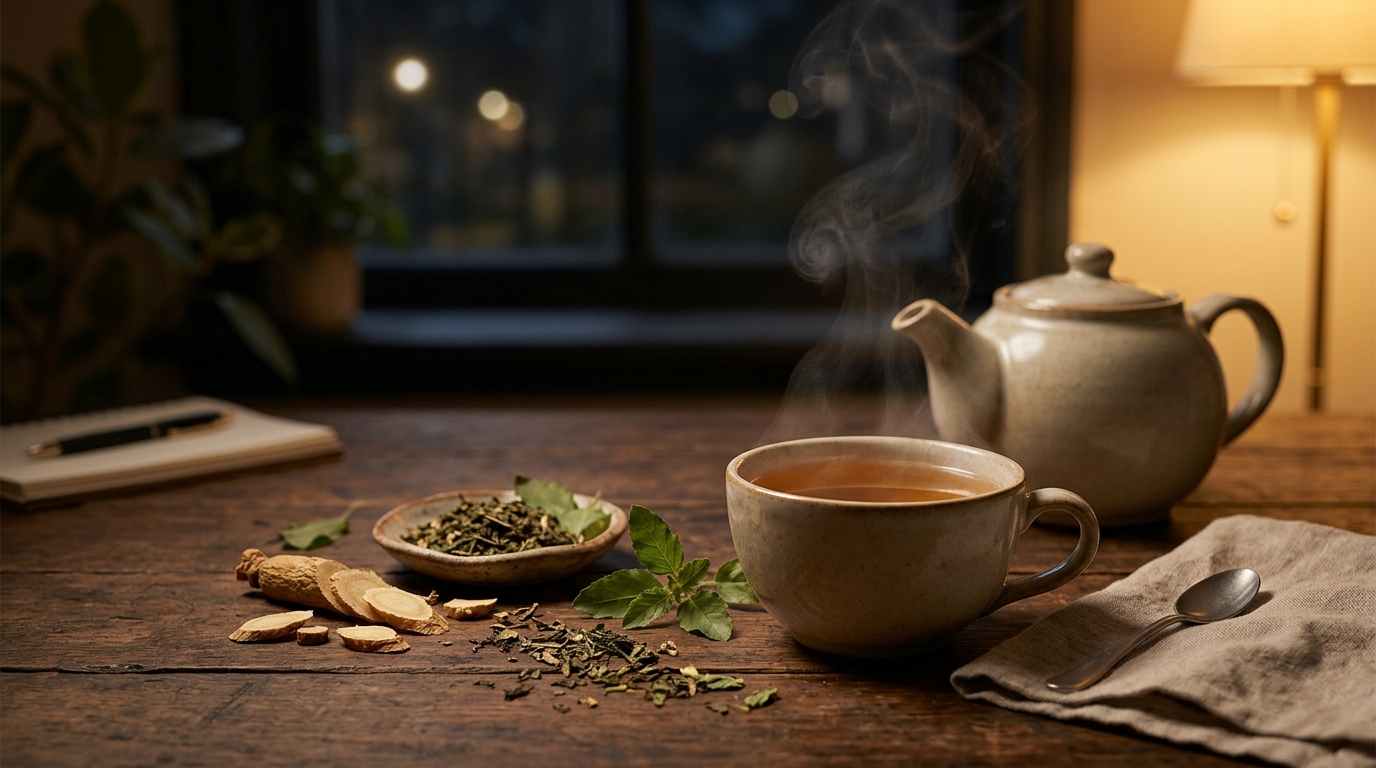
Together they make a thoughtful evening tea. The ginseng brings a grounded, earthy warmth and a reputation for supporting stamina, while the tulsi adds a clove-like, peppery sweetness and a calming quality that keeps that energy from tipping into restlessness. This blend is meant for the hours when you still need to be sharp but want to be able to unwind afterward.
2
cups
Ingredients
- 2 tspdried Asian ginseng root, thinly sliced or cut
- 2 tspdried holy basil (tulsi) leaves
- 480 mlfiltered water
- —raw honey to taste (optional)
- —a thin slice of fresh ginger (optional)
How to Brew
Click on an item below to shop for the recommended items for this recipe on Amazon.
As an Amazon Associate, we earn from qualifying purchases.
- Heat 480 ml of filtered water until just below a full boil, around 90 to 95°C (194 to 203°F). Water that is too violently boiling can make ginseng taste harsh and bitter.
- Place the sliced ginseng root in a teapot or heatproof jar first. Pour about a third of the hot water over it and let it sit for 2 minutes. This gives the denser root a head start.
- Add the holy basil leaves and pour in the remaining hot water. Cover immediately to hold in the volatile aromatic oils from the tulsi.
- Steep for a further 6 to 8 minutes, until the liquid turns a deep golden amber. Longer steeping increases earthiness and mild bitterness.
- Strain into two mugs. Sweeten with a little raw honey if you like, and sip slowly about 60 to 90 minutes before the busiest stretch of your shift.
- Combine 4 tsp of sliced ginseng root and 4 tsp of dried holy basil in a clean glass jar. Using a stronger herb ratio than the hot brew compensates for the gentler extraction of cold water.
- Pour in 1 liter of cool filtered water and stir once to submerge the herbs fully.
- Cover the jar and refrigerate for 8 to 12 hours. Overnight works well, so you can prepare it before bed and have it ready for the next afternoon.
- Strain through a fine mesh sieve or a coffee filter to remove all root fragments and leaf bits.
- Serve over ice or straight from the fridge in a thermos to take to work. Stir in a spoonful of honey if you want it sweeter, and drink within 48 hours.
- Add 2 tsp of ginseng root and 480 ml of cold filtered water to a small saucepan. Starting with cold water lets the root release its compounds gradually as the temperature rises.
- Bring to a gentle simmer over medium-low heat. Do not let it reach a rolling boil. Reduce the heat and simmer, partially covered, for 15 to 20 minutes until the liquid has reduced by roughly a quarter and darkened to a rich amber.
- Remove the pan from the heat and add 2 tsp of holy basil leaves. Tulsi’s delicate oils are easily lost with prolonged heat, so it joins the pot only at the end.
- Cover and steep for 5 minutes off the heat, allowing the tulsi to infuse while the decoction is still hot.
- Strain through a fine sieve into a mug or insulated flask. Add a slice of fresh ginger or a little honey if desired. This concentrated version can be gently reheated and sipped throughout the evening.
Health Benefits
Clinical trials on Panax ginseng suggest it can reduce subjective fatigue and support physical stamina, likely through effects on energy metabolism and the stress-response system rather than through direct stimulation.
Some human studies report improvements in attention, working memory, and mental performance after ginseng intake. Holy basil is also traditionally used to promote clear thinking, though human evidence is less robust.
Both herbs are classed as adaptogens. Small clinical trials on holy basil show reductions in self-reported stress and lower cortisol-related symptoms, while ginseng is studied for its modulating effect on the hypothalamic-pituitary-adrenal axis.
Both ginseng and tulsi have been investigated for effects on glucose regulation, which may help smooth out the energy peaks and dips that come with irregular meal times on a late shift.
Rosmarinic acid, ursolic acid, and ginsenosides all show antioxidant activity in laboratory research, which may help the body manage the oxidative strain associated with long hours and disrupted routines.
🧪 Key Bioactive Compounds
The Science Behind Ginseng
The effects of this blend come largely from two groups of compounds. In ginseng, the key players are ginsenosides, a family of steroid-like saponins concentrated in the root. Research suggests that ginsenosides such as Rg1 and Rb1 interact with the body’s stress-response and energy pathways, which may explain why ginseng is associated with reduced fatigue and improved performance under mental strain. Importantly, this is not a stimulant effect in the way caffeine works, which is part of why ginseng is often described as providing energy without the sharp spike and crash.
Holy basil contributes a different set of tools. Its leaves are rich in phenolic compounds such as rosmarinic acid and in triterpenoids such as ursolic acid, along with the aromatic oil eugenol. Studies, including several small randomized trials, suggest tulsi may help lower perceived stress and support mood, and laboratory work points to anti-inflammatory and antioxidant activity. These properties fit tulsi’s traditional role as a calming, balancing herb.
It is worth being honest about the limits of the evidence. Many ginseng studies are small, vary in the type and dose of extract used, and produce mixed results, and tulsi research is still developing. A cup of tea delivers a modest dose compared with concentrated extracts used in trials. Think of this blend as a supportive daily ritual rather than a cure for exhaustion, one that works best alongside adequate sleep, regular meals, and hydration.
Brewing Tips
- Drink this tea earlier in your shift, ideally 60 to 90 minutes before your busiest period, so any gentle stimulating effect from ginseng is behind you by the time you head home to sleep.
- Choose Asian ginseng (Panax ginseng) for a warming, more stimulating effect, or American ginseng (Panax quinquefolius) if you prefer something cooler and gentler. Both work in this blend, but they taste and feel different.
- The ginseng root can be re-steeped once or twice. Save the spent slices and add fresh tulsi each time for a second and third cup with a softer flavor.
- Keep dried herbs in airtight, opaque containers away from heat and light, since tulsi’s aromatic oils fade quickly when exposed to air.