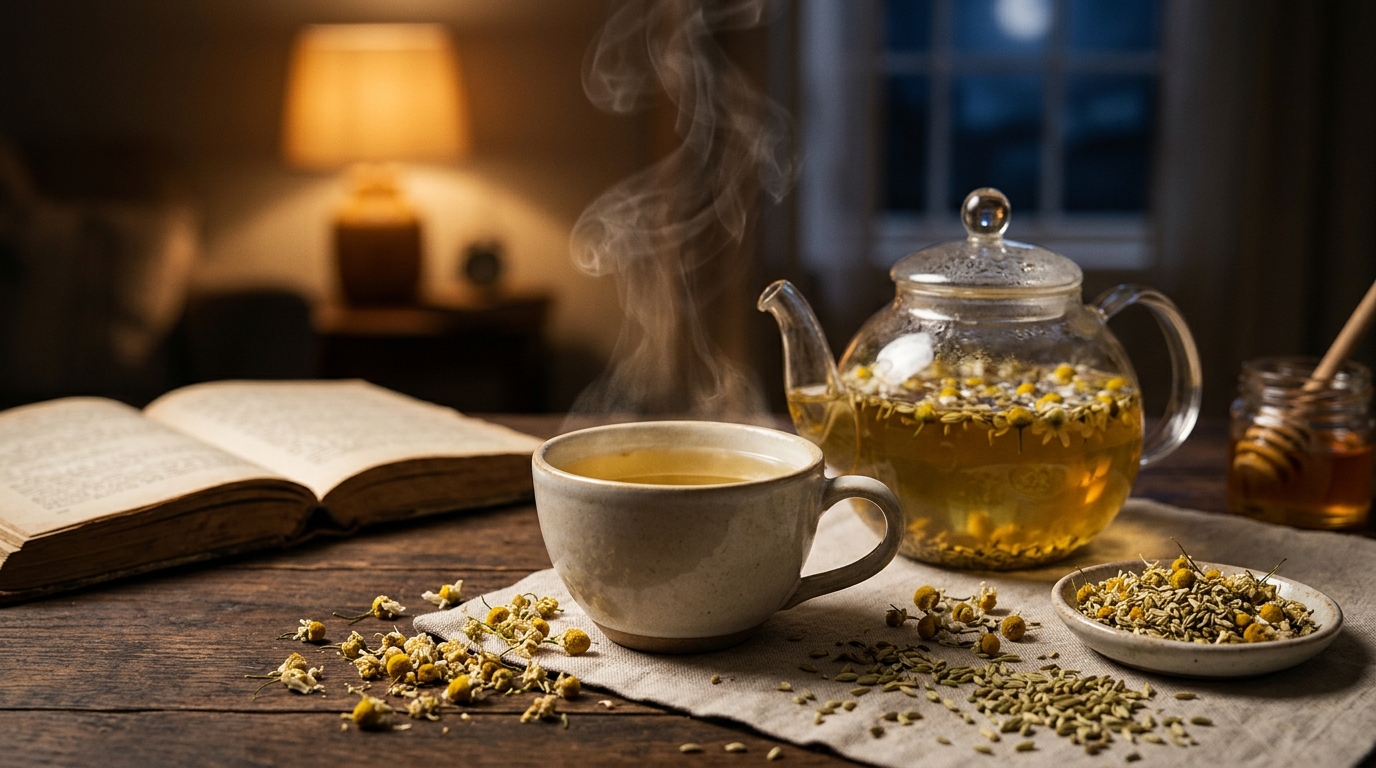
Chamomile has been a bedside herb for thousands of years. Ancient Egyptians dedicated it to their sun god Ra, Greek physicians such as Dioscorides recommended it for fevers and restlessness, and its name comes from the Greek chamaimelon, meaning ‘ground apple’, a nod to its sweet, fruity aroma. German chamomile (Matricaria chamomilla) is the variety most often used in tea, and generations of European households have reached for a warm cup of it to soothe frayed nerves, upset stomachs, and fretful children at the end of the day.
Fennel (Foeniculum vulgare) brings a different but complementary gift. Its seeds have long been served after meals across the Mediterranean, the Middle East, and India, where bowls of roasted fennel seeds sit by the restaurant door as a digestive and breath freshener. Herbalists classify fennel as a carminative, meaning it helps relieve gas, bloating, and cramping. Roman soldiers reportedly chewed it for strength, and medieval monks grew it in physic gardens for stomach complaints.
Together, the two herbs address the two most common obstacles to a peaceful night: a busy mind and an uncomfortable gut. The result is a pale golden tea with a soft floral sweetness from the chamomile and a warm, faintly licorice-like finish from the fennel. It is an ideal wind-down ritual after a late or heavy dinner, and gentle enough to drink every evening.
2
cups
Ingredients
- 2 tbspdried chamomile flowers
- 1 tspfennel seeds, lightly crushed
- 480 mlwater (95°C / 203°F)
- —raw honey to taste (optional)
- —thin strip of lemon peel (optional)
How to Brew
Click on an item below to shop for the recommended items for this recipe on Amazon.
As an Amazon Associate, we earn from qualifying purchases.
- Measure the fennel seeds into a mortar, or onto a cutting board, and crush them lightly with a pestle or the flat side of a knife. You only want to crack the seed coats to release the oils, not grind them to powder.
- Heat fresh water in a kettle until it just comes off the boil, then let it rest for about 30 seconds so it settles to roughly 95°C (203°F).
- Place the dried chamomile flowers and crushed fennel seeds in a teapot or in a large mug fitted with an infuser. Give the flowers room to expand.
- Pour the hot water over the herbs, cover immediately with a lid or small saucer, and steep for 7 to 10 minutes. Closer to 7 gives a delicate, floral cup, while 10 gives a fuller, more soothing one.
- Strain into cups, pressing the flowers gently against the strainer to release the last of the infusion. Stir in raw honey if desired and add a strip of lemon peel for brightness.
- Sip slowly, ideally 30 to 60 minutes before bed, while dimming the lights and putting screens away.
- Lightly crush the fennel seeds, as the cold water extracts more slowly and needs the cracked seed coats to draw out their flavor.
- Combine 3 tablespoons of dried chamomile flowers and 1.5 teaspoons of crushed fennel seeds in a clean glass jar. This is a slightly stronger ratio than hot brew to compensate for the gentler extraction.
- Pour 720 ml (3 cups) of cold, filtered water over the herbs and stir once with a long spoon to wet everything.
- Seal the jar and refrigerate for 8 to 12 hours, or overnight. Do not exceed 12 hours, as the tea can begin to taste flat or slightly bitter.
- Strain through a fine-mesh sieve lined with a muslin cloth or coffee filter to catch the tiny chamomile petals.
- Serve over ice, or pour into a saucepan and warm very gently over low heat if you prefer a soothing evening cup without the harshness of boiling water. Store leftovers in the refrigerator for up to 2 days.
- Add 1.5 teaspoons of fennel seeds, lightly crushed, to a small saucepan with 500 ml of cold water.
- Bring to a gentle boil over medium heat, then reduce to the lowest simmer. Cover and simmer for 10 minutes, until the kitchen smells sweetly of anise.
- Turn off the heat and let the liquid cool for 1 to 2 minutes, until it stops actively bubbling. This protects the chamomile’s delicate oils.
- Stir in 2 tablespoons of dried chamomile flowers, cover the saucepan, and steep for 5 minutes. Resist the urge to leave it longer, as extended contact makes chamomile taste bitter and medicinal.
- Strain through a fine-mesh sieve directly into warmed mugs. The fennel decoction gives this version a deeper golden color and a richer, spicier body than the simple hot brew.
- Sweeten with a little honey if desired and drink while still warm, preferably seated and unhurried.
Health Benefits
Apigenin in chamomile interacts with GABA receptors, and small clinical trials have linked chamomile consumption with improved sleep quality and reduced nighttime waking, though results are modest and vary between studies.
Fennel’s anethole relaxes intestinal smooth muscle and helps gas move through the digestive tract, which is why it is a traditional after-meal remedy and is often used for infant colic in European herbal practice.
Chamomile’s bisabolol and flavonoids have antispasmodic and anti-inflammatory properties that may calm cramping and an irritated stomach, particularly when stress is a contributing factor.
A randomized controlled trial of chamomile extract found significant reductions in generalized anxiety symptoms, and the ritual of drinking a warm tea adds a behavioral calming effect of its own.
Caffeine-free and warming, this tea gives the body a consistent cue that the day is ending, and pairing herbal action with ritual is one of the most effective ways to build better sleep habits.
🧪 Key Bioactive Compounds
The Science Behind Chamomile
The calming reputation of chamomile rests largely on apigenin, a flavonoid that makes up a significant portion of the herb’s active content. Research in cell and animal models shows apigenin binds to benzodiazepine receptors on the GABA-A complex in the brain, the same general pathway targeted by prescription anti-anxiety drugs, but with a much weaker and gentler effect. Human trials are smaller and less consistent, yet several have found improvements in sleep quality, particularly in postpartum women, older adults, and people with chronic insomnia.
Fennel’s digestive action is driven chiefly by trans-anethole and fenchone, the volatile oils that give the seed its flavor. Laboratory studies show these compounds relax smooth muscle in the gastrointestinal tract, reduce spasms, and may help the body expel trapped gas. Clinical research on fennel is more limited than the long tradition suggests, but studies on functional bloating, mild constipation, and infant colic have reported encouraging results, and its use is well established in European and Asian herbal pharmacopoeias.
Chamomile’s bisabolol and chamazulene add an anti-inflammatory and antispasmodic layer that complements fennel’s carminative effect. Because stress and digestion are closely linked through the gut-brain axis, a tea that eases both the nervous system and the digestive tract may help break the cycle in which an unsettled stomach disturbs sleep and poor sleep worsens digestion. While none of these effects are dramatic, their gentleness is exactly what makes the blend suitable for nightly use.
Brewing Tips
- Use whole dried chamomile flowers rather than finely cut tea bag dust whenever possible. Whole flowers retain far more of their volatile oils and give a sweeter, more floral cup.
- Crush fennel seeds just before brewing. Pre-ground fennel loses its aromatic oils quickly, while whole seeds stay potent for a year or more when stored in a sealed jar away from light.
- Always cover your cup or teapot while steeping to trap the volatile oils, and store dried herbs in airtight glass containers away from heat and sunlight.
- Drink the tea 30 to 60 minutes before bed rather than right as you lie down, so you have time to use the bathroom and let the herbs begin to work.
- If chamomile tastes too bitter to you, shorten the steep time or lower the water temperature slightly. A small spoonful of honey also rounds off any sharp edges.