Few flowers carry as much botanical lore and quiet magic as the elder blossom. Sambucus nigra, the European elder tree, has been woven into the fabric of folk healing across Britain, Scandinavia, and Central Europe for well over two thousand years. Its creamy white flower clusters, which appear in late spring and early summer, were gathered by herbalists who called the elder tree the “medicine chest of the country people,” using every part from root to berry for ailments ranging from fevers to frayed nerves. The flowers, in particular, were prized as a gentle nervine, brewed into steaming cups to ease sleeplessness, quiet anxious minds, and coax a troubled body toward rest.
In Nordic tradition, the elder tree was said to be guarded by the Elder Mother, a protective spirit who would bless those who treated the tree with reverence and harm those who did not. Across England, bundles of dried elderflowers were hung in doorways to ward off illness, and country healers steeped the blossoms in hot water to break fevers and calm children through restless nights. This rich ceremonial relationship with the elder flower reflects something genuine: the blossoms contain a complex array of flavonoids, volatile aromatic compounds, and triterpenes that work in quiet but meaningful ways on the human nervous system, immune response, and respiratory tract.
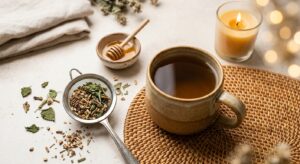
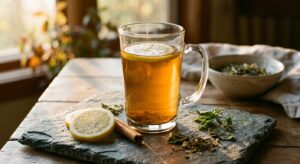
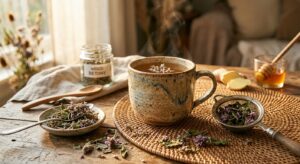
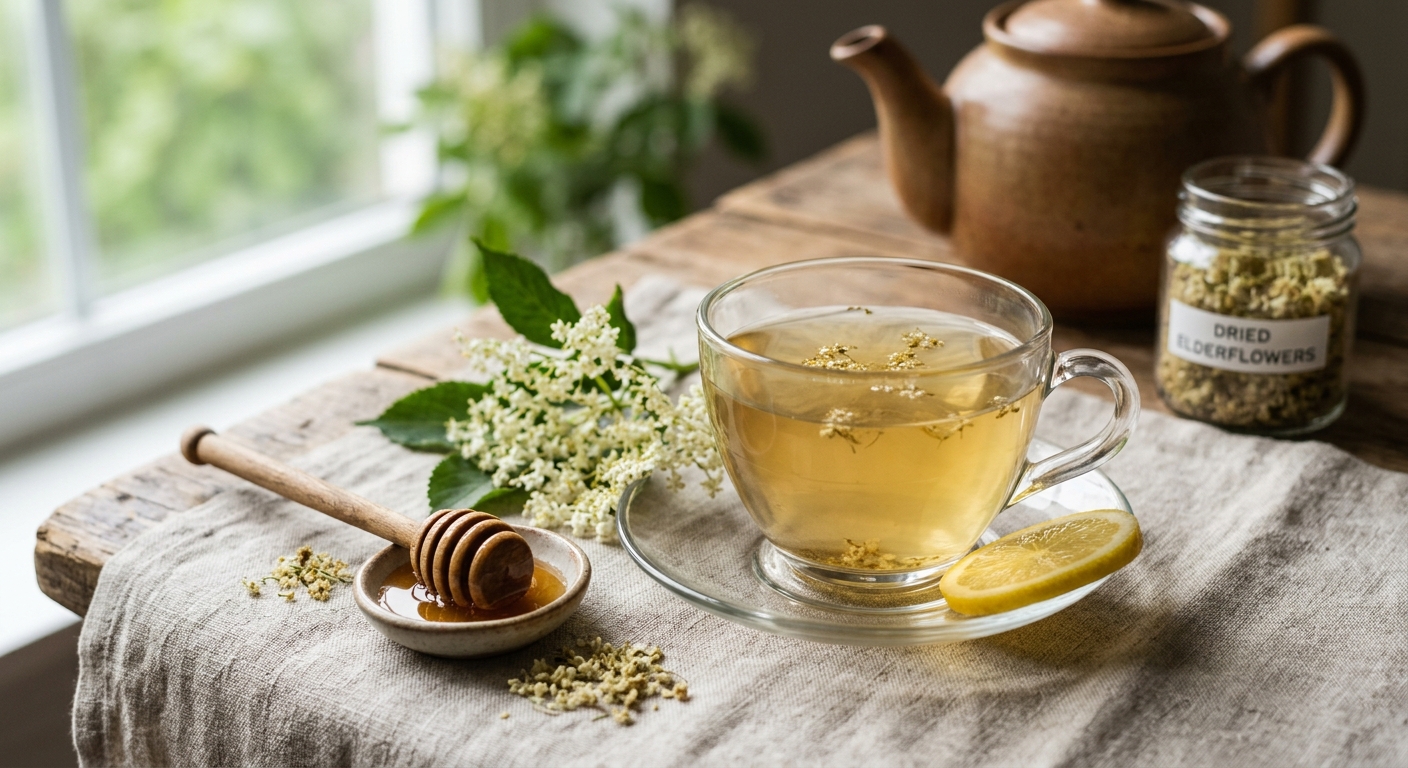
Elderflower tea has a sensory quality entirely its own. The brew is pale gold to soft ivory in the cup, luminous and almost ethereal, and it carries an aroma that is floral without being perfumed, gently sweet with a hint of something almost musky and green beneath the surface. On the palate it is delicate, honey-like, and softly warm, with a clean, dry finish that invites a second cup. Brewed in the evening, with or without a swirl of raw honey, it is one of the most graceful herbal teas in the Western tradition and one of the most underappreciated remedies for those seeking natural, gentle support for sleep and calm.
2
cups
Ingredients
- 4 tspdried elderflowers
- 480 mlwater (90°C / 194°F)
- —raw honey or elderflower cordial to taste (optional)
- —thin slice of lemon (optional)
How to Brew
Click on an item below to shop for the recommended items for this recipe on Amazon.
As an Amazon Associate, we earn from qualifying purchases.
- Heat filtered water to approximately 90°C (194°F). If you do not have a temperature-controlled kettle, bring water to a full boil and allow it to rest uncovered for 2 to 3 minutes before pouring.
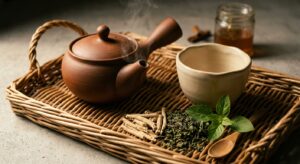
- Measure 2 heaped teaspoons of dried elderflowers per cup (approximately 240 ml) and place them in a tea infuser, muslin bag, or directly into a warmed teapot.
- Pour the heated water slowly over the elderflowers, ensuring all the blossoms are submerged. Place a saucer or lid over the cup or teapot to trap the aromatic steam, which contains many of the beneficial volatile compounds.
- Steep for 7 to 10 minutes. The longer steep develops a richer floral character; 7 minutes gives a lighter, more delicate cup best suited to sensitive palates.
- Remove the infuser or strain the flowers through a fine mesh strainer. Add a small slice of lemon or a swirl of raw honey if desired, and sip slowly in the hour before bed.
- Measure 3 heaped teaspoons of dried elderflowers per 240 ml of water. Because no heat is used, a slightly higher ratio compensates for the slower extraction and produces a well-rounded flavor.
- Place the elderflowers in a clean glass jar or glass pitcher. Pour cold, filtered water over the flowers, ensuring they are fully submerged. Gently press the blossoms down with a clean spoon so none are floating above the waterline.
- Seal or cover the jar and leave it at room temperature for 1 hour to begin the extraction, then transfer to the refrigerator.
- Allow the elderflowers to cold brew for a total of 8 to 12 hours, ideally overnight. Check at the 8-hour mark; the brew should be palest gold with a pronounced floral fragrance.
- Strain through a fine mesh strainer lined with a small piece of cheesecloth to catch all fine flower particles. Serve over ice in a tall glass, with a slice of cucumber or a splash of elderflower cordial for an elegant warm-weather drink. Consume within 48 hours.
- Select a clear glass jar with a tight-fitting lid. Measure 3 teaspoons of dried elderflowers per 240 ml of cool, filtered water and add them to the jar.
- Pour cold filtered water over the flowers to fill the jar. Seal tightly. If desired, add a few thin slices of fresh lemon or a small sprig of fresh mint for a complementary botanical note.
- Place the sealed jar in a sunny outdoor location or on a south-facing windowsill in full, direct sunlight. Allow it to steep for 3 to 4 hours. The gentle warmth will slowly draw out the flowers’ delicate volatile oils and flavonoids without the harshness of boiling water.
- Check the color periodically. When the brew is a warm, luminous pale gold and the aroma through the jar is distinctly floral and sweet, the sun tea is ready.
- Bring the jar inside, strain through a fine mesh strainer, and taste. Sweeten with a light drizzle of raw honey or elderflower cordial if desired. Serve over ice immediately, or refrigerate and consume within 24 hours.
Health Benefits
Flavonoids such as isoquercitrin and kaempferol found in elderflower interact with GABA-A receptors, the same receptors targeted by pharmaceutical sleep aids, producing a gentle calming effect that eases the transition into sleep. Traditional European herbalism consistently lists elderflower as a mild sedative suited to those with difficulty falling asleep due to nervous tension.
The volatile aromatic compound linalool, released during steeping, has been demonstrated in multiple studies to lower anxiety and reduce stress hormone activity through olfactory stimulation of the limbic system. Combined with the flavonoid isoquercitrin’s direct action on GABA receptors, elderflower tea offers a gentle two-pathway approach to calming an overactive nervous system.
Elderflower has a long history in European phytotherapy as a diaphoretic and respiratory tonic, used to open nasal passages, reduce catarrh, and support the body during colds and mild fevers. Modern analysis confirms the presence of anti-inflammatory flavonoids and mucilage-like compounds that soothe irritated mucous membranes and may reduce nasal congestion that disrupts sleep.
Elderflowers are rich in polyphenolic compounds including rutin, chlorogenic acid, and kaempferol, all of which neutralize free radicals and reduce oxidative stress in tissues. Regular consumption of antioxidant-rich herbal teas is associated with reduced systemic inflammation and improved long-term cellular health.
Chlorogenic acid and flavonoids in elderflower have been shown to modulate immune responses, reducing excessive inflammatory signaling while supporting the body’s natural defenses. This aligns with the traditional use of elderflower tea during early-stage colds and seasonal transitions, when immune support and restful sleep are both needed.
🧪 Key Bioactive Compounds
The Science Behind Elderflower
The calming properties of elderflower tea are rooted in a group of flavonoid glycosides, particularly isoquercitrin and kaempferol, that have been shown in laboratory and animal studies to interact with gamma-aminobutyric acid type A (GABA-A) receptors in the central nervous system. GABA is the brain’s primary inhibitory neurotransmitter, responsible for quieting overactivated neural circuits and promoting the neurological state required for both relaxation and sleep onset. Compounds that positively modulate GABA-A receptor activity, even gently and indirectly as plant flavonoids do, can reduce the subjective experience of anxiety, slow racing thoughts, and lower the physiological arousal that keeps people awake. This mechanism is structurally similar to the one exploited by benzodiazepine medications, though elderflower’s action is considerably milder, making it suitable for regular gentle use without the risks of dependency.
Alongside its direct neurochemical activity, elderflower contains linalool, a monoterpene volatile compound also found in lavender and coriander, which contributes meaningfully to the tea’s anxiolytic effect through a different pathway. When linalool enters the air during steeping and is inhaled, it stimulates olfactory receptors connected to the limbic system, the brain’s emotional and memory center, triggering a measurable reduction in sympathetic nervous system arousal. Research published in peer-reviewed pharmacology journals has demonstrated that inhalation of linalool reduces levels of serum corticosterone, a stress hormone, in animal models, and human studies on closely related aromatic compounds support the idea that inhaling fragrant teas actively contributes to their calming effect, not just the ingested constituents. Covering the cup while steeping and then slowly inhaling the rising steam is therefore not just sensory pleasure but a genuinely therapeutic act.
Elderflower is also notable for its antioxidant and anti-inflammatory phenolic profile. Rutin, one of the most abundant compounds in the dried flowers, has been clinically studied for its ability to strengthen capillary integrity, reduce inflammatory cytokine activity, and protect neurons from oxidative damage. Chlorogenic acid adds further antioxidant depth and has been investigated for its role in modulating immune function and supporting the body’s response to viral infections. These compounds do not produce sedation directly but contribute to the overall physiological environment in which sleep becomes easier: reduced systemic inflammation, lower oxidative burden, and a more regulated immune response all support the kind of deep, restorative sleep that herbal sleep traditions have sought for millennia.
Brewing Tips
- Always cover your cup or teapot while steeping elderflower tea. The most fragrant and therapeutically active volatile compounds evaporate quickly and are lost to the air if left uncovered, reducing both the aroma and the calming effect of the final brew.
- Source your dried elderflowers from a reputable herbal supplier that tests for heavy metals and pesticide residues. Elderflowers absorb compounds from their growing environment readily, and quality varies significantly between suppliers.
- Brew elderflower tea as part of a consistent pre-sleep ritual rather than as a one-off remedy. The calming effect is cumulative and is reinforced when the brain begins to associate the scent and warmth of the cup with the transition to rest, a genuine example of conditioned relaxation.