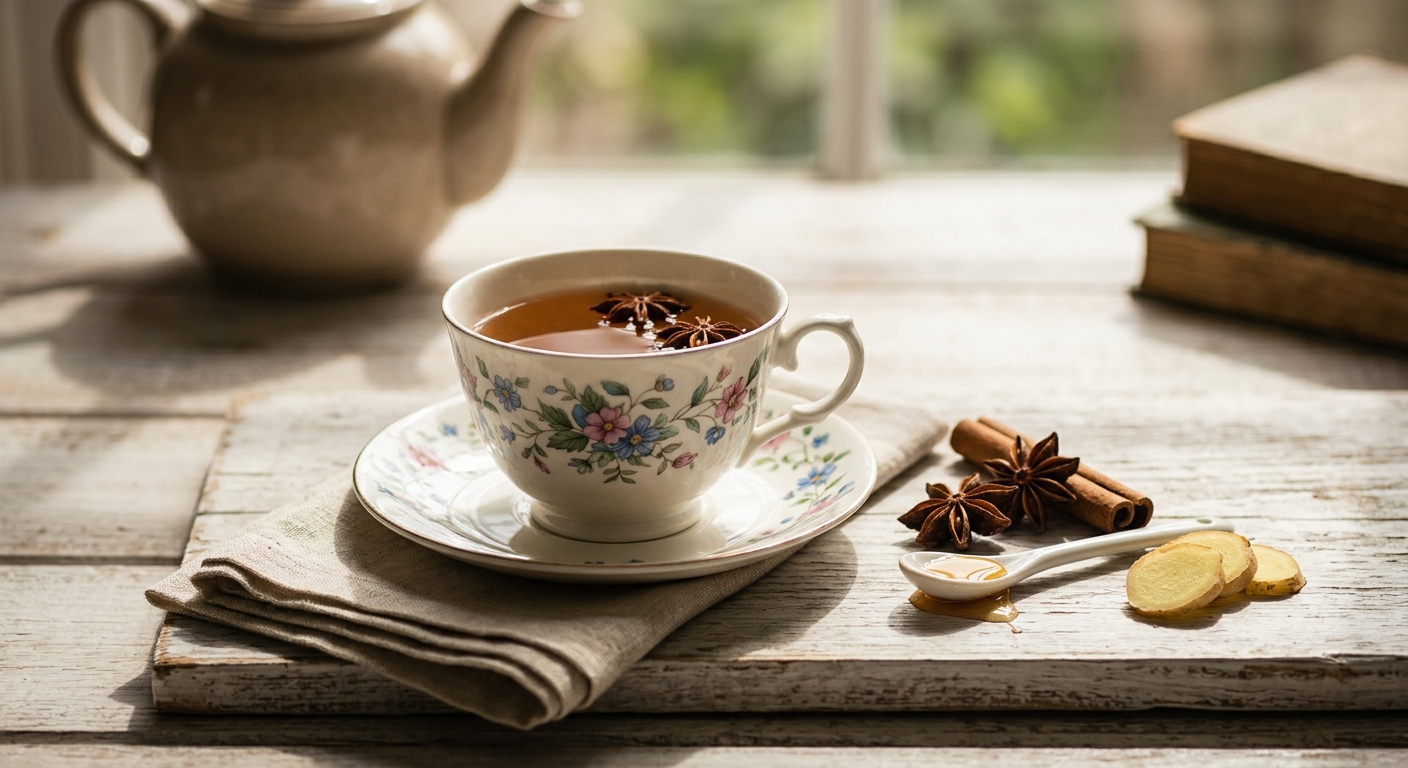
Few herbs command attention the way star anise does. The eight-pointed pods of Illicium verum have graced Chinese apothecaries, Vietnamese pho pots, and Indian spice markets for well over two thousand years. In Traditional Chinese Medicine, star anise is classified as a warming herb, prescribed to dispel cold from the middle burner (the digestive center), relieve abdominal pain, and restore harmony to a sluggish gut. The Latin genus name Illicium means ‘allure’ or ‘enticement,’ a fitting nod to the spice’s intoxicating fragrance that has drawn traders and healers alike across centuries and continents.
Star anise tea arrived in Europe during the 17th century, carried by Dutch traders who prized it as a cheaper alternative to European anise (Pimpinella anisum). Despite sharing a similar flavor, the two plants are botanically unrelated. Star anise’s licorice-like depth comes primarily from anethole, a phenylpropanoid compound that also gives the spice its antimicrobial and antispasmodic properties. Traditional herbalists across Southeast Asia brewed the pods with ginger and clove to create warming digestive tonics, sipping them after heavy meals to prevent bloating and encourage healthy gut motility. This practice has survived the centuries largely intact, and modern research is beginning to validate what these cultures understood intuitively.
What makes star anise particularly rewarding as a tea is the way it transforms with temperature. Hot-brewed, it delivers a deep, spiced warmth that feels almost medicinal. Cold-brewed overnight, the same pods yield a surprisingly delicate, almost floral sweetness with none of the harsh bite. Whether you are reaching for a cup to settle your stomach after dinner or simply craving something aromatic and grounding on a cold afternoon, star anise tea offers one of the most distinctive and satisfying experiences in the herbal tea world.
2
cups
Ingredients
- 4 whole podsdried star anise
- 480 mlwater (95°C / 203°F)
- —1 cinnamon stick (optional, for extra warmth)
- —raw honey or coconut sugar to taste (optional)
- —a few slices of fresh ginger (optional, for digestive synergy)
How to Brew
Click on an item below to shop for the recommended items for this recipe on Amazon.
As an Amazon Associate, we earn from qualifying purchases.
- Place 4 whole dried star anise pods on a cutting board. Press down firmly with the flat side of a knife or a mortar and pestle to crack them open, releasing their essential oils. Do not grind to a powder, just crack.
- If using optional additions, lightly bruise a few slices of fresh ginger and break the cinnamon stick in half to expose more surface area.
- Add the cracked star anise (and any optional spices) to a small saucepan with 480 ml of cold water. Bring slowly to 95°C (203°F) over medium heat, just below a full boil.
- Once the water reaches temperature, reduce the heat to low and allow the pods to simmer gently for 10 to 15 minutes. The liquid should deepen to a warm amber and the kitchen will fill with a rich, spiced aroma.
- Strain through a fine mesh strainer into two warmed mugs. Sweeten with raw honey or coconut sugar if desired, and serve immediately while the volatile oils are at their most fragrant.
- Use whole, uncracked star anise pods for cold brew. Because the extraction is slow and cold, cracking them would make the flavor overpowering. Place 6 whole pods into a clean glass jar.
- Pour 600 ml of room temperature filtered water over the pods. If you prefer a hint of sweetness, add one teaspoon of raw honey now and stir gently to dissolve partially, as it will continue to incorporate overnight.
- Seal the jar with a lid and leave it at room temperature for one hour to begin releasing the aromatic oils, then transfer to the refrigerator and allow it to steep for a further 10 to 12 hours, or overnight.
- Remove from the refrigerator and taste. If you prefer a stronger flavor, allow it to steep for up to 14 hours, but beyond this point the flavor can become flat. Strain through a fine mesh strainer into glasses filled with ice and serve chilled. The brew will keep refrigerated for up to 48 hours.
- Combine 6 to 8 whole star anise pods in a small saucepan. For a traditional digestive tonic, add complementary spices: one cinnamon stick, 4 to 5 green cardamom pods (lightly crushed), and 3 to 4 thin slices of fresh ginger root.
- Add 500 ml of cold filtered water. Bring to a full boil over medium-high heat without a lid, stirring once to ensure nothing is sticking.
- Once boiling, reduce the heat to maintain a gentle, steady simmer. Allow the decoction to reduce and concentrate for 20 to 25 minutes. You should end up with approximately 350 to 400 ml of deeply colored, fragrant liquid.
- Remove from heat and allow to rest for 3 to 5 minutes before straining through a fine mesh strainer lined with a piece of muslin or a coffee filter to remove all fine particles.
- Pour into small mugs or cups. This brew is intentionally strong, so sip slowly and savor. It pairs beautifully with a small drizzle of dark honey and a thin slice of orange. If you find the flavor too intense, dilute with a small amount of hot water to taste.
Health Benefits
The anethole and estragole in star anise act as antispasmodics on the smooth muscle of the intestinal wall, reducing cramping and encouraging the release of trapped gas. Traditional herbalists have used star anise as a carminative for this purpose for centuries, and in vitro studies confirm its relaxant effect on gut smooth muscle.
Star anise stimulates the secretion of digestive enzymes and bile, promoting more efficient breakdown of fats and proteins. Sipping a hot decoction after meals is a well-established traditional practice across China and Vietnam for this reason.
Research has demonstrated that anethole and other compounds in star anise exhibit significant antimicrobial activity against bacteria such as E. coli, Salmonella, and Listeria. This supports its traditional use as a protective digestive herb, particularly for gut infections and dysbiosis.
The quercetin, rutin, and shikimic acid content of star anise collectively contribute to a measurable anti-inflammatory effect. A 2012 study published in the Journal of Medicinal Plants Research found that star anise extracts significantly reduced inflammatory markers in animal models.
Shikimic acid, found in high concentrations in star anise pods, gained global attention as the primary raw material used to synthesize oseltamivir. While drinking star anise tea does not replicate pharmaceutical doses, the compound’s presence alongside anethole and flavonoids may offer modest antiviral support during cold and flu season.
🧪 Key Bioactive Compounds
The Science Behind Star Anise
The pharmacological story of star anise begins with trans-anethole, the phenylpropanoid compound that accounts for 75 to 90 percent of the essential oil extracted from Illicium verum pods. Anethole is a well-characterized antispasmodic: it reduces the tone and contractile activity of smooth muscle in the gastrointestinal tract by inhibiting calcium influx into muscle cells. This is the biochemical basis for star anise’s long-standing use as a carminative and antispasmodic. When you sip a hot cup of star anise tea after a heavy meal and feel your bloating or cramping ease, you are experiencing this mechanism in action. Anethole also demonstrates broad-spectrum antimicrobial activity, disrupting bacterial cell membranes and inhibiting biofilm formation in multiple species of gut pathogens, including Escherichia coli and Salmonella typhimurium.
Shikimic acid, another notable constituent, became globally significant in the early 2000s when pharmaceutical researchers identified it as the ideal precursor compound for synthesizing oseltamivir phosphate, the active ingredient in the antiviral drug Tamiflu. Star anise pods were the primary commercial source of shikimic acid for Tamiflu production for many years. Within the context of herbal tea, shikimic acid contributes to the brew’s anti-inflammatory profile. Studies using isolated shikimic acid have shown it inhibits the aggregation of platelets and reduces the production of pro-inflammatory prostaglandins, suggesting modest cardiovascular and anti-inflammatory benefits at regular dietary exposures.
The flavonoids quercetin and rutin round out the bioactive picture. Both compounds are potent antioxidants that scavenge reactive oxygen species and help maintain the integrity of the gut mucosal lining. Quercetin has been shown in multiple cell studies to inhibit the activation of NF-kB, a master regulator of inflammation, and to support tight junction proteins that prevent intestinal permeability. Rutin complements this by strengthening capillary walls and improving microcirculation in the gut tissue. Together, these compounds help explain why regular consumption of star anise tea in traditional cultures has long been associated not just with symptom relief but with sustained digestive resilience over time.
Brewing Tips
- Always crack or lightly crush star anise pods before hot brewing or simmering. The seeds inside the pods hold the highest concentration of essential oils, and exposing them dramatically intensifies both flavor and therapeutic potency.
- Star anise pairs exceptionally well with other warming digestive herbs. Try combining it with fennel seeds for enhanced carminative effect, with licorice root for added sweetness and gut-soothing properties, or with fresh ginger for a warming blend that combats nausea and sluggish digestion simultaneously.
- Store whole dried star anise pods in an airtight glass jar away from light and heat. Properly stored, they retain their volatile oil content and flavor for up to two years. Avoid pre-ground star anise powder for tea, as the volatile oils dissipate rapidly once the pods are ground, leaving a flat, diminished brew.