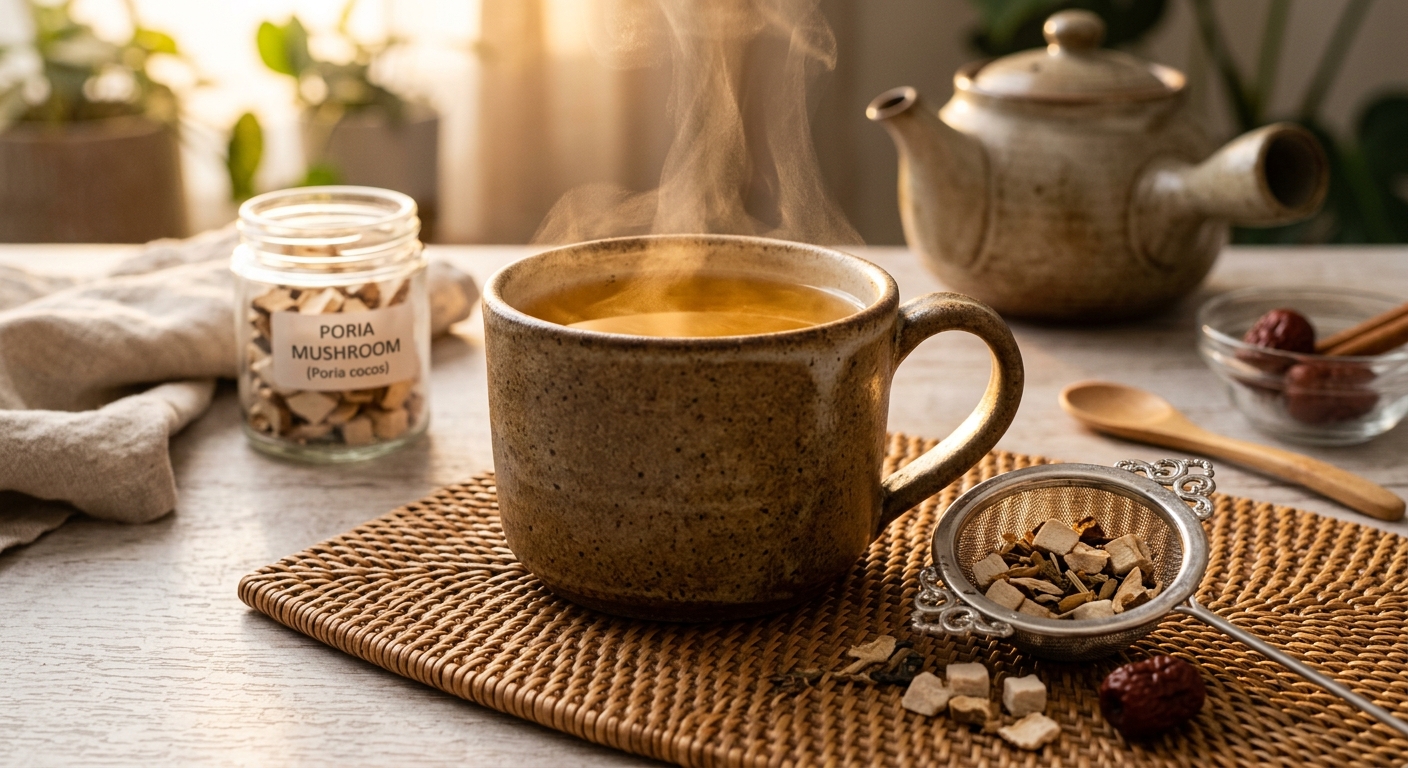
Poria mushroom, known in Chinese as Fu Ling and in Latin as Wolfiporia extensa (formerly Poria cocos), is one of the most enduring tonics in the classical Chinese pharmacopeia. Referenced in texts dating back to the Shennong Bencao Jing, a foundational herbal compendium from roughly 200 CE, Poria was classified as a superior herb, meaning one suitable for long-term daily use to nourish vitality without causing harm. It grows underground, a dense woody fungus that forms around the roots of pine trees, and was prized by ancient practitioners precisely because of this hidden, slow-growing nature. They believed it absorbed the essence of the pine over many years, concentrating a quiet, stabilizing energy.
In Traditional Chinese Medicine, Poria is said to calm the Heart and settle the Spirit, a poetic framework that maps closely onto what modern herbalists describe as nervous system support. It was prescribed for people who suffered from restless sleep, excessive worry, palpitations, and what we might now call anxiety-driven fatigue. Its reputation traveled beyond China into Japanese Kampo medicine and Korean traditional medicine, where it remains a staple ingredient in compound formulas targeting insomnia, cognitive clarity, and digestive weakness. Unlike more aggressive sedatives, Poria was never seen as a knock-out herb but rather as a gentle guide toward a more grounded, settled state of being.
What makes Poria particularly interesting today is how well its traditional reputation holds up under scientific scrutiny. Researchers have identified a range of bioactive polysaccharides and triterpenoids in the sclerotium that interact with the immune system, the gut microbiome, and the central nervous system in measurable ways. For tea drinkers looking for something beyond chamomile or valerian, Poria offers a subtle, slightly nutty brew with a long history and a growing body of evidence behind it. It blends beautifully with other calming herbs such as reishi, jujube seed, or polygala, but it is quietly compelling even when prepared on its own.
2
cups
Ingredients
- 10 gdried Poria mushroom pieces or slices
- 600 mlwater (for hot brew)
- —raw honey or jujube dates to taste (optional)
- —a small cinnamon stick (optional, pairs beautifully)
How to Brew
Click on an item below to shop for the recommended items for this recipe on Amazon.
As an Amazon Associate, we earn from qualifying purchases.
- Place 10 g of dried Poria pieces into a small saucepan. If the pieces are large, break or crush them slightly to increase surface area.
- Add 600 ml of cold water and bring it to a full boil over medium-high heat.
- Once boiling, reduce the heat to a low simmer, cover the pot partially with a lid, and let it decoct gently for 20 to 30 minutes. The liquid will reduce slightly and deepen to a warm amber color.
- Remove from heat and strain through a fine mesh strainer into two mugs, discarding the spent mushroom pieces.
- Taste the brew. It is naturally mild and earthy. Add raw honey, a few jujube dates, or a small piece of cinnamon during the last 5 minutes of simmering if you prefer a sweeter, warmer cup.
- Drink one cup in the evening about 30 to 60 minutes before bed for best sleep support.
- Measure 12 g of dried Poria pieces (slightly more than the hot brew ratio to compensate for the lower extraction efficiency of cold water) and place them in a clean glass jar.
- Pour 700 ml of filtered room-temperature water over the Poria pieces. Do not use hot water at any stage.
- Stir briefly, then cover the jar with a lid or cloth and let it sit at room temperature for 1 hour to allow initial hydration of the mushroom.
- Transfer the jar to the refrigerator and leave it to cold brew for 12 to 18 hours, or overnight.
- Strain the brew through a fine mesh strainer or cheesecloth into a clean bottle or pitcher, pressing gently on the solids to release the liquid.
- Serve chilled over ice. The flavor is lighter and slightly more neutral than the hot decoction. Add a few drops of honey dissolved in warm water, or a slice of fresh ginger, to lift the flavor if desired. Keeps refrigerated for up to 3 days.
- Combine 30 g of dried Poria pieces with 500 ml of cold water in a medium saucepan. The higher herb-to-water ratio is intentional for concentrate production.
- Bring to a full boil over medium-high heat, then reduce immediately to the lowest possible simmer. Cover the pot with a tight-fitting lid to minimize evaporation.
- Simmer low and slow for 45 to 60 minutes, checking occasionally to ensure the liquid has not reduced below roughly 250 ml. Add small amounts of water only if needed to prevent scorching.
- Remove from heat and allow the liquid to cool in the pot for 10 minutes. The concentrate will be noticeably darker, richer, and more viscous than a standard brew.
- Strain through a fine mesh strainer into a clean glass jar, pressing firmly on the solids. You should have approximately 200 to 250 ml of concentrate.
- Store the sealed jar in the refrigerator. To use, dilute 2 to 3 tablespoons of concentrate into 200 ml of hot water, warm plant-based milk, or a calming herbal base such as chamomile or passionflower tea. Use within 7 days.
Health Benefits
Lanostane triterpenoids in Poria, particularly pachymic acid, appear to enhance GABAergic activity in the brain, the same inhibitory pathway targeted by many pharmaceutical sleep aids but through a gentler, modulatory mechanism. A 2020 study published in Phytomedicine found that Poria polysaccharides prolonged non-rapid eye movement sleep in animal models and reduced sleep latency without causing morning grogginess.
Poria has been used for centuries to address what TCM calls ‘Heart-Spirit disquiet,’ manifesting as racing thoughts, anxiety, and an inability to settle. Pharmacological studies suggest its triterpenoid content modulates the HPA axis stress response and GABA receptor sensitivity, producing a calming effect without the cognitive blunting associated with stronger sedative herbs.
The beta-glucan polysaccharides in Poria, particularly pachymaran, act as biological response modifiers, meaning they help the immune system respond proportionately rather than simply stimulating or suppressing it. This immunomodulatory action has been the subject of substantial research in both oncology support settings and general immune health contexts.
TCM has long paired Poria with herbs that address dampness and digestive sluggishness, and modern research offers a plausible mechanism: Poria polysaccharides appear to selectively feed beneficial gut bacteria including Bifidobacterium and Lactobacillus species, supporting a microbiome environment linked to better mood, sleep, and immune regulation.
Emerging research suggests that Poria’s polysaccharide complexes may help protect neurons from oxidative stress and neuroinflammation, making it a candidate for long-term cognitive support. Several studies have found reduced markers of neuroinflammation in animal models supplemented with Poria extracts, aligning with its traditional use as a longevity tonic for mental clarity.
🧪 Key Bioactive Compounds
The Science Behind Poria Mushroom
The sleep-supporting reputation of Poria mushroom rests on two primary classes of compounds: polysaccharides and lanostane triterpenoids. The polysaccharides, most notably a beta-glucan complex called pachymaran, are high-molecular-weight carbohydrate chains that the human digestive system cannot break down in the conventional sense. Instead, they interact directly with immune receptors in the gut lining, particularly Toll-like receptors and Dectin-1 receptors on immune cells, triggering an immunomodulatory cascade. This is significant for sleep because immune signaling molecules called cytokines, including interleukin-1 beta and tumor necrosis factor-alpha, are deeply intertwined with sleep regulation. By helping to maintain a balanced cytokine environment, Poria’s polysaccharides may support the kind of physiological conditions in which natural, restorative sleep cycles can occur.
The triterpenoid fraction, particularly pachymic acid and related lanostane compounds, provides Poria’s more direct neurological activity. These lipid-soluble molecules are structurally capable of crossing the blood-brain barrier to a modest degree, where they appear to interact with GABA-A receptors, the principal inhibitory receptors in the central nervous system. GABA (gamma-aminobutyric acid) is the brain’s primary calming neurotransmitter, and drugs like benzodiazepines work by dramatically amplifying its effect. Poria’s triterpenoids appear to exert a far gentler, modulatory influence on this same system, which may explain the herb’s reputation for promoting calm without causing heavy sedation or next-day impairment. Research by Zheng and colleagues published in the Journal of Ethnopharmacology demonstrated that Poria triterpenoid extracts significantly reduced anxiety-like behavior in rodent models through GABAergic pathways.
A third and increasingly discussed mechanism involves the gut-brain axis. Poria’s prebiotic polysaccharides selectively stimulate the growth of beneficial gut bacteria, particularly Bifidobacterium longum and Lactobacillus species. These bacteria produce short-chain fatty acids and influence the enteric nervous system, which communicates bidirectionally with the brain via the vagus nerve. A healthier gut microbiome is associated with lower baseline anxiety, better stress resilience, and improved sleep quality, suggesting that Poria’s long-term calming effects may work partly through cultivating a more favorable gut environment over weeks and months of regular use. This systemic, multi-pathway action distinguishes Poria from single-mechanism herbal sedatives and may explain why it has endured as a daily tonic rather than an occasional acute remedy.
Brewing Tips
- Do not discard the spent Poria pieces after a single decoction. They can be re-simmered with fresh water for a second, lighter brew, as the dense woody matrix releases its compounds gradually over multiple extractions.
- Buy Poria from a reputable supplier who can confirm species identity and provides third-party testing for heavy metals and pesticide residue, as the mushroom supplement market has significant quality variation.
- Combine Poria with roasted barley or roasted rice (a traditional practice in Korean and Japanese preparations) for a warming, grain-forward drink with a deeper, toasty undertone that makes a satisfying caffeine-free evening beverage.