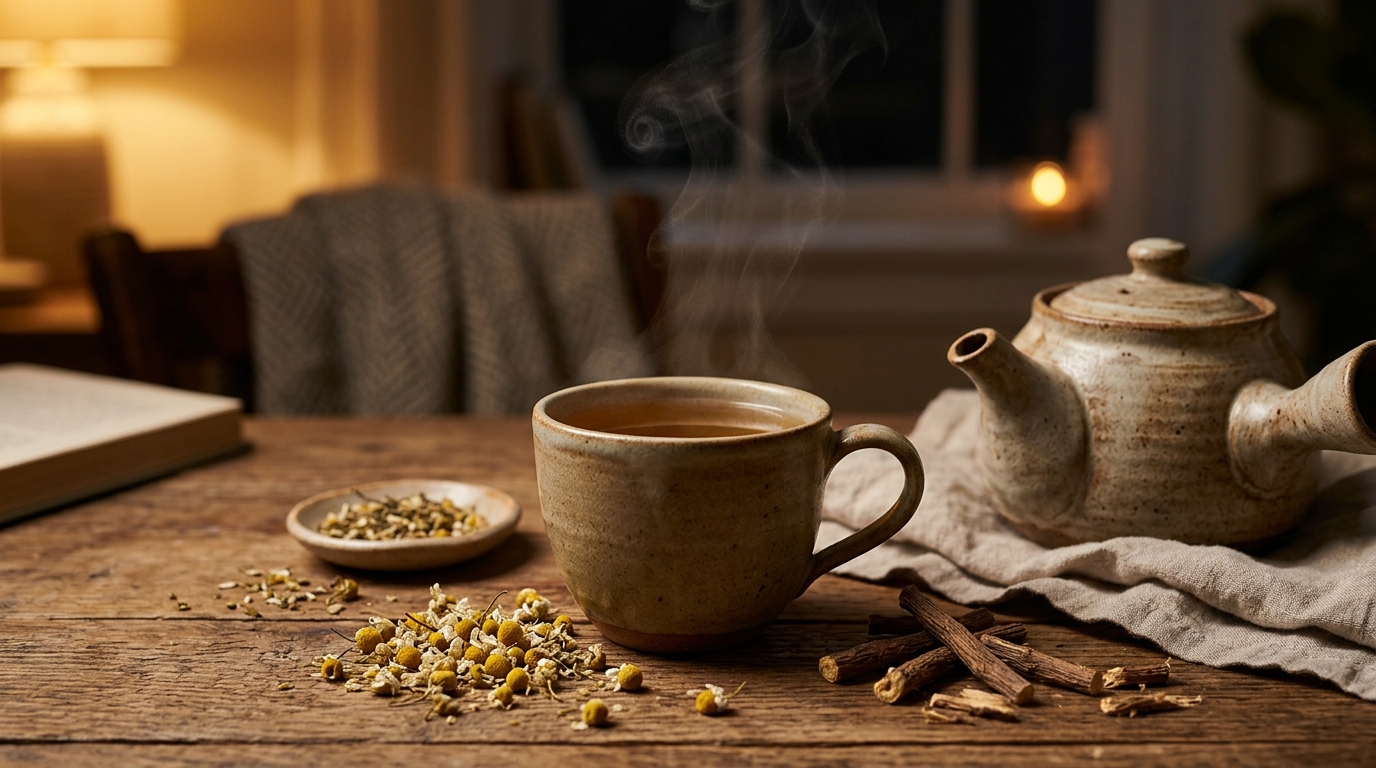
Licorice root (Glycyrrhiza glabra) has been prized for thousands of years. Jars of it were found in the tomb of Tutankhamun, Greek and Roman physicians prescribed it for coughs and stomach complaints, and Traditional Chinese Medicine counts it among its most frequently used herbs, often added to formulas as a harmonizer. Its main sweetening compound, glycyrrhizin, is roughly 30 to 50 times sweeter than sugar, which is why a small piece of root can transform an entire pot of tea.
Chamomile (Matricaria chamomilla) is the other half of this partnership. Its small, daisy-like flowers have been steeped as a bedtime remedy across Europe and the Middle East for centuries, valued for calming both the nervous system and the digestive tract. Herbalists have long grouped it among the carminatives, herbs that ease gas, cramping, and bloating after a meal.
Together, the two make a natural pairing. Licorice brings body, sweetness, and a soft, coating quality that herbalists call demulcent, while chamomile contributes its floral, apple-like fragrance and gentle relaxant action. The result is a mellow, golden nightcap that tastes like dessert but works quietly on a restless gut.
2
cups
Ingredients
- 1 tspdried licorice root, cut and sifted
- 2 tspdried chamomile flowers
- 480 mlwater (95°C / 203°F)
- —a thin slice of fresh ginger (optional)
- —a small strip of lemon peel (optional)
How to Brew
Click on an item below to shop for the recommended items for this recipe on Amazon.
As an Amazon Associate, we earn from qualifying purchases.
- Measure 1 teaspoon of cut and sifted licorice root and 2 teaspoons of dried chamomile flowers into a teapot or a large mug fitted with a basket infuser.
- Heat fresh water to just off the boil, around 95°C (203°F). Allow the kettle to rest for about 30 seconds after boiling so the water is not violently hot.
- Pour 480 ml of the hot water over the herbs, then immediately cover with a lid or small saucer to keep the aromatic oils in the cup.
- Steep for 8 to 10 minutes. Licorice root is dense and needs this longer window to release its sweet glycyrrhizin and soothing mucilage, while chamomile alone would be ready sooner.
- Strain well, pressing the herbs lightly against the strainer to extract the last of the sweet liquid, and sip slowly about 30 to 60 minutes before bed.
- Combine 2 teaspoons of cut licorice root and 3 teaspoons of chamomile flowers in a clean glass jar. This slightly higher ratio compensates for the gentler extraction of cold water.
- Pour in 700 ml of cool, filtered water, stir once with a spoon to wet the herbs, and seal the jar with its lid.
- Refrigerate for 8 to 12 hours, or overnight. There is no need to shake or stir during this time.
- Strain through a fine mesh sieve lined with a piece of muslin or a coffee filter to catch the tiny chamomile petals and licorice fibers.
- Serve over a few ice cubes or at refrigerator temperature, and finish the batch within 48 hours for the best flavor.
- Place 1 tablespoon of cut licorice root and a thin slice of fresh ginger, if using, into a small saucepan with 500 ml of cold water.
- Bring slowly to a gentle simmer over medium-low heat, then reduce the heat so the surface barely trembles. Avoid a rolling boil, which can make the licorice taste harsh and medicinal.
- Simmer uncovered for 15 minutes, until the liquid turns a pale honey color and smells distinctly sweet and anise-like. The volume will reduce slightly.
- Remove the pan from the heat, add 2 tablespoons of chamomile flowers, cover, and let steep for 5 minutes.
- Strain into a warmed mug and add a small strip of lemon peel if you like a bright finish. This richer, more concentrated cup is especially good after a heavy meal.
Health Benefits
Licorice has a demulcent, mucilage-like quality that coats irritated tissue, and a deglycyrrhizinated form (DGL) has been studied for dyspepsia and stomach discomfort. Chamomile adds a mild antispasmodic effect that relaxes tension in the digestive muscles.
Chamomile is a classic carminative, and its volatile oils help relax the smooth muscle of the intestines so trapped gas can pass more comfortably. Traditional European herbal medicine has used it for this purpose for generations.
Chamomile’s apigenin is believed to interact with GABA-related pathways, and small clinical studies suggest chamomile may modestly improve sleep quality. Settling the stomach before bed also removes a common source of nighttime restlessness.
Chamomile has been investigated in trials for mild anxiety, with some showing modest benefit. The warm ritual of sipping a sweet, fragrant tea slowly is itself a recognized way to signal the nervous system to downshift.
The same demulcent mucilage that comforts the stomach lining also coats the throat, which is why licorice root has long appeared in traditional cough and sore throat remedies.
🧪 Key Bioactive Compounds
The Science Behind Licorice Root
The sweetness and much of the soothing character of licorice come from glycyrrhizin, a saponin that is broken down in the gut into glycyrrhetinic acid. In laboratory and animal studies, licorice compounds have shown anti-inflammatory and mucosal-protective effects, and deglycyrrhizinated licorice (DGL) extracts have been used in clinical research on functional dyspepsia and gastric discomfort. Because glycyrrhizin itself can influence cortisol metabolism and blood pressure, the amount consumed matters, which is why moderation is the guiding rule with this herb.
Chamomile’s activity is led by its essential oil and flavonoids. Alpha-bisabolol and chamazulene display anti-inflammatory and antispasmodic properties in preclinical research, which supports chamomile’s traditional use for cramping and indigestion. Apigenin, a flavone abundant in the flowers, binds to benzodiazepine-like sites on GABA-A receptors, though far more weakly than a medication would, which likely accounts for the mild calming effect people notice. Human trials on chamomile for sleep and anxiety are generally small, so the evidence is encouraging but not conclusive.
Together, the two herbs address the gut from complementary angles: licorice coats and protects, while chamomile relaxes and calms. Taken in the evening, the blend supports the body’s natural wind-down, easing digestion at a time when a settled stomach makes rest come more easily.
Brewing Tips
- Use cut and sifted licorice root rather than powder. Powder clouds the cup and can taste overly strong, while small root pieces release sweetness slowly and evenly.
- Because licorice is naturally sweet, skip the honey at first. Most people find the tea sweet enough on its own, and you avoid adding sugar before bed.
- Store both herbs in airtight, opaque containers away from light and heat. Chamomile loses its apple-like fragrance quickly, so buy small amounts and use within six months.
- Make this tea a ritual rather than a rush. Sip it slowly about an hour before bed and keep the lights low to help your body shift toward rest.