
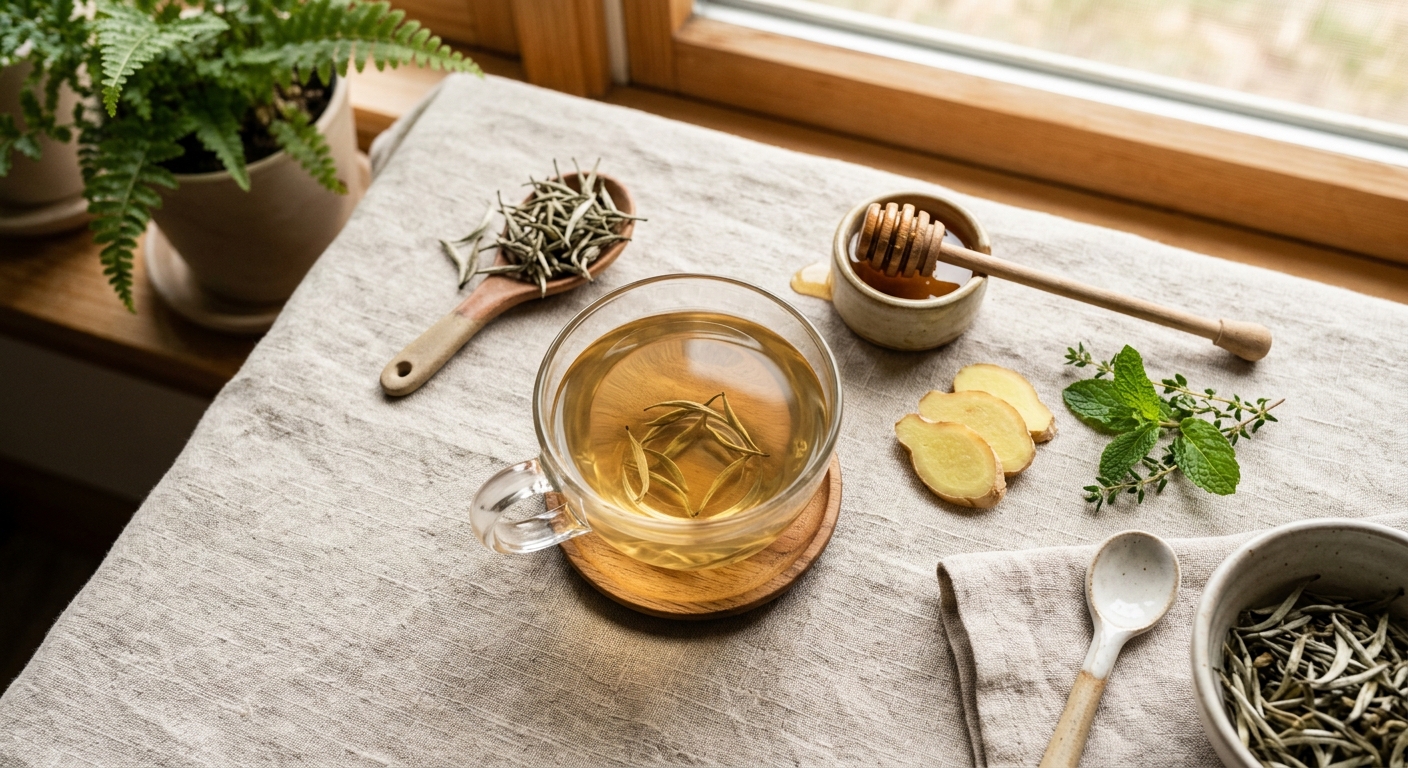
White tea occupies a rare place in the world of tea: it is simultaneously the simplest and the most delicate. Harvested primarily in Fujian province, China, white tea has been cultivated for over a thousand years, with records of its ceremonial use dating back to the Song Dynasty (960 to 1279 CE). Imperial court officials would present the finest white buds, known as Silver Needle or Baihao Yinzhen, as tribute to the emperor. Unlike green or black teas, white tea undergoes almost no processing. The buds are simply plucked, withered slowly in sunlight or gentle heat, and dried, preserving an extraordinary concentration of polyphenols, amino acids, and aromatic compounds that other processing methods tend to destroy.
In traditional Chinese medicine, white tea was valued for its cooling and cleansing properties. Practitioners used it to clear heat from the body, support the lungs, and promote mental clarity. This connection between white tea and mental acuity is not merely folklore. The combination of modest caffeine content alongside a high concentration of the amino acid L-theanine produces what researchers now describe as a state of relaxed alertness, a calm, sustained focus quite different from the sharp spike and crash associated with coffee. For those seeking enhanced concentration without overstimulation, white tea occupies a uniquely effective middle ground.
Sensory experience is central to white tea’s enduring appeal. A well-brewed cup reveals layers of flavor: fresh melon, honeysuckle, and a clean sweetness reminiscent of morning dew on new leaves. The liquor is pale, often barely golden, and the aroma is so subtle it rewards slow, attentive sipping. This gentleness is not weakness. It is a reflection of the tea’s extraordinary purity, one that has made it among the most prized and sought-after teas in the world for centuries.
2
cups
Ingredients
- 2 tsploose leaf white tea (Silver Needle or White Peony)
- 240 mlwater (75 to 80°C / 167 to 176°F)
- —raw honey or rock sugar to taste (optional)
- —thin slice of fresh ginger (optional)
How to Brew
Click on an item below to shop for the recommended items for this recipe on Amazon.
As an Amazon Associate, we earn from qualifying purchases.
- Bring filtered water to a full boil, then remove it from heat and allow it to rest for 5 to 6 minutes until it cools to approximately 75 to 80°C (167 to 176°F). Alternatively, use a variable-temperature kettle set to this range.
- Warm your teapot or mug by rinsing it with a small splash of hot water and discarding it. This keeps the brewing temperature stable once you add your tea.
- Add 2 teaspoons (approximately 2 to 3 grams) of loose leaf white tea per 240 ml of water to your infuser or teapot. Silver Needle buds are bulky, so a generous measure by volume is appropriate.
- Pour the cooled water gently over the leaves in a slow, circular motion. Avoid pouring directly onto the buds with force, as this can bruise them and cause unpleasant bitterness.
- Steep for 2 to 4 minutes. Begin tasting at the 2-minute mark. The tea is ready when it turns a pale champagne gold and carries a clean floral sweetness. Remove the infuser promptly to prevent over-steeping.
- White tea buds are excellent for multiple infusions. Re-steep the same leaves up to three times, adding an additional 30 to 60 seconds per subsequent infusion. The flavor shifts subtly with each steeping, from floral to slightly creamier and more mineral.
- Measure 3 teaspoons (approximately 4 grams) of loose leaf white tea per 480 ml of cold or room-temperature filtered water. Cold brewing requires a slightly higher leaf-to-water ratio than hot brewing to compensate for slower extraction.
- Combine the tea and water in a glass jar or pitcher. There is no need to pre-heat the vessel. Simply add leaves directly, as cold water will not damage them.
- Stir gently to ensure the leaves are fully submerged and making contact with the water. Do not shake, as agitation can introduce air bubbles that affect clarity and flavor.
- Cover the jar or pitcher with a lid or plastic wrap and place it in the refrigerator. Allow it to steep for a minimum of 6 hours, with 8 to 10 hours delivering the most balanced flavor. Overnight steeping is ideal and very convenient.
- When steeping is complete, strain the tea through a fine mesh strainer or muslin cloth into a clean pitcher or glass. The resulting liquor should be crystal clear, very pale gold, and noticeably sweeter than a hot-brewed cup.
- Serve over ice in tall glasses. Cold-brewed white tea pairs beautifully with a wedge of fresh cucumber or a sprig of mint. Store leftover tea covered in the refrigerator for up to 48 hours.
- Use a gaiwan or small Yixing clay teapot with a capacity of 100 to 150 ml. Measure approximately 5 grams of loose leaf white tea, filling the vessel roughly one-third to one-half full by volume. The high leaf-to-water ratio is fundamental to gongfu brewing.
- Heat filtered water to 78 to 82°C (172 to 180°F). Perform a rinse infusion: pour just enough hot water over the leaves to briefly submerge them, then immediately discard this liquid after 5 to 8 seconds. This rinse hydrates the tightly furled buds, awakens their aroma, and removes any surface dust.
- Pour the hot water over the leaves again in a steady, gentle stream, filling the gaiwan. Steep for only 15 to 20 seconds for the first infusion. Pour all the liquor immediately into a small pitcher (gong dao bei) and then distribute into tasting cups.
- Observe the color, inhale the aroma, and sip slowly. The first infusion of Silver Needle will often be almost colorless with a delicate floral sweetness. Subsequent infusions become progressively more golden and develop notes of melon, light honey, and a subtle mineral quality.
- Continue steeping with incremental time increases: add 10 to 15 seconds per infusion. A high-quality Silver Needle can sustain 6 to 8 infusions. White Peony (Bai Mu Dan) typically yields 4 to 6 excellent infusions before the flavor becomes thin.
- Between infusions, keep the lid of the gaiwan slightly ajar so the leaves do not continue to steam in residual heat. This small step preserves the integrity of later infusions and prevents overcooking the delicate leaf material.
Health Benefits
The synergistic action of L-theanine and caffeine in white tea is well-documented in human clinical trials. L-theanine smooths the stimulant curve of caffeine, sustaining attention and reaction time while significantly reducing the anxiety and heart-rate elevation that caffeine alone can cause.
Because white tea is minimally processed and not oxidized, it retains higher levels of catechins, particularly EGCG, than green or black tea. These polyphenols scavenge reactive oxygen species (free radicals) that contribute to cellular aging and chronic disease development.
Regular consumption of white tea has been associated in multiple population studies with lower LDL cholesterol oxidation and improved arterial function. The flavonoids kaempferol and quercetin help maintain the elasticity of blood vessel walls and reduce inflammatory markers associated with heart disease risk.
Catechins in white tea have demonstrated inhibitory activity against a range of bacteria including Streptococcus mutans, the primary bacterium responsible for dental caries. Regular consumption may support a healthier oral microbiome and reduce the risk of cavities and gum disease.
The polyphenols in white tea have been shown in both in vitro and some human studies to inhibit enzymes that break down collagen and elastin, the structural proteins responsible for skin firmness. This has led to growing interest in white tea as both an ingestible and a topical ingredient in dermatology.
🧪 Key Bioactive Compounds
The Science Behind White Tea
The most compelling pharmacological story in white tea involves the interplay between two naturally occurring compounds: caffeine and L-theanine. On its own, caffeine blocks adenosine receptors in the brain, reducing feelings of fatigue and increasing the firing rate of neurons. However, caffeine in isolation also elevates cortisol, raises heart rate, and can provoke anxiety in sensitive individuals. L-theanine, an amino acid found almost exclusively in the Camellia sinensis plant, modifies this response in a meaningful way. It crosses the blood-brain barrier and increases alpha brain wave activity, which is associated with a wakeful but relaxed mental state. Multiple double-blind human trials have confirmed that the combination of caffeine and L-theanine produces superior attention, working memory, and processing speed compared to either compound alone, with significantly reduced anxiety and jitteriness as a side effect. White tea’s relatively high L-theanine to caffeine ratio makes it one of the most favorable teas for this balanced cognitive effect.
White tea is also distinguished by its exceptional polyphenol content. Because the leaves and buds undergo no oxidation during processing, the enzymes that would normally convert catechins into theaflavins and thearubigins (the compounds that give black tea its color and robust flavor) are never activated. This means white tea retains a much higher proportion of intact catechins, including the well-studied epigallocatechin gallate (EGCG). EGCG operates through several mechanisms: it directly scavenges reactive oxygen species, chelates metal ions that catalyze oxidative reactions, and modulates signaling pathways involved in inflammation, including NF-kB and MAPK. Population studies, particularly from East Asian cohorts with high tea consumption, consistently associate catechin intake with reduced incidence of cardiovascular disease and certain cancers, though researchers are careful to note that these are correlational findings rather than established causation.
Emerging research has also examined white tea’s effects on metabolic health and skin biology. In vitro studies have found that white tea extract inhibits adipogenesis (the formation of new fat cells) and may support glucose metabolism by improving insulin sensitivity at the cellular level. For skin health, the flavonoids kaempferol and quercetin have demonstrated measurable inhibition of matrix metalloproteinase enzymes (MMPs), which are responsible for breaking down collagen and elastin in the skin’s extracellular matrix. While clinical human trials on these specific effects remain limited, the mechanistic evidence supports the growing interest in white tea as a plant-based tool for healthy aging, both internally and externally.
Brewing Tips
- Always use filtered water when brewing white tea. Chlorine and minerals in tap water can dramatically mask the tea’s delicate floral notes and produce a flat, dull cup.
- Store loose leaf white tea in an airtight, opaque container away from light, heat, and strong odors. Unlike pu-erh, white tea does not benefit from moisture or air exposure and will degrade rapidly if stored incorrectly.
- If your white tea tastes bitter or grassy, your water is almost certainly too hot. Drop the temperature by 5°C and reduce steep time by 30 seconds. The ideal brew should taste sweet and clean with no astringency whatsoever.