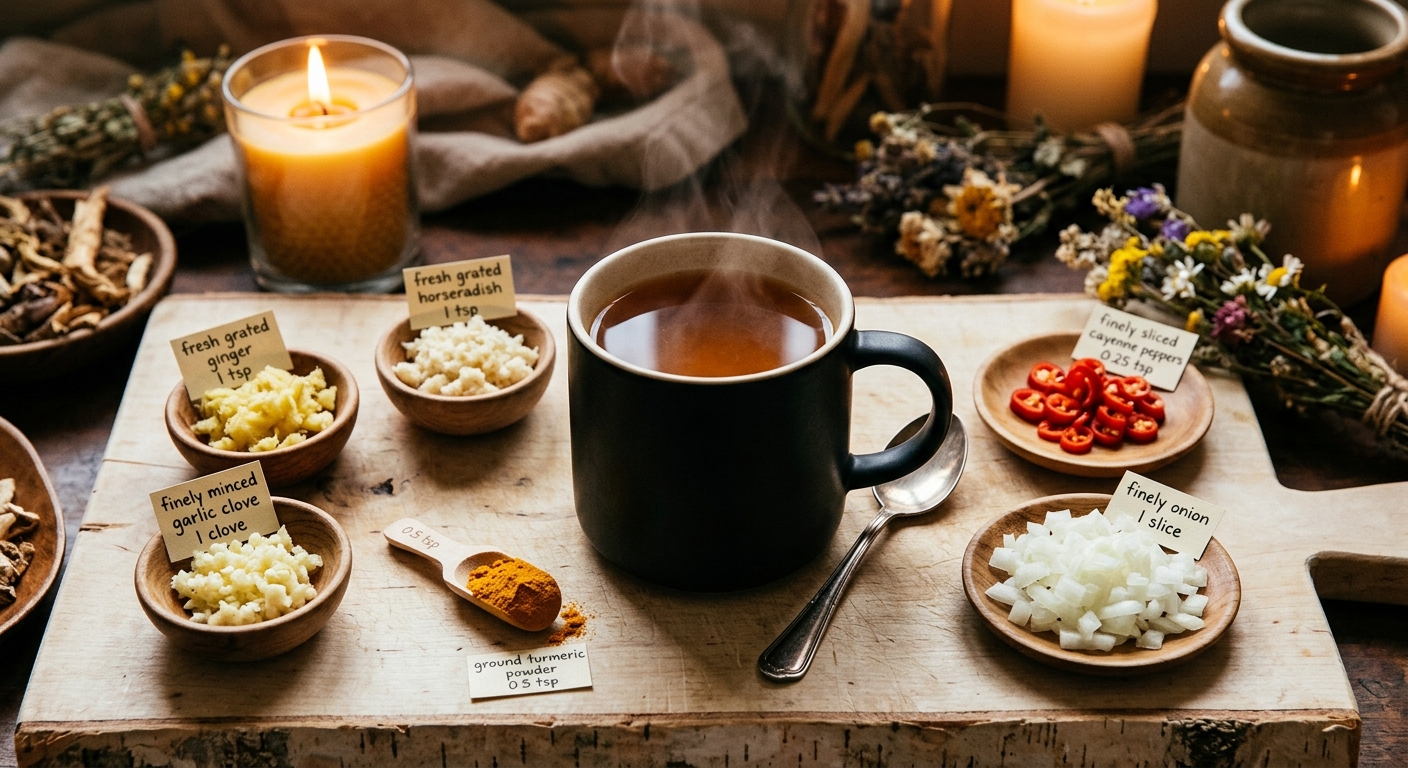
Long before modern pharmacies stocked cold remedies, healers across Europe and the Americas relied on a powerful preparation known by many names: fire cider, master tonic, thieves’ vinegar, and plague tonic among them. At its core, the master tonic is a blend of some of nature’s most aggressively antimicrobial and immune-activating plants, traditionally macerated together to extract every last drop of their protective potential. Brewed as a tea, this same spirit-lifting, sinus-clearing combination becomes an accessible daily ritual for anyone looking to fortify their defenses, especially in the colder months when viruses circulate freely.
The roots of master tonic trace back through European herbalism and Ayurvedic medicine, where ginger, garlic, and horseradish were considered irreplaceable tools for combating respiratory illness and systemic infection. Medieval plague doctors and folk healers alike prepared variations of this blend, believing that the heat and pungency of these plants could purge sickness from the body. While modern science has since confirmed many of the antimicrobial and anti-inflammatory properties once attributed only to folklore, the tradition of drinking a warming, spicy tonic at the first sign of a cold remains as alive as ever.
What makes Master Tonic Tea genuinely special is the synergy among its ingredients. Ginger and turmeric bring broad-spectrum anti-inflammatory support, garlic delivers its renowned allicin compounds, horseradish opens the sinuses with almost immediate effect, and the capsaicin in hot pepper stimulates circulation and sweating to help the body process infection. Together, steeped into a strong, steaming brew, they create one of the most effective natural remedies available in a teacup. The flavor is bold, fiery, and unmistakably medicinal, but with a squeeze of lemon and a spoonful of raw honey, it becomes something you will genuinely look forward to reaching for when you feel a cold coming on.
2
cups
Ingredients
- 1 tspfreshly grated ginger (or 0.5 tsp dried ground ginger)
- 1 tspfreshly grated or prepared horseradish
- 1 clovefresh garlic, minced or crushed
- 0.5 tspground turmeric
- 0.25 tspcayenne pepper or finely sliced fresh hot pepper
- 1 slicewhite or yellow onion, finely chopped
- 480 mlfiltered water
- —juice of half a lemon (optional but recommended)
- —raw honey to taste (optional)
- —pinch of black pepper (enhances turmeric absorption)
How to Brew
Click on an item below to shop for the recommended items for this recipe on Amazon.
As an Amazon Associate, we earn from qualifying purchases.
- Prepare your ingredients: grate fresh ginger and horseradish, crush or mince the garlic clove, finely chop the onion slice, and measure out the turmeric, cayenne, and black pepper.
- Add all prepared ingredients to a small saucepan with 480 ml of filtered water. Bring to a gentle boil over medium heat.
- Once boiling, reduce the heat to low and allow the blend to simmer uncovered for 10 to 15 minutes. The liquid will reduce slightly and deepen in color. The aroma will become very strong – this is normal and desirable.
- Remove from heat and allow to cool for 2 minutes. Pour through a fine mesh strainer into two mugs, pressing the solids gently with a spoon to extract remaining liquid.
- Squeeze in fresh lemon juice and stir in raw honey to taste. Add an extra pinch of cayenne if you want more heat. Drink while hot for maximum sinus-clearing effect.
- Prepare a double batch of ingredients for best results: use 2 tsp grated fresh ginger, 2 tsp fresh horseradish, 2 crushed garlic cloves, 1 tsp turmeric, 0.5 tsp cayenne, and 2 onion slices per 960 ml of cold filtered water.
- Place all prepared ingredients into a clean glass jar. Pour cold filtered water over the top. Stir briefly to distribute the ingredients, then seal the jar tightly with a lid.
- Leave the jar at room temperature for 1 to 2 hours to begin the infusion, then transfer to the refrigerator. Allow to steep for a total of 12 to 24 hours. A longer steep produces a more intense, medicinal result.
- When ready, strain the infusion through a fine mesh strainer or cheesecloth into a clean bottle or jug, pressing firmly on the solids to extract all liquid. Discard the solids.
- Pour into a glass over ice or at room temperature. Stir in fresh lemon juice and a small amount of honey. The cold brew concentrate keeps refrigerated for up to 5 days. Shake or stir well before each use, as sediment will settle naturally.
- Combine a large batch of ingredients in a medium saucepan: 2 tablespoons freshly grated ginger, 2 tablespoons freshly grated horseradish, 4 crushed garlic cloves, 1 teaspoon turmeric, 0.5 teaspoon cayenne, and one quarter of a small onion, roughly chopped.
- Add 960 ml of filtered water and bring to a full boil over medium-high heat.
- Reduce heat to medium-low and simmer uncovered for 25 to 30 minutes, allowing the liquid to reduce by roughly half to around 480 ml. The concentrate will be very deep in color, fragrant, and intensely flavored.
- Remove from heat and cool for 5 minutes. Strain through a fine mesh strainer or cheesecloth into a clean glass jar, pressing the solids firmly to extract maximum liquid.
- Once fully cooled, stir in 2 tablespoons of raw apple cider vinegar and the juice of one lemon. This brightens the flavor and adds additional antimicrobial properties. Seal the jar and refrigerate.
- Take as a 30 to 60 ml wellness shot daily, or dilute 60 ml of concentrate into 180 ml of hot water or herbal tea for a full tonic cup. The concentrate keeps refrigerated for up to 10 days.
Health Benefits
The combination of allicin from garlic, quercetin from onion, and curcumin from turmeric collectively stimulate innate immune cell activity and reduce systemic inflammation that can leave the body vulnerable to infection. Multiple clinical studies support garlic supplementation in reducing both the frequency and duration of common colds.
Horseradish contains allyl isothiocyanate, a compound that acts as a powerful natural expectorant and decongestant, loosening mucus and opening sinus passages almost immediately upon ingestion. Capsaicin from hot pepper amplifies this effect by stimulating mucus secretion and drainage.
Several compounds in this blend, particularly allicin, sinigrin derivatives, and gingerols, have demonstrated direct antimicrobial activity against common cold and flu pathogens in laboratory studies. While in vivo evidence is still growing, traditional use across cultures strongly supports this blend as a first-response infection remedy.
Ginger and turmeric are among the most comprehensively studied natural anti-inflammatory agents available. Curcumin inhibits NF-kB signaling, a key driver of chronic and acute inflammation, while gingerols suppress pro-inflammatory cytokines, making this tea beneficial beyond acute illness as an ongoing anti-inflammatory practice.
Capsaicin, gingerols, and horseradish compounds all promote peripheral vasodilation and warming of the body, which supports the immune system’s fever-mediated defense mechanisms and may help the body process illness more efficiently.
🧪 Key Bioactive Compounds
The Science Behind Master Tonic Blend (Ginger, Garlic, Horseradish, Turmeric, Hot Pepper, Onion)
The immune-activating reputation of Master Tonic Tea is not simply folklore. Each ingredient brings specific, well-characterized bioactive compounds that have been studied in isolation and, increasingly, in combination. Garlic’s allicin is perhaps the most clinically validated of these compounds. A landmark randomized controlled trial published in Advances in Therapy found that daily garlic supplementation reduced the incidence of common colds by over 60 percent compared to placebo, with significantly faster recovery times. Allicin exerts its effects by disrupting the enzyme systems of bacteria and viruses, while simultaneously modulating white blood cell activity to heighten the body’s own defense response.
Ginger and turmeric represent the anti-inflammatory backbone of this blend. Curcumin, the principal polyphenol in turmeric, inhibits nuclear factor kappa-B (NF-kB), one of the most important molecular switches controlling immune and inflammatory gene expression. Without adequate piperine, however, curcumin passes through the digestive system largely unabsorbed, which is why adding a pinch of black pepper to this tea is not merely a cooking habit but a pharmacokinetically sound practice. Piperine has been shown to increase curcumin bioavailability by up to 2,000 percent. Ginger’s gingerols and shogaols work through complementary but distinct pathways, suppressing COX-2 enzyme activity much like pharmaceutical anti-inflammatories, while also demonstrating direct antiviral activity against respiratory syncytial virus and influenza strains in cell culture studies.
Horseradish and cayenne pepper contribute some of the most immediately felt effects of this tonic. When horseradish cells are ruptured by grating or chewing, the enzyme myrosinase converts sinigrin into allyl isothiocyanate, a volatile compound with powerful antimicrobial properties and pronounced mucolytic action. This is what drives the characteristic sinus-clearing sensation within seconds of consumption. Capsaicin from hot pepper activates TRPV1 receptors throughout the body, stimulating thermogenesis, increasing mucosal secretions in the airways, and promoting the kind of peripheral circulation that supports efficient immune cell trafficking. Together, these compounds create a synergistic effect that is greater than the sum of its parts, one that has sustained this tonic’s place in herbal medicine traditions across continents for centuries.
Brewing Tips
- Always crush or mince garlic and let it rest for 5 to 10 minutes before adding it to heat. This resting period allows the enzyme reaction that produces allicin to complete fully before the heat can deactivate the enzyme, maximizing the medicinal potency of the garlic in your brew.
- If the heat of cayenne and horseradish is too intense at first, start with half the listed amounts and gradually increase over several days. Your tolerance will build quickly, and the full-strength version will become far more comfortable within a week of regular use.
- For maximum immune effect during acute illness, drink one cup of the hot brew three times daily between meals rather than with food. Consuming it on an empty stomach allows faster absorption of the active compounds, though people with sensitive stomachs should always have a small amount of food first to protect the gastric lining.