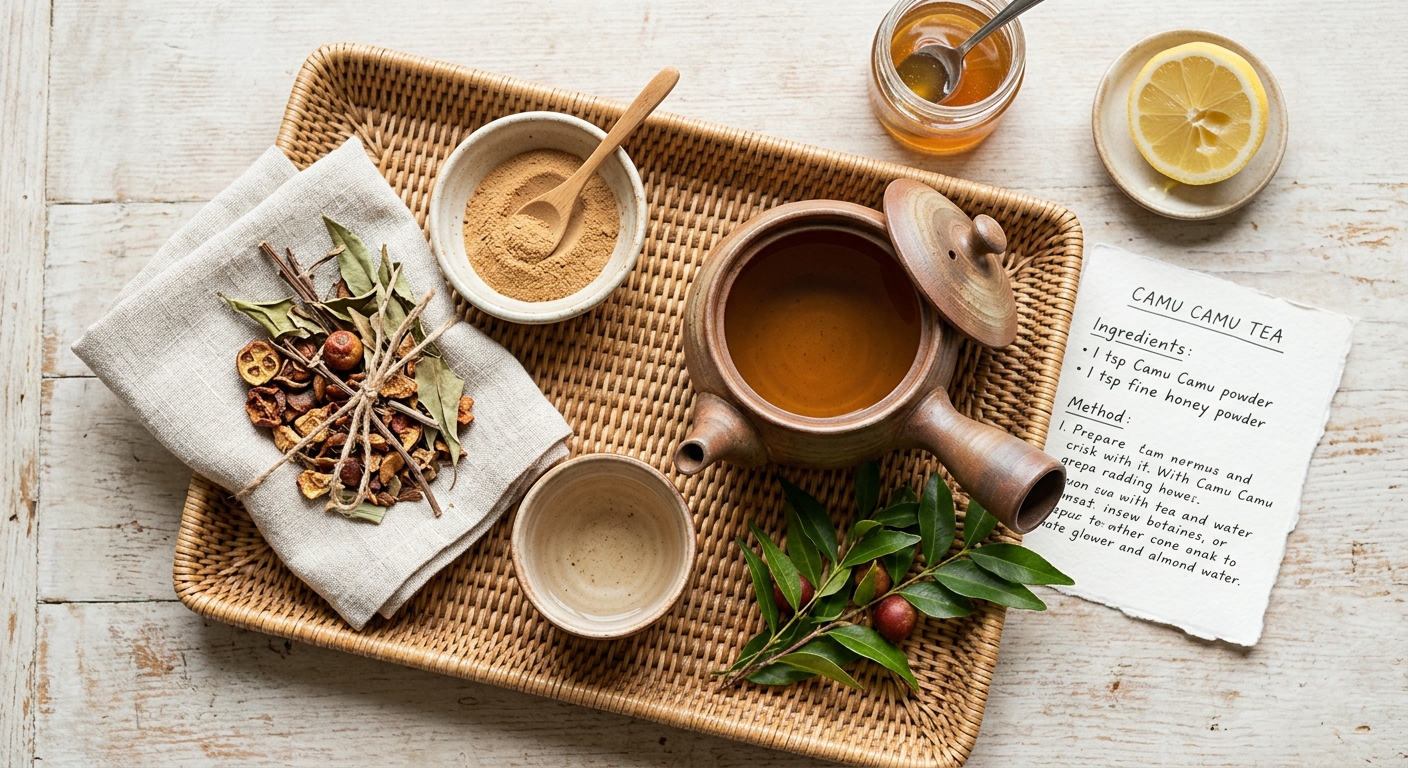
Deep within the flooded forests of the Amazon basin, a small, cherry-like berry grows along the banks of rivers in Peru, Brazil, and Colombia. Known as camu camu (Myrciaria dubia), this unassuming fruit has been gathered and used by indigenous Amazonian peoples for generations, prized not only as a food source but as a remedy for colds, inflammation, and fatigue. Long before modern nutritional science arrived, communities along the Amazon River understood that this tart little fruit carried something powerful within its flesh.
What makes camu camu truly remarkable is its extraordinary concentration of vitamin C. Gram for gram, it contains anywhere from 20 to 40 times more vitamin C than oranges, making it one of the richest natural sources of ascorbic acid ever recorded. When brewed into a tea using dried powder or dehydrated fruit pieces, those vitamin C compounds along with a suite of polyphenols, flavonoids, and ellagic acid are released into the cup, creating a beverage that is as functionally impressive as it is vibrantly tangy.
Camu camu tea has gained significant attention in the wellness world as a natural approach to immune support, especially during cold and flu season. Its striking citrus-forward flavor, ranging from sharp and sour to a softer tartness depending on preparation, makes it a sensory delight as well as a health ritual. Whether you are sipping it hot on a winter morning or chilling it down into a refreshing cold brew, camu camu tea offers a direct connection to one of the most nutrient-dense plants the Amazon has to offer.
2
cups
Ingredients
- 1 tspcamu camu powder (or 2 tsp dried camu camu fruit pieces)
- 240 mlwater (70 to 80°C / 158 to 176°F)
- —raw honey or maple syrup to taste (optional)
- —a squeeze of fresh lemon juice (optional, enhances absorption)
How to Brew
Click on an item below to shop for the recommended items for this recipe on Amazon.
As an Amazon Associate, we earn from qualifying purchases.
- Heat fresh filtered water to 70 to 80°C (158 to 176°F). If you do not have a temperature-controlled kettle, bring water to a full boil and allow it to rest uncovered for 4 to 5 minutes before using.
- Add 1 teaspoon of camu camu powder per 240 ml of water directly into your mug. If using dried fruit pieces, measure 2 teaspoons and place them in a fine mesh infuser or strainer set over your mug.
- Pour the cooled water slowly over the powder or infuser and stir gently for 20 to 30 seconds to ensure the powder disperses evenly with no clumping.
- Allow the tea to steep for 3 to 5 minutes. If using fruit pieces, gently press them with the back of a spoon before removing the infuser to extract maximum flavor and nutrients.
- Sweeten with raw honey or maple syrup to balance the tartness, and add a small squeeze of fresh lemon juice if desired. The acidity actually helps stabilize the vitamin C. Sip while warm and enjoy the bright, citrus-forward flavor.
- Measure 2 teaspoons of camu camu powder per 500 ml of cold, filtered water. For a lighter brew, reduce to 1.5 teaspoons. Add the powder directly to a glass jar or cold brew pitcher.
- Pour room-temperature or cold filtered water over the powder. Stir vigorously or seal the jar and shake for 30 to 60 seconds to fully dissolve the powder and prevent it from settling in clumps at the bottom.
- Seal the jar tightly and place it in the refrigerator. Allow it to cold brew for a minimum of 6 hours, though 8 to 10 hours overnight produces the fullest, most balanced flavor.
- When ready to serve, give the jar another shake or stir, as some powder may have settled. Strain through a fine mesh sieve into glasses filled with ice if desired.
- Taste before sweetening. The cold brew method naturally softens the sharpest sourness, so you may find you need less honey. Add a thin slice of fresh ginger or a few mint leaves for a refreshing variation.
- Bring 250 ml of filtered water to approximately 70 to 75°C (158 to 167°F). Measure 3 to 4 teaspoons of camu camu powder into a heat-proof glass measuring jug or small saucepan.
- Pour the heated water over the powder and whisk continuously for 1 to 2 minutes until fully dissolved and no dry powder remains. The mixture will be deeply colored and intensely tart.
- Allow the concentrate to steep for 8 to 10 minutes, stirring once or twice during this time. Do not bring to a boil at any point, as sustained heat will degrade the ascorbic acid content.
- Optionally stir in 1 to 2 tablespoons of raw honey while the concentrate is still warm, which allows the honey to dissolve fully and acts as a mild natural preservative.
- Pour the cooled concentrate into a small glass bottle or jar. Store in the refrigerator for up to 5 days. To serve, dilute 2 to 3 tablespoons of concentrate in 200 to 250 ml of hot water, cold water, or sparkling water.
Health Benefits
Camu camu delivers extraordinarily high levels of vitamin C, a nutrient essential to the production and function of white blood cells including neutrophils and lymphocytes. Clinical evidence consistently shows that adequate vitamin C intake reduces the duration and severity of common colds and supports immune defense against respiratory pathogens.
Beyond vitamin C, camu camu contains anthocyanins, ellagic acid, and quercetin, which together create a broad-spectrum antioxidant profile. Studies comparing camu camu extract to isolated ascorbic acid have found the whole fruit exerts greater antioxidant activity, suggesting synergistic effects between its many bioactive compounds.
Ellagic acid and quercetin found in camu camu have been shown to suppress key inflammatory markers including interleukin-6 and C-reactive protein. A 2013 human study published in the Journal of Cardiology found that camu camu supplementation significantly reduced oxidative stress and inflammatory biomarkers compared to vitamin C tablets delivering the same ascorbic acid dose.
Vitamin C plays a critical role in the biosynthesis of neurotransmitters, including dopamine and norepinephrine. Adequate levels are associated with reduced fatigue, better stress resilience, and improved mood, making camu camu tea a thoughtful choice during periods of physical or mental strain.
Ascorbic acid is a required cofactor for the enzymes that build collagen, the structural protein underpinning skin elasticity and wound repair. Regular consumption of vitamin-C-rich foods and beverages like camu camu tea supports skin integrity from within, complementing topical skincare approaches.
🧪 Key Bioactive Compounds
The Science Behind Camu Camu
The most celebrated compound in camu camu is without question ascorbic acid, better known as vitamin C. Dried camu camu fruit powder has been measured at concentrations of 1,000 to 3,000 mg of vitamin C per 100 grams, a figure that dwarfs virtually every other whole food source. Vitamin C is indispensable to immune function, acting as a direct antioxidant that neutralizes reactive oxygen species produced during infections, while also stimulating the proliferation and activity of natural killer cells, T-lymphocytes, and phagocytes. Because humans cannot synthesize vitamin C endogenously, dietary and beverage sources like camu camu tea provide a meaningful and bioavailable way to maintain optimal tissue saturation.
What distinguishes whole camu camu from isolated vitamin C supplements is its matrix of synergistic polyphenols. Ellagic acid, a polyphenol found in high concentrations in the fruit, has been shown in cell and animal studies to inhibit nuclear factor kappa-B (NF-kB), a central regulator of the inflammatory response. Anthocyanins, the pigments responsible for the berry’s vivid red-purple color, exert their own antioxidant and antiviral activity, and the flavonoid rutin is known to enhance the bioavailability of vitamin C by protecting it from oxidation in the gut. A landmark human trial published in the Journal of Cardiology (Inoue et al., 2013) demonstrated that subjects supplemented with camu camu showed significantly lower oxidative stress biomarkers than those given an equivalent dose of synthetic ascorbic acid, providing compelling evidence that the whole-food matrix matters.
Quercetin, another flavonoid present in camu camu, has attracted considerable scientific interest for its immune-modulating properties. Research has demonstrated that quercetin can inhibit viral replication, stabilize mast cells to dampen inappropriate inflammatory responses, and modulate the Th1/Th2 immune balance relevant to both acute infections and allergic conditions. When combined with vitamin C, quercetin’s antiviral activity is potentiated, as ascorbic acid helps regenerate quercetin after it has neutralized a free radical, keeping it active in circulation. This elegant biochemical synergy within a single cup of camu camu tea exemplifies why whole-plant medicine often outperforms isolated compounds in clinical settings.
Brewing Tips
- Always use water below 85°C when brewing with camu camu powder to protect the heat-sensitive vitamin C. Even a few minutes at boiling temperature can degrade a meaningful portion of the ascorbic acid content.
- Store camu camu powder in an airtight container away from light, heat, and moisture. Exposure to air and UV light accelerates oxidation of vitamin C, reducing both potency and shelf life. A dark glass jar in a cool cupboard is ideal.
- If the tartness is overwhelming at first, start with half a teaspoon per cup and work up gradually. Pairing camu camu tea with a gentle base herb like hibiscus or rosehip creates a naturally harmonious blend that softens the sourness while adding complementary antioxidants.