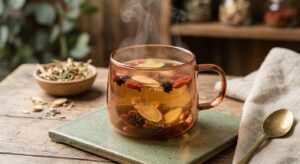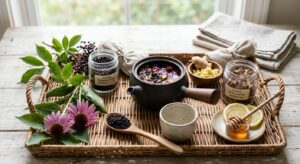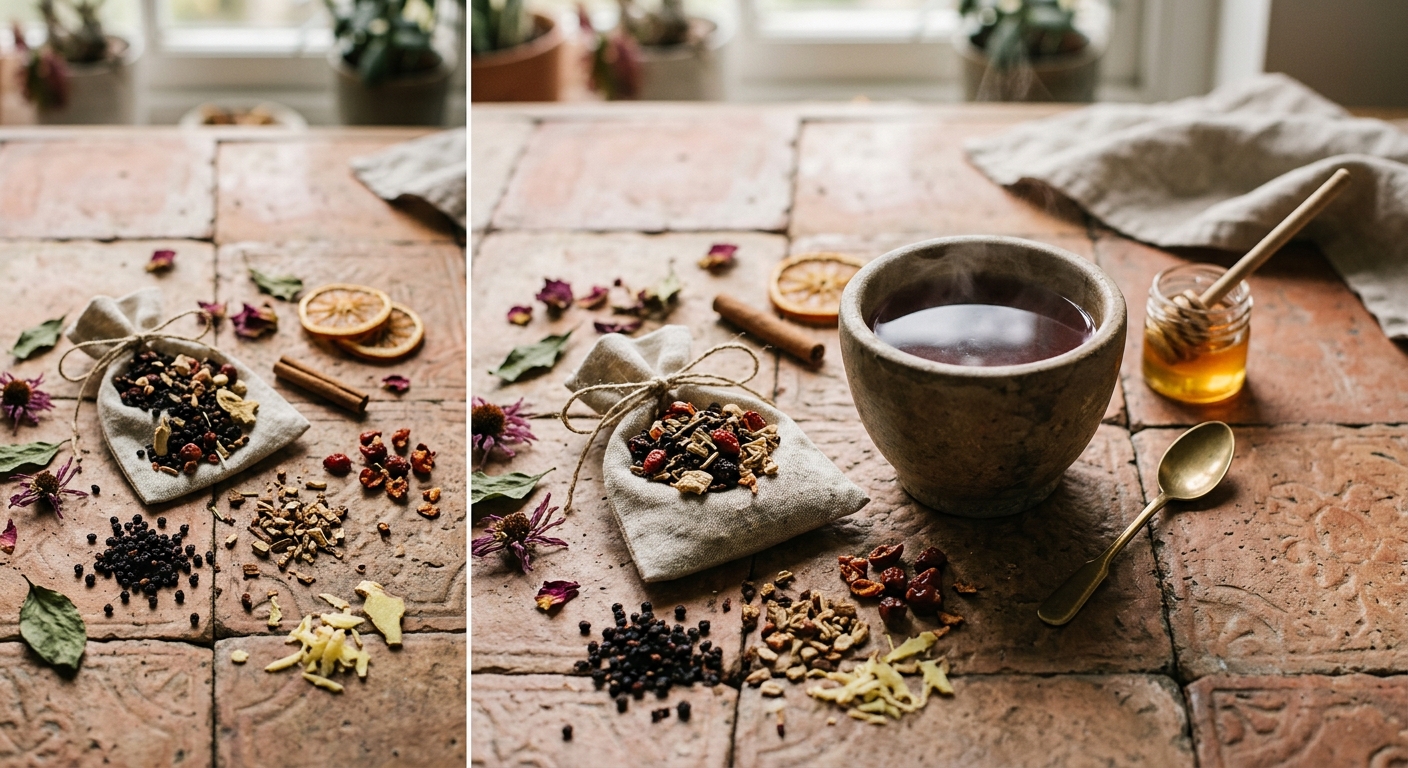
As the days shorten and the air turns crisp, our bodies face a familiar challenge: the seasonal shift that invites colds, fatigue, and lowered immunity. For centuries, herbalists across Europe, North America, and Asia have turned to specific plants at exactly this time of year, not to treat illness, but to fortify the body before it arrives. Elderberry was brewed into winter syrups by medieval apothecaries, echinacea was carried by Plains Indigenous healers as one of the most trusted medicinal plants on the continent, rosehip became a national supplement in wartime Britain when citrus was scarce, and ginger has warmed and defended the body in Ayurvedic and Traditional Chinese Medicine for over three thousand years. Together, these four herbs form a synergistic blend that feels as much like a seasonal ritual as it does a health practice.
What makes this blend particularly well-suited to autumn is the way each herb addresses a different dimension of immune health. Elderberry delivers anthocyanins that directly interfere with viral replication. Echinacea stimulates the production and activity of white blood cells. Rosehip provides a powerful natural source of vitamin C and bioflavonoids that support immune cell function. Ginger brings warming gingerols that reduce inflammation, support circulation, and soothe the throat and sinuses. Brewed together, they produce a tea that is deeply ruby-red, warming, gently tart, and faintly spiced, a cup that signals to your body that it is time to prepare.
This post will walk you through the full story of each herb, their key bioactive compounds, how to brew this blend using three distinct methods, and how to get the most from this tea as a daily autumn practice. Whether you are new to herbal medicine or a seasoned herbalist refreshing your seasonal toolkit, Autumn Immune Prep Tea is one of the most well-supported and genuinely enjoyable blends you can add to your cooler-weather routine.
2
cups
Ingredients
- 2 tspdried elderberries (Sambucus nigra)
- 1 tspdried echinacea root or aerial parts
- 1 tspdried rosehip pieces (seeds removed)
- 0.5 tspfreshly grated or dried ginger root
- 480 mlwater (95 to 100°C / 203 to 212°F)
- —raw honey or maple syrup to taste (optional)
- —slice of lemon to serve (optional)
How to Brew
Click on an item below to shop for the recommended items for this recipe on Amazon.
As an Amazon Associate, we earn from qualifying purchases.
- Combine dried elderberries, echinacea, rosehip pieces, and ginger in a small saucepan or heatproof teapot. If using echinacea root (rather than aerial parts), add it to cold water and bring to a gentle simmer for 5 minutes before adding the other herbs, as roots require more heat to extract fully.
- Bring 480 ml of fresh filtered water to a full boil (100°C / 212°F). Pour over the herbs in the teapot or add the other herbs to the simmering saucepan.
- Cover the vessel tightly with a lid or a small saucer to trap the volatile aromatic compounds from the ginger. Allow to steep for 12 to 15 minutes. The cover is especially important here as ginger’s beneficial gingerols can escape with rising steam.
- Strain the tea through a fine mesh strainer into warmed mugs, pressing the spent herbs lightly with a spoon to extract the last of the dark, nutrient-rich liquid. The tea should be a vivid, deep ruby-red.
- Taste before adding sweetener. The blend is naturally tart from the rosehips with a warming ginger finish. Add raw honey after pouring (not during brewing) to preserve its enzymes and antimicrobial properties. A squeeze of fresh lemon brightens the flavor and adds additional vitamin C.
- Lightly crush the dried elderberries and rosehip pieces using a mortar and pestle or the back of a spoon before adding them to your jar. This increases surface area and compensates for the lower extraction temperature of cold water.
- Combine all herbs in a clean glass jar: elderberries, echinacea aerial parts (not root, as root does not cold-extract efficiently), rosehip pieces, and ginger slices or dried ginger. Pour 480 ml of cold, filtered water over the herbs. Do not use hot water at any point.
- Stir gently to ensure all herbs are submerged. Place a piece of cheesecloth or a small plate over the jar opening and leave at room temperature for 2 hours to begin extraction, then transfer to the refrigerator.
- Allow the blend to cold-steep in the refrigerator for a total of 12 to 16 hours, or overnight. The resulting brew will be a translucent garnet color, noticeably less astringent and more gently tart than the hot-brewed version.
- Strain through a fine mesh strainer lined with cheesecloth into a glass or pitcher. Serve over ice or lightly chilled. Sweeten with a drizzle of honey or a splash of apple juice for an autumn-forward flavor. Consume within 48 hours as no heat was used to sterilize the brew.
- Place 2.5 tsp dried elderberries, 1.5 tsp echinacea root (chopped), 1.5 tsp rosehip pieces, and 1 tsp fresh ginger slices into a small stainless steel saucepan. Add 600 ml of cold, filtered water. Starting in cold water allows the herbs to release compounds gradually as the temperature rises.
- Bring the mixture to a boil over medium heat, then immediately reduce the heat to a gentle simmer. You should see small, lazy bubbles breaking the surface but no vigorous rolling boil. Maintain this temperature throughout. Cover the saucepan with a lid to minimize evaporation and retain the ginger’s volatile oils.
- Simmer uncovered for the final 5 minutes to allow slight concentration of the brew. You should begin with approximately 600 ml and aim to finish with around 480 ml after evaporation and straining. The liquid will deepen to a very dark, almost opaque garnet.
- Remove from heat and allow to sit covered for a further 5 minutes off the heat. This resting period allows the polysaccharides and flavonoids to fully disperse into the liquid without any additional heat degrading delicate compounds.
- Strain through a fine mesh strainer into mugs, pressing the spent herbs firmly. The decoction will be noticeably stronger, darker, and more full-bodied than the hot-brewed version. Dilute with a splash of hot water if desired. Sweeten with raw honey and a cinnamon stick for a potent, warming autumn tonic. This method is best used no more than once daily given its higher concentration.
Health Benefits
Multiple randomized controlled trials, including a 2016 study published in Nutrients, found that standardized elderberry extract significantly reduced the duration of colds by an average of two days. Echinacea has also shown in meta-analyses to reduce cold incidence by up to 58% when taken at onset.
Echinacea’s alkylamides and polysaccharides work through distinct but complementary mechanisms, activating macrophages, increasing natural killer cell activity, and raising circulating white blood cell counts, providing a broad-spectrum upregulation of first-line immune defenses.
Rosehips contain 10 to 100 times more vitamin C per gram than fresh oranges, alongside bioflavonoids like tiliroside and quercetin that dramatically increase its bioavailability. Elderberry’s anthocyanins add further antioxidant capacity, protecting immune cells from free radical damage during infection.
Ginger’s gingerols actively suppress the inflammatory compounds responsible for sore throats, congested sinuses, and airway swelling. A 2015 review in the International Journal of Preventive Medicine confirmed ginger’s efficacy as a natural anti-inflammatory agent for respiratory conditions.
Approximately 70% of the immune system is located in the gut-associated lymphoid tissue. Echinacea polysaccharides act as prebiotics, and elderberry’s anthocyanins have been shown in preliminary research to support beneficial gut microbiota populations, indirectly reinforcing systemic immune function.
🧪 Key Bioactive Compounds
The Science Behind Elderberry
The immune-supporting power of this blend is rooted in several well-characterized mechanisms. Elderberry’s standout compounds are its anthocyanins, particularly cyanidin-3-glucoside and cyanidin-3-sambubioside, which have been shown in laboratory studies to bind directly to influenza virus hemagglutinin proteins, physically preventing the virus from docking onto respiratory epithelial cells. A 2016 randomized, double-blind, placebo-controlled trial published in Nutrients found that elderberry supplementation reduced cold duration by an average of 2 days in air travelers, a high-exposure population, confirming that these effects translate beyond the laboratory.
Echinacea operates through a dual mechanism that makes it uniquely valuable as an immune primer. Its fat-soluble alkylamides bind to CB2 cannabinoid receptors expressed on immune cells, triggering macrophage activation and influencing cytokine production in ways that prime the innate immune system without causing inflammatory overstimulation. Simultaneously, its water-soluble polysaccharides activate the complement system and stimulate phagocytosis, the process by which immune cells engulf and destroy pathogens. This two-pronged action is why echinacea preparations standardized to contain both fractions consistently outperform single-extract products in clinical trials. Rosehip adds a critical nutritional layer: its vitamin C content, accompanied by flavonoids that increase absorption, supports the rapid replication of lymphocytes needed during an active immune response.
Ginger’s contribution is primarily anti-inflammatory and circulatory. The gingerols and shogaols in dried ginger inhibit the COX and LOX enzyme pathways responsible for producing prostaglandins and leukotrienes, the compounds that drive the swelling, congestion, and discomfort of upper respiratory infections. By modulating rather than suppressing this inflammation, ginger helps the body manage immune responses without the tissue damage that prolonged unchecked inflammation can cause. Research also suggests that ginger improves peripheral circulation, which matters for immune function because immune cells must travel efficiently through the bloodstream to reach sites of infection. Together, these four herbs create a blend whose mechanisms are not redundant but genuinely complementary, addressing immune defense at the cellular, nutritional, and systemic levels simultaneously.
Brewing Tips
- Crush dried elderberries lightly before brewing in any method to break the skin and dramatically increase the surface area available for anthocyanin extraction. This single step can visibly deepen the color and potency of your brew.
- Cycle your use of this blend seasonally. Drink it daily for four to six weeks at the start of autumn as an immune primer, then take a one to two week break before continuing through winter. This cycling approach maintains echinacea’s effectiveness and prevents the diminishing returns of continuous use.
- Source your elderberries from a reputable supplier and confirm they are Sambucus nigra (European or American elderberry) rather than Sambucus ebulus (dwarf elderberry), which is toxic. Quality dried elderberries should be uniformly dark purple-black, never green or reddish, and should have been properly heat-processed during drying.