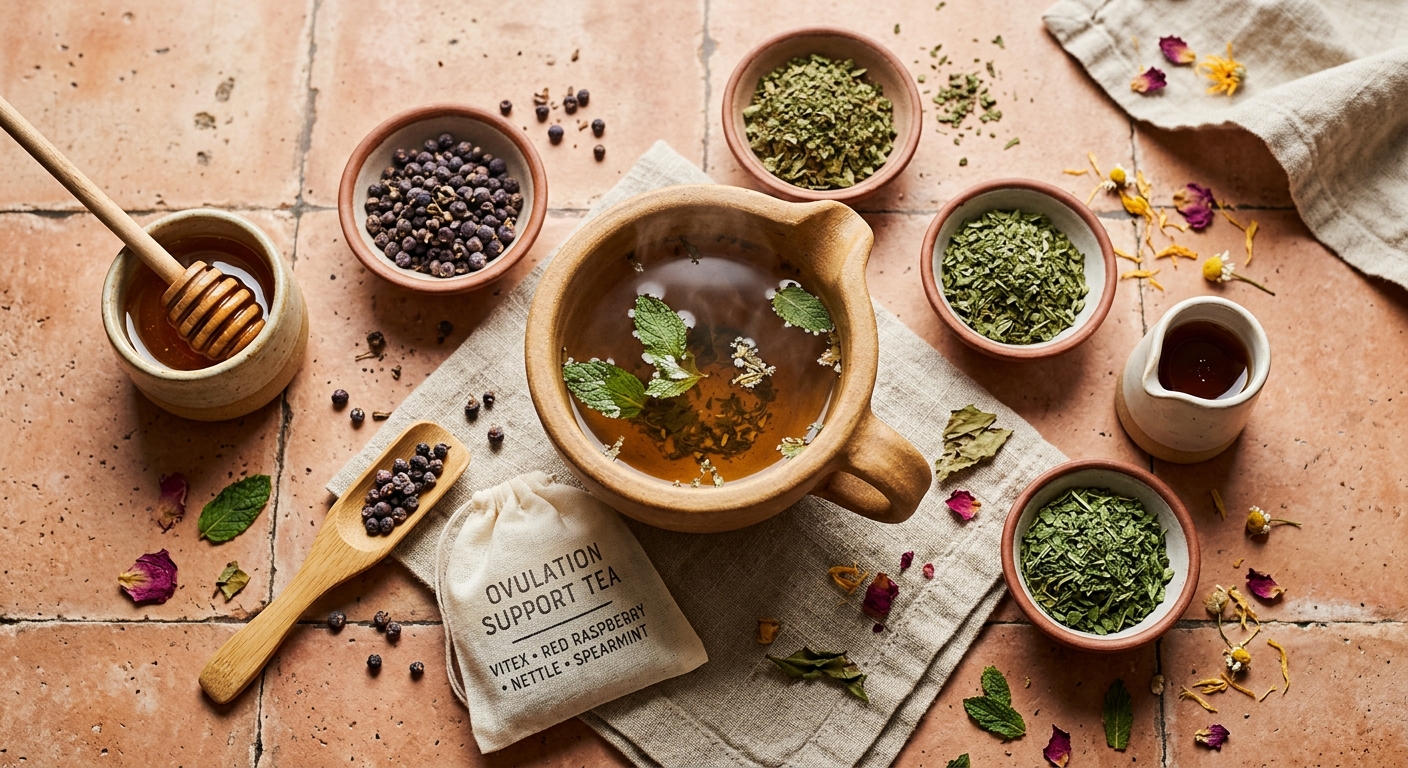
For generations, herbalists and midwives have turned to the plant kingdom to support women through every phase of the menstrual cycle. The herbs in this ovulation support blend, including vitex (chaste tree berry), red raspberry leaf, and nettle, appear in folk medicine traditions spanning ancient Greece, medieval Europe, and indigenous North American healing practices. These plants were prized not for dramatic intervention but for their gentle, cumulative effect on hormonal rhythm and reproductive vitality.
Ovulation is the cornerstone of a healthy menstrual cycle, and the process depends on a finely tuned hormonal cascade involving the pituitary gland, the ovaries, and the uterus. Modern life, stress, poor nutrition, and environmental factors can disrupt this balance. Vitex berry has been used in European herbal medicine for over 2,500 years to regulate the luteinizing hormone (LH) surge that triggers ovulation, while red raspberry leaf has long been celebrated as a uterine tonic, rich in fragarine and key minerals that tone and nourish the reproductive organs. Nettle rounds out the blend with a remarkable density of vitamins and minerals that address the nutritional demands of a healthy cycle.
This tea is best enjoyed as part of a consistent daily practice during the follicular phase of your cycle, the days between menstruation and ovulation, typically days 5 through 14 in a 28-day cycle. The flavor is earthy and gently herbaceous, with a pleasant green depth from the raspberry leaf and nettle and subtle peppery warmth from the vitex. Think of it less as a quick fix and more as a long-term act of nourishment, a quiet ritual that signals to your body that it is cared for and supported.
2
cups
Ingredients
- 1 tspdried vitex berries (lightly crushed)
- 2 tspdried red raspberry leaf
- 1 tspdried nettle leaf
- 0.5 tspdried spearmint leaf (optional, for brightness)
- 480 mlwater (95°C / 203°F)
- —raw honey or maple syrup to taste (optional)
- —a thin slice of lemon to serve (optional)
How to Brew
Click on an item below to shop for the recommended items for this recipe on Amazon.
As an Amazon Associate, we earn from qualifying purchases.
- Lightly crush the dried vitex berries using a mortar and pestle or the back of a spoon. This breaks the seed coat slightly and dramatically improves extraction of the active phytochemicals.
- Combine the crushed vitex berries, red raspberry leaf, nettle leaf, and spearmint (if using) in a teapot or heatproof vessel fitted with a fine mesh infuser or a piece of cheesecloth.
- Heat your water to 95°C (203°F). If using a stovetop, bring water to a full boil and allow it to rest for 30 seconds before pouring. Pour the hot water directly over the herb blend in the infuser.
- Cover the teapot or mug with a lid or small plate to trap the volatile aromatic compounds and maintain temperature. Steep for a full 10 to 15 minutes. A longer steep extracts more of the tannins and active flavonoids, particularly from the raspberry leaf.
- Remove the infuser and squeeze gently to extract remaining liquid. Pour into two mugs. Add honey or a slice of lemon to taste. Drink one cup in the morning and, if desired, one in the early afternoon.
- Lightly crush the vitex berries as you would for hot brew. Combine all herbs in a clean glass jar with a tight-fitting lid. For cold brew, increase the herb ratio slightly, using 1.5 teaspoons of vitex, 3 teaspoons of red raspberry leaf, and 1.5 teaspoons of nettle for 480 ml of water, to compensate for the lower extraction efficiency at cold temperatures.
- Pour 480 ml of filtered room-temperature water over the herbs. Stir gently with a long spoon to make sure all the plant material is fully submerged and hydrated.
- Seal the jar and leave it at room temperature for one hour to begin the initial infusion, then transfer it to the refrigerator. Allow the herbs to steep for a further 7 to 11 hours, ideally overnight.
- In the morning, strain the liquid through a fine mesh strainer or cheesecloth-lined strainer into a clean pitcher or bottle, pressing the herbs lightly to extract remaining liquid. Discard the spent herbs.
- Serve cold over ice, or allow it to come to room temperature before drinking. The cold brew keeps refrigerated for up to 48 hours. Add a sprig of fresh mint or a lemon wedge for added brightness.
- Lightly crush 2 teaspoons of vitex berries and place them in a small saucepan with 600 ml of cold filtered water. The extra water accounts for evaporation during the simmering process.
- Bring the water and vitex berries to a very gentle simmer over low to medium-low heat. You are aiming for a quiet simmer with small bubbles, not a rolling boil. Maintain this temperature for 20 to 25 minutes, stirring occasionally.
- After 20 minutes of simmering, remove the saucepan from the heat. Add the red raspberry leaf and nettle directly into the hot decoction liquid. Cover the saucepan with a lid and allow the softer leaves to steep by the residual heat for a further 10 minutes. This two-stage process avoids degrading the delicate tannins and chlorophyll in the leaves.
- Strain the finished decoction through a fine mesh strainer into two mugs, pressing the herbs gently. You should have approximately 400 to 450 ml of concentrated, richly colored tea.
- Taste before adding sweetener. A decoction is noticeably more robust and earthy than the standard hot brew. A small amount of raw honey or a pinch of cinnamon balances the flavor well. Drink one cup per day, particularly during the follicular phase.
Health Benefits
Vitex berry’s iridoid glycosides act on the hypothalamic-pituitary axis to help normalize the LH surge required for ovulation. Multiple randomized controlled trials, including a 2017 study published in the Journal of Alternative and Complementary Medicine, show improved ovulatory frequency in women with irregular cycles after 3 months of vitex supplementation.
By reducing excess prolactin via dopamine receptor activity, vitex helps the corpus luteum produce adequate progesterone after ovulation. Low progesterone is one of the most common contributors to luteal phase defects and difficulty conceiving.
Red raspberry leaf has been used as a uterine tonic in European and North American herbal traditions for centuries. The alkaloid fragarine is thought to strengthen the uterine musculature, while the high magnesium and calcium content supports smooth muscle function and reduces cramping.
Nettle leaf is one of the most nutrient-dense plants used in herbal medicine, providing bioavailable iron, folate, vitamins C and K, and trace minerals. These nutrients directly support the energy demands of the follicular phase and the hormonal processes leading up to ovulation.
Chronic low-grade inflammation is increasingly recognized as a factor that can impair follicular development and hormonal signaling. The combined quercetin and kaempferol content of nettle and raspberry leaf provides anti-inflammatory activity that may help create a more favorable hormonal environment.
🧪 Key Bioactive Compounds
The Science Behind Vitex (Chaste Tree Berry)
The most studied constituent of vitex berry is agnuside, an iridoid glycoside that acts on the hypothalamic-pituitary axis rather than directly on the ovaries. Specifically, the bicyclic diterpenes in vitex, particularly rotundifuran, bind to dopamine D2 receptors in the anterior pituitary gland. This binding inhibits the secretion of prolactin, the hormone responsible for suppressing ovulation in cases of hyperprolactinemia. Even mildly elevated prolactin, sometimes caused by stress or thyroid dysfunction, can prevent the LH surge that signals the ovary to release an egg. By gently normalizing prolactin output, vitex creates the hormonal conditions necessary for a well-timed, successful ovulation.
Red raspberry leaf contributes a distinct mechanism through its content of fragarine, a plant alkaloid with selective action on uterine smooth muscle. Unlike most muscle relaxants, fragarine appears to have a toning effect rather than a purely relaxing one, helping the uterus contract and release in a coordinated way. This is why it has historically been used both to ease cramping and to prepare the uterus for healthy function. Alongside fragarine, raspberry leaf contributes significant amounts of magnesium, which is essential for over 300 enzymatic reactions in the body, many of them related to hormonal synthesis and stress regulation. Magnesium deficiency is associated with PMS, dysmenorrhea, and impaired estrogen metabolism.
Nettle leaf earns its place in this blend through sheer nutritional density and its flavonoid content, particularly quercetin and kaempferol. Both compounds have demonstrated the ability to modulate estrogen receptor activity in cell studies, acting as partial agonists that may help buffer the effects of excess estrogen relative to progesterone, a condition sometimes called estrogen dominance. Quercetin also inhibits the enzyme aromatase in vitro, the enzyme responsible for converting androgens into estrogens, though human clinical evidence at tea-dose levels remains preliminary. What is well established is nettle’s role as a rich source of bioavailable iron, folate, and vitamin C. Adequate folate and iron are critical not only for conceiving but for supporting the rapid cellular demands of early follicular development and the luteal phase that follows ovulation.
Brewing Tips
- Begin drinking this tea on day 5 of your cycle, the first day after menstruation ends for most women, and continue through day 14 or until ovulation is confirmed. Timing the blend to your follicular phase maximizes its support of the hormonal cascade leading up to the LH surge.
- Consistency matters more than quantity with vitex. One well-prepared cup per day over 3 or more months is more effective than drinking several cups sporadically. Set a morning ritual around this tea to build a sustainable habit.
- Track your cycle alongside drinking this tea using basal body temperature charting or ovulation predictor kits. This not only helps you time the tea correctly but also lets you observe whether your ovulation timing becomes more regular over months of consistent use.
- Store dried vitex berries in an airtight glass jar away from heat and light. Whole berries retain their potency significantly longer than pre-ground material. Crush only the amount you need for each brew to preserve the volatile diterpenes.
- If you find the earthy, slightly bitter flavor profile challenging, try adding a half-teaspoon of dried licorice root to the blend. It adds natural sweetness without sugar and has its own mild estrogenic activity that complements the blend during the follicular phase.