Long Covid, the constellation of lingering symptoms that persist weeks or months after an acute SARS-CoV-2 infection, has driven millions of people to seek additional support beyond conventional medicine. Symptoms including crushing fatigue, brain fog, breathlessness, and immune dysregulation have pushed researchers and herbalists alike to revisit traditional plant medicines with renewed urgency. This recovery tea blends three deeply researched adaptogens and immune tonics, each chosen for a specific role in the post-viral healing process.
Astragalus root (Astragalus membranaceus) has been a cornerstone of Traditional Chinese Medicine for over 2,000 years, prized for its ability to tonify the wei qi, or defensive energy, and rebuild vitality after illness. Elderberry (Sambucus nigra) brings a rich European folkloric heritage as a remedy for respiratory illness and immune resilience. Tulsi, or Holy Basil (Ocimum tenuiflorum), is revered in Ayurvedic medicine as an adaptogen that steadies the nervous system, clears respiratory pathways, and reduces the oxidative stress that lingers long after a viral infection subsides. Together, these three herbs form a synergistic blend that addresses the multi-system nature of post-viral illness.
This is not a quick-fix cure. Long Covid is a complex condition, and this tea is designed to be a consistent daily ritual, a warm, nourishing practice that layers gentle immune support over weeks and months. The flavor is deeply satisfying: earthy and slightly sweet from the astragalus, rich and berry-forward from the elderberry, and bright with the peppery, clove-like warmth of tulsi. Brew it slowly, drink it mindfully, and let the ritual itself be part of the healing.
2
cups
Ingredients
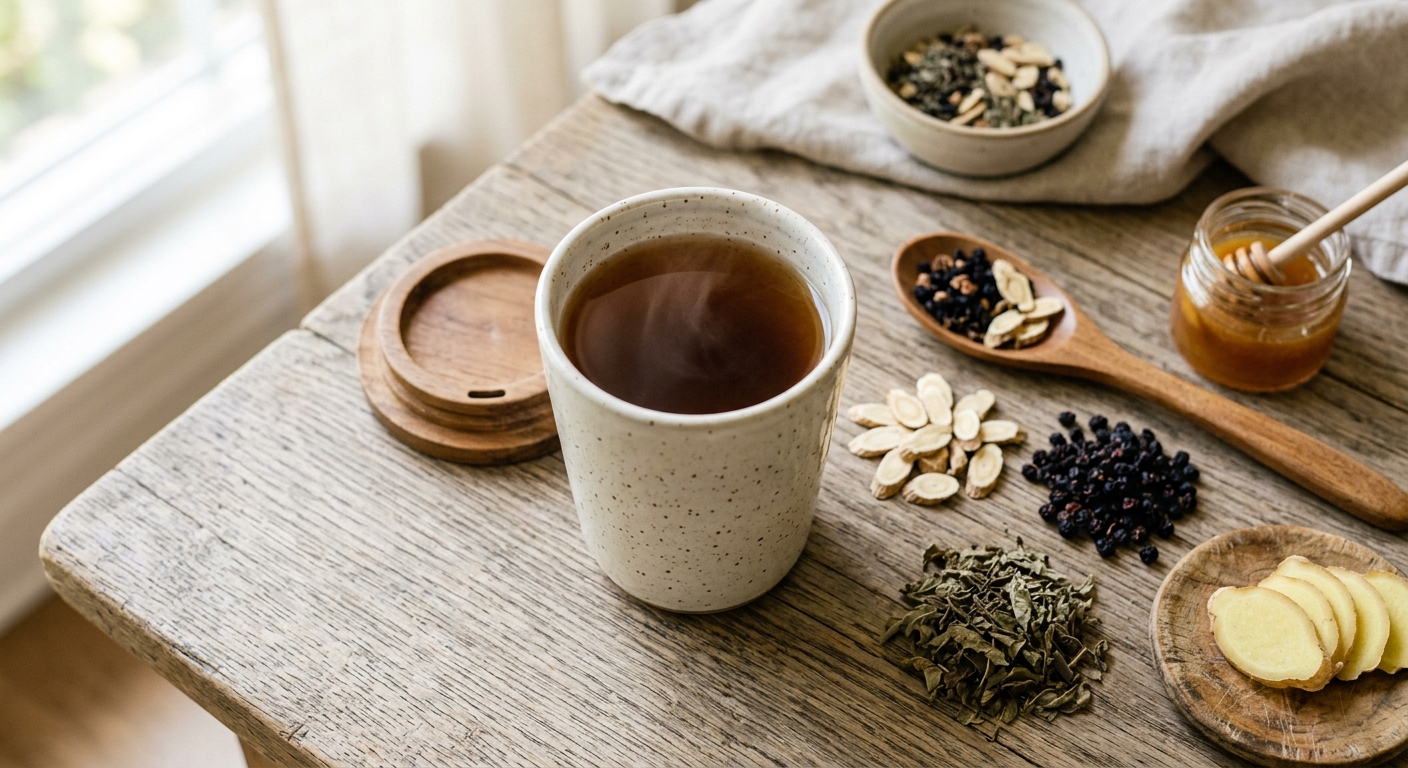
- 2 tbspdried astragalus root slices
- 1 tbspdried elderberries
- 1 tbspdried tulsi (holy basil) leaves
- 1 tspfresh ginger root, thinly sliced
- 480 mlfiltered water
- —raw honey or manuka honey to taste (optional)
- —a squeeze of fresh lemon juice (optional)
How to Brew
Click on an item below to shop for the recommended items for this recipe on Amazon.
As an Amazon Associate, we earn from qualifying purchases.
- Place the astragalus root slices, dried elderberries, and fresh ginger into a small saucepan with 480 ml of cold filtered water. Do not pre-boil the water; starting cold helps draw out the deeper root compounds gradually.
- Bring the mixture to a full rolling boil over medium-high heat, then reduce heat to a gentle simmer. Cover the saucepan with a lid to retain volatile compounds and simmer for 20 minutes. The liquid will reduce slightly and turn a deep garnet color.
- After 20 minutes, remove the saucepan from heat and allow it to cool for approximately 2 minutes until the temperature drops to around 90°C (194°F). Add the dried tulsi leaves directly to the hot decoction.
- Cover and steep the tulsi in the hot decoction for 5 minutes. Do not allow tulsi to boil, as this degrades its essential oils and delicate adaptogens.
- Strain the blend through a fine-mesh strainer into two mugs. Press the herbs gently with the back of a spoon to extract the full depth of flavor and beneficial compounds.
- Stir in raw or manuka honey and a squeeze of fresh lemon juice if desired. Drink warm, ideally in the morning or early afternoon to support energy and immune function throughout the day.
- Increase your herb quantities slightly for cold brew: use 3 tablespoons of astragalus root slices, 1.5 tablespoons of dried elderberries, 1.5 tablespoons of dried tulsi, and 1 teaspoon of sliced fresh ginger.
- Combine all herbs in a large glass jar. Pour 600 ml of room-temperature filtered water over the herbs. Stir gently to ensure all plant material is submerged.
- Allow the jar to sit uncovered at room temperature for 1 hour. This initial room-temperature phase begins the extraction process and allows the astragalus root to start releasing its water-soluble polysaccharides without heat.
- After 1 hour, seal the jar with a lid and transfer it to the refrigerator. Let it steep for 10 to 12 hours, or overnight. The cold environment slows oxidation and preserves the delicate volatile oils in the tulsi.
- The next morning, strain the cold brew through a fine-mesh strainer lined with cheesecloth into a pitcher or directly into glasses over ice. Press the herbs firmly to extract all liquid.
- Taste before sweetening. Cold brew naturally suppresses bitterness and highlights the berry and earthy sweetness of the blend. Add honey or a splash of elderflower cordial if desired and serve over ice or chilled.
- Scale up the recipe significantly for batch brewing: combine 6 tablespoons of astragalus root slices, 3 tablespoons of dried elderberries, 3 tablespoons of dried tulsi, and 2 teaspoons of sliced fresh ginger in a medium saucepan.
- Add 1 litre of cold filtered water. Bring to a full boil over medium-high heat, then reduce to a low simmer. Cover the pot and allow to decoct gently for 40 to 45 minutes, checking occasionally. The liquid should reduce by approximately half, yielding around 480 to 500 ml of concentrate.
- In the final 5 minutes of simmering, add an additional tablespoon of dried tulsi and remove the pot from heat immediately after. This late addition preserves the aromatic and adaptogenic qualities of the tulsi that are lost in prolonged boiling.
- Allow the concentrate to cool for 10 minutes, then strain through a fine-mesh strainer lined with cheesecloth into a clean glass jar. Press the spent herbs firmly to extract every drop.
- Optional: while still warm, stir in 2 tablespoons of raw honey or manuka honey, which also acts as a natural preservative. Seal the jar and refrigerate immediately.
- To serve, dilute one part concentrate (approximately 80 to 100 ml) with two parts hot water or herbal broth. Drink one to two servings daily as part of a consistent recovery protocol.
Health Benefits
Astragalus polysaccharides have been shown in multiple studies to modulate both innate and adaptive immune responses, increasing interferon production and NK cell activity. Elderberry anthocyanins independently inhibit viral attachment and replication, making this blend a complementary tool for rebuilding a dysregulated post-viral immune system.
Tulsi and astragalus are both classified as adaptogens, meaning they help the body manage the physiological effects of chronic stress and illness. Ocimumosides in tulsi regulate the HPA axis, reducing the elevated cortisol that drives adrenal exhaustion and the bone-deep fatigue reported by many long Covid patients.
Long Covid is associated with elevated inflammatory markers including IL-6 and TNF-alpha. Elderberry cyanidin compounds and tulsi’s ursolic acid and eugenol content work synergistically to suppress pro-inflammatory cytokine signaling through NF-kB pathway inhibition, offering a gentle anti-inflammatory effect appropriate for daily use.
Brain fog is among the most debilitating long Covid symptoms. Tulsi contains rosmarinic acid and antioxidant flavonoids that cross the blood-brain barrier and reduce neuroinflammation. Astragalus polysaccharides have shown neuroprotective effects in animal studies by reducing oxidative damage to neural tissue.
Elderberry and tulsi both have a long traditional and evidenced history of supporting the respiratory mucosa. Tulsi acts as a gentle expectorant and bronchodilator, while elderberry flavonoids help reduce mucosal inflammation, supporting those experiencing persistent respiratory symptoms after Covid infection.
🧪 Key Bioactive Compounds
The Science Behind Astragalus Root
The immune dysregulation at the heart of long Covid involves persistent activation of inflammatory pathways, impaired interferon signaling, and evidence of viral persistence in some tissues. Astragalus polysaccharides (APS) address this directly by acting as biological response modifiers, compounds that normalize immune signaling rather than simply stimulating or suppressing it. Research published in peer-reviewed journals including the Journal of Ethnopharmacology and Phytomedicine has demonstrated that APS upregulates interferon-gamma and interleukin-2 production while reducing the excessive TNF-alpha activity associated with post-viral cytokine dysregulation. Cycloastragenol, a triterpenoid derived from astragalus, has attracted particular scientific interest for its role as a telomerase activator. By promoting the enzyme that maintains telomere length in immune cells, it may support the cellular repair and longevity signaling that chronic illness depletes.
Elderberry’s primary bioactive compounds, the cyanidin anthocyanins, have been shown in vitro to inhibit viral hemagglutinin, the protein viruses use to fuse with and enter host cells. A 2016 randomized controlled trial published in Nutrients found that elderberry extract significantly reduced the duration and severity of colds, and subsequent research has identified the NF-kB signaling pathway as a key site of elderberry’s anti-inflammatory action. Critically, concerns about elderberry triggering a cytokine storm have not been substantiated in human clinical evidence, and the existing research suggests the opposite: that elderberry flavonoids actually help modulate and normalize cytokine responses rather than amplify them unchecked.
Tulsi brings a uniquely broad phytochemical profile to this blend. Its adaptogenic glycosides, ocimumosides A and B, work on the hypothalamic-pituitary-adrenal axis to normalize elevated cortisol, directly addressing the physiological stress burden that underlies post-viral fatigue and immune suppression. Eugenol, the compound responsible for tulsi’s clove-like aroma, is a potent COX-2 inhibitor, placing it in the same mechanistic category as common anti-inflammatory medications but with a gentler, food-safe profile suitable for daily use. Rosmarinic acid, also present in tulsi, has demonstrated neuroprotective and anti-neuroinflammatory properties in animal models, offering a plausible biochemical rationale for its traditional use in clearing brain fog and restoring mental clarity after illness.
Brewing Tips
- Slice or lightly crush your astragalus root slices before simmering to increase surface area and dramatically improve polysaccharide extraction. A mortar and pestle or the flat of a heavy knife works well.
- Buy whole dried elderberries rather than pre-ground elderberry powder for this recipe. Whole berries retain their anthocyanin content far better during the long simmer, and they are easier to strain out cleanly.
- Brew this tea as a consistent daily ritual for at least four to six weeks to experience cumulative adaptogenic benefits. Adaptogens like astragalus and tulsi work best when taken consistently over time rather than as occasional remedies.
- If you find the earthiness of astragalus too pronounced, add a small cinnamon stick to the decoction stage. Cinnamon complements the berry and tulsi notes beautifully and adds its own anti-inflammatory and blood-sugar stabilizing properties.
- Store any leftover concentrate or cold brew in a sealed glass jar in the refrigerator for up to five days. Gently reheat individual servings on the stovetop rather than microwaving, which can degrade heat-sensitive compounds in the tulsi.