
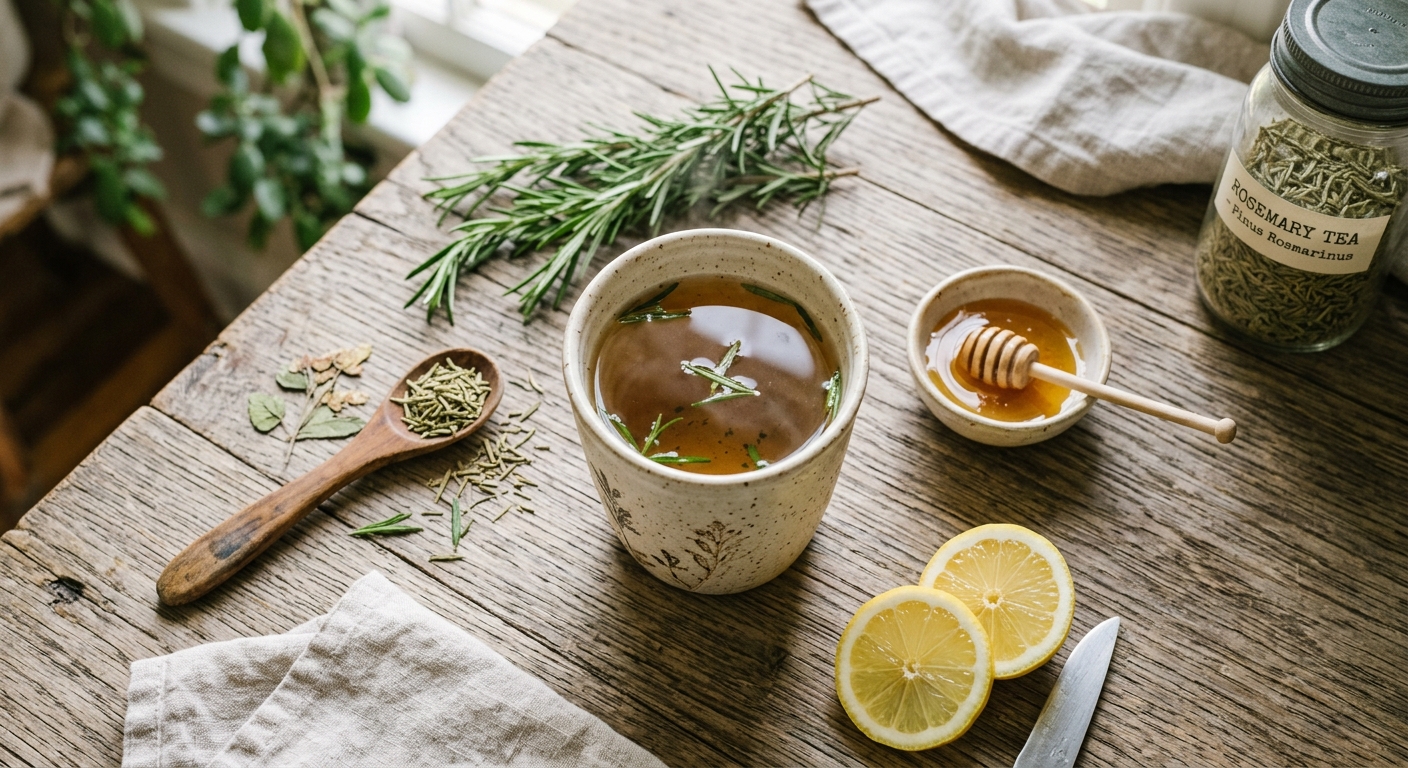
Long before rosemary became a kitchen staple, it was a sacred herb. Ancient Greeks wove sprigs into their hair during examinations, believing it strengthened memory, while Roman physicians prescribed it for headaches, low spirits, and nervous exhaustion. In medieval European herbalism, it was known as the herb of remembrance, used in both wedding garlands and funeral rites as a symbol of fidelity and continuity. This deep cultural rootedness speaks to something real: rosemary has always been understood as a plant that connects the mind to the body, sharpening attention while quieting anxiety.
As a tea, rosemary offers a completely different experience from its culinary presence. Steeped gently in hot water, it releases a complex aromatic brew that is piney and slightly resinous, with a warmth that spreads from the chest outward. The volatile oils responsible for that distinctive scent, particularly 1,8-cineole and camphor, are among the most studied compounds in the plant, with modern neuroscience now catching up to what Greek scholars intuited millennia ago. Inhalation of rosemary aroma alone has been shown in clinical settings to improve speed and accuracy in cognitive tasks, and drinking the tea brings those compounds into direct bioavailability.
What makes rosemary particularly suited to the Stress and Anxiety category is its dual action: it is simultaneously a nervous system stimulant and a muscle relaxant. Unlike adaptogens that work slowly over weeks, rosemary tea can produce a noticeable shift in mental state within a single sitting, making it ideal for moments of foggy overwhelm, tension headaches, or the kind of low-grade anxiety that comes with mental overload. It is one of the few herbs that can replace a second cup of coffee without the jittery aftermath.
2
cups
Ingredients
- 2 tspfresh rosemary leaves (or 1 tsp dried)
- 480 mlwater (90°C / 194°F)
- —raw honey or lemon slice to taste (optional)
How to Brew
Click on an item below to shop for the recommended items for this recipe on Amazon.
As an Amazon Associate, we earn from qualifying purchases.
- Bring filtered water to 90 to 95°C (194 to 203°F). If you do not have a temperature-controlled kettle, bring water to a full boil and let it rest for 90 seconds before pouring.
- Place 2 teaspoons of fresh rosemary leaves (or 1 teaspoon dried) into a tea infuser or directly into a warmed ceramic mug. Lightly bruise fresh sprigs between your fingers before placing them in the infuser to help release the essential oils.
- Pour 240 ml of hot water over the rosemary and immediately cover the mug with a small saucer or lid. Covering is important: it traps the volatile aromatic compounds that would otherwise escape as steam, keeping the most therapeutically active constituents in your cup.
- Steep for 5 to 7 minutes. Taste at 5 minutes; a longer steep deepens the flavor and increases rosmarinic acid extraction but can intensify bitterness. Remove the infuser or strain the leaves.
- Add a small slice of lemon or a drizzle of raw honey if desired. The citric acid in lemon brightens the pine notes and enhances the tea’s clarity without masking the herb’s character.
- Measure 3 teaspoons of fresh rosemary leaves or 1.5 teaspoons of dried rosemary per 480 ml of cold, filtered water. Cold brewing is less efficient than hot, so a slightly higher ratio is needed to achieve good flavor and compound extraction.
- Place the rosemary into a clean glass jar. If using fresh sprigs, lightly crush them against the side of the jar with the back of a spoon before adding the water, to open up the cellular structure and improve extraction at low temperatures.
- Pour cold filtered water over the rosemary, seal the jar with a lid, and leave it at room temperature for 30 minutes to allow the initial extraction to begin without shocking the herb in a cold environment.
- Transfer the sealed jar to the refrigerator and steep for a further 10 to 12 hours, or overnight. Do not exceed 14 hours, as prolonged cold steeping can introduce a slightly astringent, tannic quality.
- Strain through a fine-mesh strainer into a tall glass filled with ice. Add a slice of lemon or a sprig of fresh mint for a refreshing, aromatic finish. The cold brew can be stored in the refrigerator for up to 48 hours.
- Fill a clear glass jar or pitcher with 480 ml of cold, filtered water. The transparency of the vessel is essential, as it allows sunlight to penetrate and gently warm the water and herb together.
- Add 3 to 4 fresh rosemary sprigs, each approximately 10 cm (4 inches) long, directly into the water without bruising or cutting them. The slow solar heat will draw out the oils naturally; aggressive preparation is unnecessary here.
- Seal the jar loosely or cover with a piece of cheesecloth secured with a rubber band. This allows some airflow while keeping debris out. Place the jar in a sunny spot outdoors or on a south-facing windowsill.
- Allow the tea to steep in direct sunlight for 3 to 4 hours. Check the color at the 3-hour mark: it should be a pale, luminous gold-green. If the color is still very faint, continue steeping for up to 1 additional hour.
- Bring the jar indoors, remove the rosemary sprigs, and taste. Add a few drops of lemon juice and a teaspoon of raw honey if desired. Serve immediately over ice or refrigerate and consume within 24 hours.
Health Benefits
The compound 1,8-cineole in rosemary inhibits acetylcholinesterase, the enzyme that breaks down acetylcholine, effectively keeping more of this learning and memory neurotransmitter available. A 2012 study by Moss and Oliver published in Therapeutic Advances in Psychopharmacology found a direct correlation between blood levels of 1,8-cineole and improved speed and accuracy on cognitive tasks.
Rosmarinic acid modulates GABA-A receptor activity in a manner similar to pharmaceutical anxiolytics but without sedating side effects, producing a calming effect that eases restlessness and nervous agitation. Multiple animal studies and early human trials support its anxiolytic activity, particularly for stress-related anxiety rather than clinical anxiety disorders.
Rosemary’s antispasmodic compounds, including camphor and rosmarinic acid, help relax the smooth muscle tissue of blood vessels and reduce the tension in the neck and scalp muscles that contribute to tension headaches. Traditional European herbal medicine has prescribed rosemary tea for headache relief for over 500 years, a use now supported by its vasodilatory and anti-inflammatory mechanisms.
Ursolic acid and carnosic acid have both demonstrated the ability to moderate the hypothalamic-pituitary-adrenal (HPA) axis, the central stress-response system, by reducing excessive cortisol secretion during periods of chronic stress. This adaptogen-like action makes rosemary tea a valuable daily tonic for individuals experiencing burnout or adrenal fatigue.
Carnosic acid activates the Nrf2 signaling pathway, the body’s master antioxidant regulatory system, which in turn upregulates the production of glutathione and other endogenous antioxidants in brain tissue. This neuroprotective effect is particularly relevant for stress-induced oxidative damage, which contributes to cognitive decline and mood dysregulation over time.
🧪 Key Bioactive Compounds
The Science Behind Rosemary
The neurological effects of rosemary tea have attracted serious scientific attention in the past two decades, largely because they are both measurable and mechanistically explainable. The most well-documented pathway involves 1,8-cineole, the dominant volatile compound in rosemary’s essential oil fraction. This monoterpene oxide crosses the blood-brain barrier with relative ease and inhibits acetylcholinesterase, the enzyme responsible for degrading acetylcholine in the synaptic cleft. The result is a sustained elevation of acetylcholine, a neurotransmitter critical for attention, working memory, and the encoding of new information. This is the same mechanism targeted by a class of Alzheimer’s medications called cholinesterase inhibitors, making rosemary’s cognitive benefits pharmacologically coherent rather than merely anecdotal.
Rosmarinic acid operates through a distinct but equally compelling pathway. As a phenolic ester of caffeic acid, it demonstrates meaningful affinity for GABA-A receptors, the primary inhibitory neurotransmitter system that anxiolytic drugs such as benzodiazepines also target. However, rosmarinic acid appears to act as a positive allosteric modulator rather than a direct agonist, meaning it enhances GABA’s natural calming effect without the dependency risk or sedative overpowering associated with pharmaceutical anxiolytics. It also suppresses pro-inflammatory cytokines in neural tissue, addressing the neuroinflammatory component of chronic stress and anxiety that is increasingly recognized as central to mood disorders.
Carnosic acid, a fat-soluble diterpene phenol abundant in rosemary, provides a third layer of activity through the Nrf2-Keap1 signaling pathway. Under oxidative stress conditions, carnosic acid undergoes metabolic activation that triggers Nrf2 to migrate to the nucleus, where it upregulates the expression of cytoprotective enzymes including heme oxygenase-1, NAD(P)H quinone oxidoreductase, and glutathione S-transferase. This cascade effectively increases the brain’s antioxidant capacity at moments of highest oxidative load, which is precisely when stress, anxiety, and cognitive strain are most damaging. Together, these three compounds make rosemary tea one of the most biochemically sophisticated herbal teas available for stress support and mental performance.
Brewing Tips
- Always cover your mug while steeping rosemary tea. The most therapeutically active compounds, particularly 1,8-cineole, are volatile and will escape in steam if left uncovered, leaving you with a less potent and less aromatic cup.
- Fresh rosemary consistently outperforms dried for cold brew and sun tea methods, where the slower extraction benefits from the higher moisture and oil content of fresh leaves. For hot brew, dried rosemary works well and produces a slightly more concentrated, less grassy flavor.
- Limit your intake to one to two cups per day. Rosemary is a potent medicinal herb, and while its culinary use is safe in any quantity, drinking large volumes of strong rosemary tea can cause gastrointestinal discomfort or overstimulation, particularly in sensitive individuals.