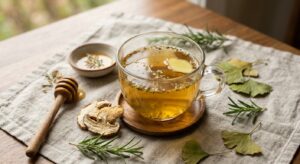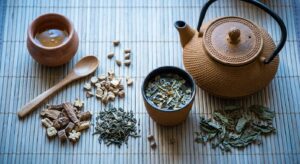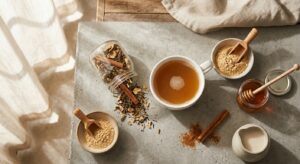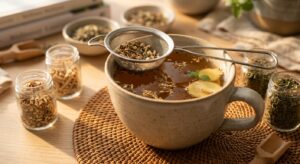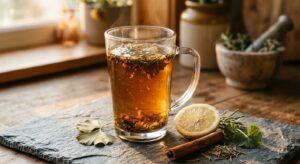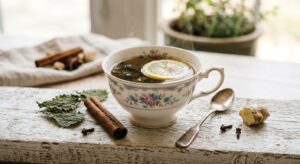
Long before sports drinks lined supermarket shelves, endurance athletes and mountain peoples relied on the plant kingdom to carry them through grueling physical demands. Siberian hunters brewed eleuthero root to sustain energy on long treks across frozen tundra. Andean runners chewed adaptogenic herbs to perform at altitude. In traditional Chinese medicine, tonic roots were prescribed to strengthen what practitioners called jing, the deep vital energy that fuels both athletic and mental exertion. The Marathon Runner Herbal Tea brings these traditions together in a single, modern-facing cup designed for people who push their limits.
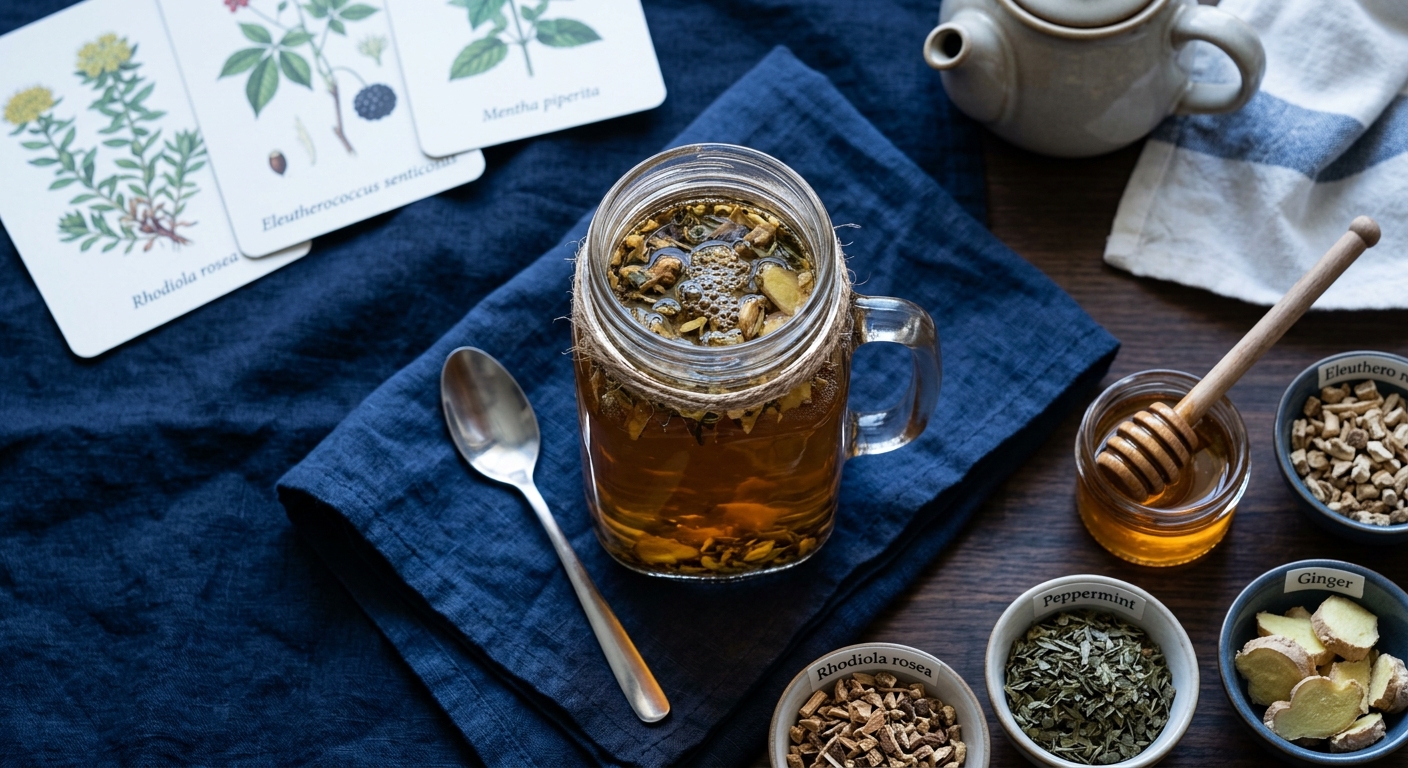
This blend centers on four powerhouse ingredients: rhodiola rosea for oxygen efficiency and mental resilience, eleuthero root for sustained non-stimulant energy, peppermint for bronchial opening and cooling circulation, and ginger for circulation, inflammation management, and digestive support during training. Together they form a layered flavor profile and a genuinely functional tonic that works with your body’s stress-response systems rather than simply spiking adrenaline like caffeine-heavy alternatives.
What makes this blend especially well suited to runners and endurance athletes is its adaptogenic foundation. Unlike stimulants, adaptogens normalize physiological responses to stress, helping your body conserve energy where it counts, recover more efficiently after exertion, and maintain mental sharpness even when fatigue sets in. Whether you brew it hot the morning before a long run, cold for an intra-workout hydration boost, or as a focused concentrate to sip strategically, this tea earns its place in every serious athlete’s routine.
2
cups
Ingredients
- 1.5 tspdried rhodiola rosea root, cut and sifted
- 1 tspeleuthero root, cut and sifted
- 1 tspdried peppermint leaf
- 0.5 tspdried ginger root, cut and sifted (or 2 to 3 fresh thin slices)
- 500 mlwater (95°C / 203°F)
- —raw honey or maple syrup to taste (optional)
- —squeeze of fresh lemon juice (optional, enhances absorption of antioxidants)
How to Brew
Click on an item below to shop for the recommended items for this recipe on Amazon.
As an Amazon Associate, we earn from qualifying purchases.
- Bring 500 ml of filtered water to 95°C (203°F). Avoid a rolling boil, as excessive heat can degrade some of the more delicate phenolic compounds in rhodiola.
- Place the rhodiola rosea root and eleuthero root into a tea strainer or infuser and lower it into your pre-warmed teapot or mug. Pour the hot water over the roots.
- Cover the vessel with a lid or small saucer to trap volatile aromatic compounds and steep the roots for 8 to 10 minutes.
- Add the dried peppermint leaf and ginger to the infuser (or directly to the pot) during the final 5 minutes of steeping. This two-stage approach ensures the roots extract fully while the peppermint retains its bright menthol character.
- Remove the infuser or strain the blend thoroughly. The liquor should appear a clear amber-gold with a faint greenish hue from the peppermint.
- Taste before sweetening. Add raw honey and a squeeze of lemon if desired. Serve immediately and drink 20 to 30 minutes before a workout or run for best results.
- Combine all herbs, including the rhodiola, eleuthero, peppermint, and ginger, into a clean glass jar. No heat is needed: the cold brew method extracts all four herbs simultaneously because temperature differentiation is not a concern here.
- Pour 600 ml of cold filtered water over the herbs. The slightly higher water volume compared to hot brew compensates for the gentler extraction rate of cold water.
- Stir gently with a long spoon to ensure all plant material is fully submerged. Place a lid on the jar and leave at room temperature for 1 hour to begin extraction.
- Transfer the jar to the refrigerator and allow it to cold steep for a further 11 to 15 hours, ideally overnight. The slow, cool extraction draws out rhodiola’s glycosides and eleuthero’s eleutherosides with minimal bitterness.
- Strain the cold brew through a fine mesh strainer or cheesecloth into a clean bottle or pitcher. Press the spent herbs gently to recover the last of the liquid.
- Serve over ice straight or diluted 1:1 with coconut water for an electrolyte-enhanced endurance drink. Store refrigerated and consume within 48 hours for peak potency.
- Double all herb quantities: use 3 tsp rhodiola, 2 tsp eleuthero, 2 tsp peppermint, and 1 tsp ginger. Place the roots into a small saucepan with 500 ml of filtered water.
- Bring the water and roots to a gentle simmer (not a rolling boil) over medium-low heat. Allow the roots to decoct at a low simmer for 15 minutes, partially covered. This mimics the traditional decoction method used for woody roots in Chinese and Ayurvedic herbal systems.
- Remove from heat and add the peppermint leaf to the hot liquid. Cover the saucepan completely and allow the peppermint to infuse off the heat for 5 to 8 minutes, preserving its menthol oils.
- Strain the concentrate through a fine mesh strainer into a glass jar or measuring jug. You should yield approximately 350 to 400 ml of concentrated tea after evaporation.
- Allow the concentrate to cool to room temperature before refrigerating. It will keep for up to 5 days in a sealed glass jar in the refrigerator.
- To serve, dilute 1 part concentrate with 1 to 2 parts hot or cold water, coconut water, or sparkling water. Add honey and lemon to taste. Use 100 to 150 ml of concentrate per serving as a pre-workout tonic.
Health Benefits
Rhodiola’s salidroside has been studied in randomized trials showing improvements in VO2 max and time-to-exhaustion in endurance athletes. It appears to support mitochondrial function and reduce the accumulation of lactate in working muscles, effectively raising the threshold at which fatigue sets in.
Both rhodiola and eleuthero have demonstrated effects on monoamine neurotransmitters including dopamine and serotonin, the brain chemicals that govern motivation, pain tolerance, and focus. Athletes report reduced perception of effort and sharper concentration during long training sessions when supplementing with rhodiola extract.
Eleuthero root contains eleutherosides that modulate the hypothalamic-pituitary-adrenal (HPA) axis, helping to normalize elevated cortisol levels caused by training load. This adaptogenic action is associated with faster recovery between sessions and reduced symptoms of overtraining syndrome such as persistent fatigue and mood disruption.
Ginger’s 6-gingerol and 6-shogaol inhibit the same cyclooxygenase (COX) pathways targeted by common NSAIDs. Multiple clinical trials on post-exercise muscle soreness have found that regular ginger consumption significantly reduces delayed-onset muscle soreness (DOMS) in the 24 to 72 hours following intense exercise.
Menthol from peppermint activates cold-receptor channels in the mouth, throat, and airways, creating a sensation of increased airflow and reduced breathlessness. Research published in the Journal of the International Society of Sports Nutrition found that peppermint oil significantly improved exercise performance, lung function, and respiratory efficiency in healthy male athletes.
🧪 Key Bioactive Compounds
The Science Behind Rhodiola Rosea
The adaptogenic science behind this blend centers on the concept of non-specific resistance, a term coined by Soviet pharmacologist Nikolai Lazarev in the 1940s to describe substances that normalize the body’s response to physical, chemical, and biological stressors without producing a stimulant spike or subsequent crash. Rhodiola rosea’s primary bioactives, the rosavins and salidroside, work by modulating stress hormone signaling in the hypothalamic-pituitary-adrenal (HPA) axis and the sympatho-adrenal system. In practical terms, this means the herb helps preserve the delicate hormonal balance that can be disrupted by heavy training loads, reducing excessive cortisol secretion while maintaining adequate energy availability for working muscles.
At the cellular level, salidroside has demonstrated the ability to stimulate mitochondrial biogenesis and upregulate antioxidant enzymes including superoxide dismutase (SOD) and catalase, both of which are critical for neutralizing the reactive oxygen species (ROS) generated during intense aerobic exercise. Meanwhile, eleuthero’s eleutherosides appear to increase the efficiency of oxygen delivery by supporting erythropoiesis and improving the deformability of red blood cells as they navigate small capillaries during sustained effort. The combined effect of these two roots on aerobic metabolism is synergistic: one addresses the neurochemical and hormonal dimensions of fatigue while the other supports the oxygen-transport machinery at a cellular level.
Peppermint’s contribution is often underappreciated in the context of athletic performance. Beyond its sensory cooling effect, menthol’s activation of TRPM8 receptors in the upper respiratory tract has been shown to reduce the rating of perceived exertion (RPE) and improve grip strength, respiratory function, and running performance in controlled studies. Ginger rounds out the science by addressing the inflammatory aftermath of hard training. Its phenolic compounds inhibit both COX-1 and COX-2 enzymes with a gentleness that the digestive system tolerates far better than pharmaceutical anti-inflammatories, making this blend as useful in recovery as it is in preparation.
Brewing Tips
- For pre-race use, drink the hot brew 20 to 30 minutes before your event. For recovery, opt for the cold brew or concentrate diluted with coconut water immediately after finishing your run to support rehydration and inflammation management simultaneously.
- Store dried rhodiola and eleuthero roots in airtight amber glass jars away from light and heat. These roots are dense with glycosides that can degrade with exposure to UV light over time, reducing their potency significantly within a few months if stored improperly.
- If you find the blend too bitter from the rhodiola root, reduce the steep time by 2 to 3 minutes on your first brew and work up from there. Some rhodiola sourced from lower altitudes can carry more pronounced bitterness than high-altitude Siberian or Tibetan material. Sourcing certified organic, high-altitude rhodiola makes a noticeable difference in both flavor and rosavin content.