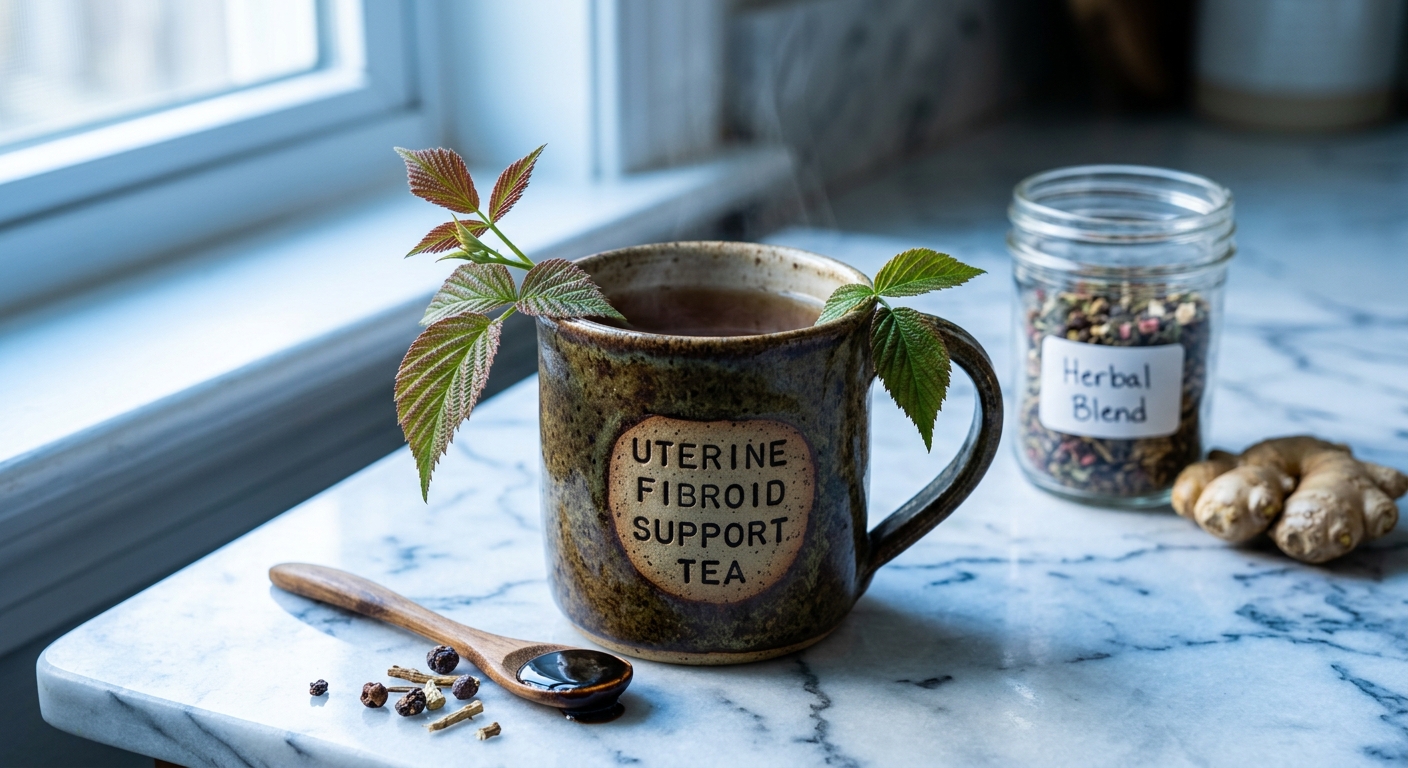
Uterine fibroids affect an estimated 70 to 80 percent of women by the age of fifty, yet conversations about natural supportive care remain surprisingly scarce. For centuries, herbalists across West Africa, East Asia, and Europe developed plant-based protocols to support uterine health, reduce heavy menstrual bleeding, and ease the pelvic congestion that often accompanies fibroid growth. This tea draws on that deep well of traditional knowledge, blending red raspberry leaf, vitex (chaste tree berry), dandelion root, and ginger into a warming, mineral-rich infusion designed to work gently alongside the body’s own rhythms.
Red raspberry leaf has long been called the ‘woman’s herb’ in European herbalism, prized for its high content of fragarine, a plant alkaloid thought to tone the smooth muscle of the uterine wall. Vitex agnus-castus, or chaste tree berry, was used by ancient Greek physicians and later by medieval monks to modulate reproductive hormones, and modern research has begun to validate its influence on the pituitary gland and progesterone pathways. Dandelion root supports the liver’s critical role in metabolizing excess estrogen, the hormone most closely linked to fibroid growth, while ginger provides anti-inflammatory heat and improves circulation to the pelvic region.
It is important to approach this tea as a supportive, complementary practice rather than a medical treatment. Fibroids vary widely in size, location, and symptom severity, and any herbal protocol should be discussed with a qualified healthcare provider, especially if you are taking hormonal medications or preparing for surgery. That said, many women find that a consistent daily ritual with this blend, combined with dietary changes and stress reduction, contributes meaningfully to their sense of comfort and wellbeing.
2
cups
Ingredients
- 2 tspdried red raspberry leaf
- 1 tspdried vitex berries (lightly crushed)
- 1 tspdried dandelion root (roasted or raw)
- 4 slicesfresh ginger root (or 0.5 tsp dried)
- 480 mlwater (95°C / 203°F)
- —raw honey or blackstrap molasses to taste (optional)
- —a squeeze of fresh lemon juice (optional)
How to Brew
Click on an item below to shop for the recommended items for this recipe on Amazon.
As an Amazon Associate, we earn from qualifying purchases.
- Bring 480 ml of filtered water to 95°C (203°F). Avoid a full rolling boil, which can degrade delicate flavonoids in the raspberry leaf.
- Place the dried red raspberry leaf, crushed vitex berries, dandelion root, and fresh ginger slices into a generously sized tea infuser or a small teapot with a built-in strainer. The blend needs room to expand and circulate.
- Pour the hot water over the herbs, making sure all plant material is fully submerged. Cover the teapot or mug with a lid or small plate to trap volatile aromatic compounds and prevent heat loss.
- Steep for 10 to 15 minutes. For a more medicinal, concentrated infusion, steep up to 20 minutes. The brew will deepen in color and the astringency will increase with time.
- Strain thoroughly into warmed mugs, pressing the herbs gently with the back of a spoon to extract the last of the liquid.
- Sweeten with raw honey or a small spoonful of blackstrap molasses, which adds supplementary iron, particularly helpful for those experiencing heavy menstrual bleeding from fibroids. Sip slowly.
- Measure all herbs into a clean glass jar: 2 tsp red raspberry leaf, 1 tsp crushed vitex berries, 1 tsp dandelion root, and 4 slices of fresh ginger. Using slightly more herb than you would for hot brew compensates for the slower, gentler extraction of cold water.
- Pour 480 ml of cold, filtered water directly over the herbs. Do not use warm or hot water, as the cold extraction is what creates the gentler flavor profile.
- Stir briefly to ensure all herbs are moistened and submerged. Seal the jar with a lid.
- Allow the jar to sit at room temperature for one hour if your kitchen is cool, then transfer it to the refrigerator and steep overnight for 8 to 12 hours.
- The following morning, strain the infusion through a fine mesh strainer or cheesecloth into a pitcher or directly into a tall glass filled with ice.
- Taste before sweetening, as cold brewing naturally softens the bitterness. Add a squeeze of fresh lemon juice to brighten the flavor and improve iron absorption from the raspberry leaf. Serve chilled.
- Combine 600 ml of cold, filtered water with the vitex berries and dandelion root in a small stainless steel or ceramic saucepan. These woody, dense materials require direct heat to release their full complement of active compounds.
- Bring the water to a gentle boil over medium heat, then immediately reduce the heat to a low simmer. You want a steady, quiet bubble, not a vigorous boil.
- Simmer the vitex and dandelion root uncovered for 15 minutes, then add the red raspberry leaf and fresh ginger slices directly to the saucepan. Adding the leaf late preserves its more delicate volatile compounds.
- Cover the saucepan with a lid, remove from heat entirely, and allow the raspberry leaf and ginger to steep off the heat for an additional 10 minutes. The residual heat is sufficient to extract their benefits without destroying heat-sensitive flavonoids.
- Strain the decoction through a fine mesh strainer into a heat-safe measuring cup or directly into mugs, pressing the plant material firmly to capture all liquid.
- Sweeten with blackstrap molasses for an additional iron and magnesium boost, both minerals that support smooth muscle function and reduce cramping. Drink one to two cups per day during the follicular and luteal phases of the menstrual cycle for consistent support.
Health Benefits
Fibroids are estrogen-dependent tumors, meaning they grow in response to elevated estrogen levels. Vitex berries support progesterone production via the pituitary gland while dandelion root enhances hepatic estrogen clearance, together helping to shift the progesterone-to-estrogen ratio in a more favorable direction.
The ellagitannins and fragarine in red raspberry leaf have a well-documented astringent and uterine-toning effect that can reduce menorrhagia, the excessive menstrual bleeding that is one of the most debilitating symptoms of uterine fibroids. Blackstrap molasses added to the brew also replenishes iron lost through heavy cycles.
6-Gingerol in ginger is a potent inhibitor of cyclooxygenase (COX) enzymes and prostaglandin synthesis, the primary biochemical drivers of menstrual cramping. Several clinical trials have found ginger to be comparable to ibuprofen for dysmenorrhea, making it a meaningful addition to a fibroid support blend.
The liver is responsible for packaging and eliminating spent estrogens via bile, and a sluggish liver allows these hormones to recirculate and stimulate fibroid growth. Dandelion root’s bitter compounds, including taraxacin and taraxacerin, promote bile flow and support Phase I and Phase II liver detoxification, both critical for estrogen metabolism.
Chronic low-grade pelvic inflammation contributes to fibroid development and symptom severity. The polyphenols, flavonoids, and gingerols in this blend collectively reduce inflammatory cytokine activity and oxidative stress in uterine tissue, potentially slowing fibroid progression over time.
🧪 Key Bioactive Compounds
The Science Behind Red Raspberry Leaf
The scientific rationale for this fibroid support blend centers on three interconnected mechanisms: hormonal modulation, uterine muscle tone, and hepatic estrogen clearance. Vitex agnus-castus has been the subject of numerous clinical trials, particularly for premenstrual syndrome and luteal phase deficiency. Its active iridoid glycosides, especially agnuside and aucubin, appear to bind to dopamine D2 receptors in the pituitary gland, inhibiting prolactin release and indirectly supporting progesterone production during the luteal phase. Since uterine fibroids are fueled by estrogen and grow in an environment of relative progesterone deficiency, restoring this balance is a cornerstone of herbal fibroid management. A 2017 review published in the journal Phytomedicine confirmed that vitex supplementation significantly reduced PMS symptoms linked to luteal insufficiency, providing a mechanistic basis for its traditional use in uterine conditions.
Red raspberry leaf’s role is primarily structural and hemostatic. Its high tannin content, dominated by ellagitannins and gallotannins, exerts a genuine astringent effect on mucosal and vascular tissue. Fragarine, the plant alkaloid unique to Rubus idaeus, has been shown in animal studies to selectively act on the smooth muscle of the uterus, inducing a toning effect that reduces both hypercontractility and atony. This dual action may explain why raspberry leaf is used both for dysmenorrhea (reducing spasm) and for menorrhagia (reducing excessive bleeding). The mineral content of raspberry leaf, including magnesium, calcium, and iron, provides additional nutritional support for uterine muscle function and blood replenishment.
Dandelion root’s contribution to this blend is primarily hepatic. The liver processes estrogens through two glucuronidation pathways, converting active estrogens into water-soluble metabolites that can be excreted via bile and urine. When liver function is compromised or bile flow is sluggish, these metabolites are deconjugated in the gut by bacterial beta-glucuronidase and reabsorbed into circulation, a process known as enterohepatic recirculation. Dandelion root’s bitter sesquiterpene lactones stimulate bile production and flow, improving this clearance pathway. Meanwhile, its inulin content feeds the beneficial gut bacteria that keep beta-glucuronidase activity low, further reducing estrogen reabsorption. Together, vitex, raspberry leaf, and dandelion root address fibroid-promoting hormonal imbalance from three distinct physiological angles, offering a rationally constructed and traditionally validated herbal protocol.
Brewing Tips
- Crush vitex berries lightly with the back of a spoon before brewing to break the outer shell and ensure you extract the active iridoid glycosides that are locked inside. Whole uncrushed berries will yield a significantly weaker brew.
- Cycle this tea in alignment with your menstrual cycle for best results. Many herbalists recommend drinking it daily from the end of menstruation through ovulation (days 5 to 14 of a 28-day cycle) and then switching to a progesterone-supporting phase during the luteal period, rather than drinking it continuously throughout the month.
- Store your herb blend in a sealed glass jar away from light and heat. Pre-mixing a two-week supply of the dry herbs in the correct ratios saves time and ensures consistency. The blend keeps well for up to six months if stored properly.