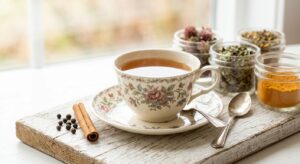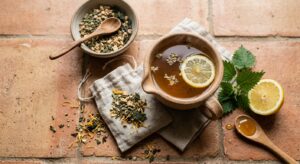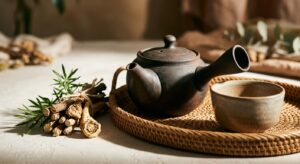
Motherwort (Leonurus cardiaca) has been tended in European cottage gardens for well over a thousand years. Its Latin species name, cardiaca, points to its oldest reputation: a remedy for the anxious, fluttering heart. Early herbalists including Culpeper recommended it for ‘the passions of the heart’ and for women in times of emotional strain, childbirth, and the transitions of midlife. The common name itself reflects this long association with women’s wellbeing, and it remains a staple of modern herbal practice for stress-related tension, heart palpitations linked to anxiety, and menstrual and menopausal discomfort.
Chamomile (Matricaria chamomilla) needs little introduction. Ancient Egyptians dedicated it to their sun god, Roman physicians prescribed it for fevers and digestive complaints, and generations of grandmothers have served it to restless children and stressed adults alike. Its gentle apple-scented flowers offer a softness that beautifully balances motherwort, which on its own is distinctly bitter and slightly astringent.
Brewed together, the two herbs make a tea with a deliberate evening purpose. Motherwort brings a deep, steadying quality aimed at tension held in the chest and nervous system, while chamomile adds sweetness, floral lightness, and a mild sedative effect. The result is a ritual cup for women juggling work, family, and the invisible load of daily life, a way to mark the line between the demands of the day and the quiet of the evening.
2
cups
Ingredients
- 2 tspdried motherwort leaf and flowering tops
- 2 tspdried chamomile flowers
- 480 mlwater (95°C / 203°F)
- —raw honey to taste (optional, helps soften motherwort’s bitterness)
- —a thin strip of lemon peel (optional)
How to Brew
Click on an item below to shop for the recommended items for this recipe on Amazon.
As an Amazon Associate, we earn from qualifying purchases.
- Measure the motherwort and chamomile into a teapot or a large mug. If you are new to motherwort, begin with 1 teaspoon of motherwort and 2 teaspoons of chamomile, since its bitterness can surprise first-time drinkers.
- Bring fresh water to a full boil, then let it rest for about a minute so it drops to roughly 95°C (203°F). Water straight off a rolling boil can scorch the delicate chamomile flowers and push out harsher bitter compounds from the motherwort.
- Pour the hot water over the herbs and cover immediately with a lid or saucer to hold in the aromatic oils.
- Steep for 10 minutes. This longer steep is appropriate for a leafy herb like motherwort, which needs time to release its alkaloids and bitter principles into the water.
- Strain into your cup, pressing the herbs gently against the strainer to capture the last of the liquid.
- Stir in a small spoonful of honey if you like, and sip slowly about an hour before bed. Take a few quiet breaths between sips as part of the ritual.
- Combine 2 teaspoons of motherwort and 2 teaspoons of chamomile in a clean glass jar. Cold extraction is gentler, so the ratio can stay the same while the flavor comes out milder.
- Add 480 ml of cold filtered water and stir well so all the herbs are fully wet and submerged.
- Seal the jar and place it in the refrigerator. Let it steep overnight for 8 to 10 hours.
- Strain through a fine mesh sieve or a coffee filter to remove all plant material, since chamomile petals can be fine and slippery.
- Serve over ice or straight from the jar, with a squeeze of lemon or a drizzle of honey. Drink within 24 hours for the best flavor and freshness.
- Place 1 tablespoon of motherwort and 1 tablespoon of chamomile in a heatproof quart jar or a French press. This is roughly double the herb-to-water ratio of the standard hot brew.
- Pour 480 ml of just-boiled water over the herbs, cover tightly, and wrap the jar in a towel to hold the heat during the long steep.
- Let the infusion stand for 20 to 30 minutes. The extended time pulls out more of motherwort’s active constituents and deepens the color to a rich amber-green.
- Strain thoroughly, pressing the herbs to release the concentrated liquid.
- Pour into a mug and dilute with a splash of hot water if the strength is too intense, or add honey and a strip of lemon peel to balance the bitterness.
- Drink warm in two portions across the evening rather than all at once, and store any leftover in the refrigerator for up to 24 hours.
Health Benefits
Motherwort has a long traditional use as a nervine for tension and anxiety, while chamomile’s apigenin acts on GABA receptors to promote relaxation. Clinical research on chamomile shows modest reductions in generalized anxiety symptoms, and motherwort’s evidence is largely traditional with emerging laboratory studies.
Chamomile has been associated with improved subjective sleep quality in several small trials, likely through its mild sedative flavonoids. Combined with motherwort’s calming effect on a busy mind and body, the tea helps create conditions that favor falling asleep.
Motherwort is traditionally used for palpitations that arise from anxiety rather than from underlying heart disease. Small studies suggest mild effects on heart rate and blood pressure, though persistent palpitations always warrant medical evaluation.
Motherwort has been used for centuries as a women’s tonic for cramping, irregular cycles, and the anxiety and hot flushes of the menopausal transition. Chamomile’s antispasmodic and anti-inflammatory actions complement this by relaxing smooth muscle.
Chamomile is a well-established digestive relaxant, easing cramping and bloating, and motherwort’s bitter principles gently stimulate digestion. Together they help when stress shows up as an unsettled stomach.
🧪 Key Bioactive Compounds
The Science Behind Motherwort
The calming reputation of chamomile rests on a fairly well-characterized mechanism. Its flavonoid apigenin binds to benzodiazepine-like sites on GABA-A receptors in the central nervous system, enhancing the activity of the brain’s main inhibitory neurotransmitter without producing the strong sedation of pharmaceutical drugs. Randomized controlled trials of chamomile extract have reported modest improvements in generalized anxiety disorder, and smaller studies suggest benefits for sleep quality, particularly in people under stress.
Motherwort’s science is less extensive but increasingly interesting. The herb contains alkaloids such as leonurine and stachydrine, along with iridoids, flavonoids, and bitter diterpenes. Laboratory and animal research suggests leonurine may influence cardiac muscle activity and blood flow, while some studies point to mild sedative and blood-pressure-lowering effects. A small clinical study of a motherwort preparation in people with anxiety-related heart symptoms and hypertension reported reduced anxiety and improved blood pressure readings, though larger, well-controlled human trials are still needed.
It is worth being honest about the evidence gap. Most of motherwort’s reputation as a women’s herb comes from centuries of traditional practice rather than modern clinical trials, and chamomile’s effects, while real, are generally mild. As a combined evening ritual, the tea works on several levels: the pharmacology of the herbs, the warmth of the drink itself, and the deliberate pause it creates in a busy day. That combination of gentle plant chemistry and mindful routine is often what makes herbal tea genuinely helpful for everyday stress.
Brewing Tips
- Start with less motherwort than you think you need. Its bitterness is strong, and you can increase the amount gradually as your palate adjusts.
- Buy motherwort and chamomile from a reputable herb supplier and check that the herbs smell fresh and look vibrant. Old, faded chamomile loses its apple scent and much of its potency.
- Drink the tea about 30 to 60 minutes before bed and pair it with screen-free time, a warm bath, or gentle stretching to reinforce the calming signal to your nervous system.
- Store dried herbs in airtight, opaque containers away from heat and light, and use within a year for the best flavor and effect.
- If you notice you need the tea daily to manage anxiety, take it as a prompt to speak with a healthcare provider about the underlying stress rather than treating the tea as the only solution.