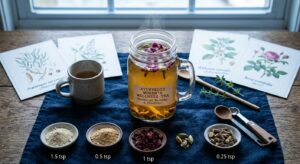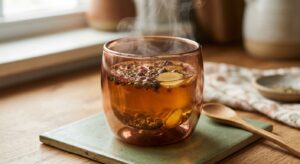
Red raspberry leaf (Rubus idaeus) has been woven into women’s health traditions across Europe and North America for centuries. Long before it appeared on modern shelves, herbalists and village midwives gathered the leaves from wild brambles, dried them in bundles, and brewed them as a strengthening tonic for women of childbearing age. It earned affectionate folk names such as the woman’s herb, and it remains one of the most recognized botanicals in traditional pregnancy care.
The leaves are not the sweet red fruit but the serrated, softly furred foliage of the plant, and they yield a surprisingly gentle cup. The flavor is mild and slightly tannic, reminiscent of a light black tea without the caffeine, with a faint green, hay-like sweetness. It is rich in minerals including calcium, magnesium, potassium, and iron, along with vitamins and astringent tannins that give the tea its characteristic dry, clean finish.
In many midwifery traditions, red raspberry leaf is introduced later in pregnancy rather than early on, and it is often framed as a nightly ritual in the final weeks. A warm cup at the end of the day offers hydration, a pause for rest, and a sense of quiet preparation. This guide walks through three brewing methods, what the research does and does not show, and the important reasons to speak with your midwife or doctor before adding it to your routine.
1
cups
Ingredients
- 1 tbspdried red raspberry leaf (cut and sifted)
- 250 mlwater (95°C / 203°F)
- —raw honey to taste (optional)
- —a thin slice of lemon (optional)
How to Brew
Click on an item below to shop for the recommended items for this recipe on Amazon.
As an Amazon Associate, we earn from qualifying purchases.
- Bring fresh filtered water to a full boil, then let it rest for about 30 seconds so it settles near 95°C (203°F).
- Place 1 tablespoon of dried red raspberry leaf into a mug-sized infuser or directly into a teapot.
- Pour 250 ml of the hot water over the leaves, making sure all the herb is fully saturated.
- Cover the mug or pot with a saucer or lid to trap the steam and volatile aromatics, and steep for 10 to 15 minutes.
- Strain out the leaves, stir in a little honey or a slice of lemon if you like, and sip slowly while it is comfortably warm.
- Add 2 tablespoons of dried red raspberry leaf to a clean glass jar, using a little more herb than the hot method to offset the gentler extraction.
- Pour in 500 ml of cool filtered water and stir once so the leaves are fully wetted.
- Seal the jar and refrigerate for 6 to 8 hours, or leave it overnight so it is ready the next evening.
- Strain through a fine mesh strainer or a piece of muslin to remove all of the plant material.
- Serve over ice or at cool room temperature, and finish with a squeeze of lemon if desired. Keep any leftover tea refrigerated and use within 24 hours.
- Place 1/2 cup of dried red raspberry leaf into a 1-liter glass jar.
- Pour 1 liter of freshly boiled water over the leaves, filling the jar to the top.
- Stir gently, screw the lid on tightly, and let the jar sit on the counter, undisturbed, for 4 to 8 hours or overnight.
- Strain the dark infusion through a fine mesh strainer, gently pressing the leaves to release the last of the liquid.
- Refrigerate and drink within 24 hours, either chilled or gently rewarmed on the stove. Do not boil the infusion when reheating, as this dulls the flavor.
Health Benefits
The leaf provides small amounts of calcium, magnesium, potassium, and iron that dissolve readily into hot water. While a cup of tea is not a substitute for prenatal vitamins or a balanced diet, it can contribute to daily mineral intake and hydration.
Herbalists have long used red raspberry leaf to tone the uterus in late pregnancy. Evidence is limited and mixed: a few small studies suggest a possible shortening of the second stage of labor, while other research finds no clear effect on labor outcomes.
The act of steeping, waiting, and sipping a warm caffeine-free drink supports relaxation and a consistent wind-down routine. The soothing effect comes largely from the ritual and warmth rather than from a sedative compound.
Flavonoids and ellagitannins in the leaf show antioxidant activity in laboratory studies. These findings suggest general protective potential, though they do not prove specific clinical outcomes in pregnancy.
The mild tannins have a traditional astringent action that herbalists use to calm an unsettled stomach and loose stools. This use is long-standing, but it rests mostly on traditional experience rather than modern trials.
🧪 Key Bioactive Compounds
The Science Behind Red Raspberry Leaf
Red raspberry leaf is chemically a mineral-and-polyphenol tea. Its most abundant active constituents are ellagitannins, a family of large polyphenols that give the leaf its drying, astringent quality, along with flavonoids such as quercetin and kaempferol and phenolic acids such as gallic acid. In laboratory settings these compounds show clear antioxidant and anti-inflammatory activity, which is part of why the herb is considered a nourishing tonic.
The question most expectant mothers ask is whether the tea affects labor. The honest answer is that the evidence is modest. Early animal and tissue studies suggested that extracts could influence uterine smooth muscle, with some fractions seeming to relax and others to stimulate contractions. The alkaloid fragarine was once proposed as the key compound, but it has not been demonstrated to act this way in people. In human research, a small number of trials and observational studies have looked at daily leaf tea or tablets in late pregnancy. Some reported no major safety concerns and hinted at a shorter second stage of labor, while a larger body of work found no significant difference in overall labor outcomes.
What the research does reasonably support is that moderate use in healthy pregnancies has not been linked to serious harm, which is why many midwives are comfortable recommending it later in pregnancy. Because study sizes are small and preparations vary widely, no one can promise a specific effect, and individual circumstances matter. The tea is best understood as a gentle, hydrating, mineral-bearing ritual rather than a guaranteed labor aid, and it should always be used with the knowledge and approval of your healthcare provider.
Brewing Tips
- Choose organic, cut and sifted red raspberry leaf from a reputable supplier, and look for leaf that is green-brown and fragrant rather than dusty or pale.
- Cover your cup while it steeps to keep the volatile aromatics in, and aim for the full 10 to 15 minutes for a properly extracted cup.
- Start with one cup a day and let your care provider guide any increase, rather than ramping up quickly.
- Store the dried leaf in an airtight tin away from light and heat, and use it within a year for the best flavor.
- If the astringency feels too dry, try the cold brew method or add a little honey to soften the finish.