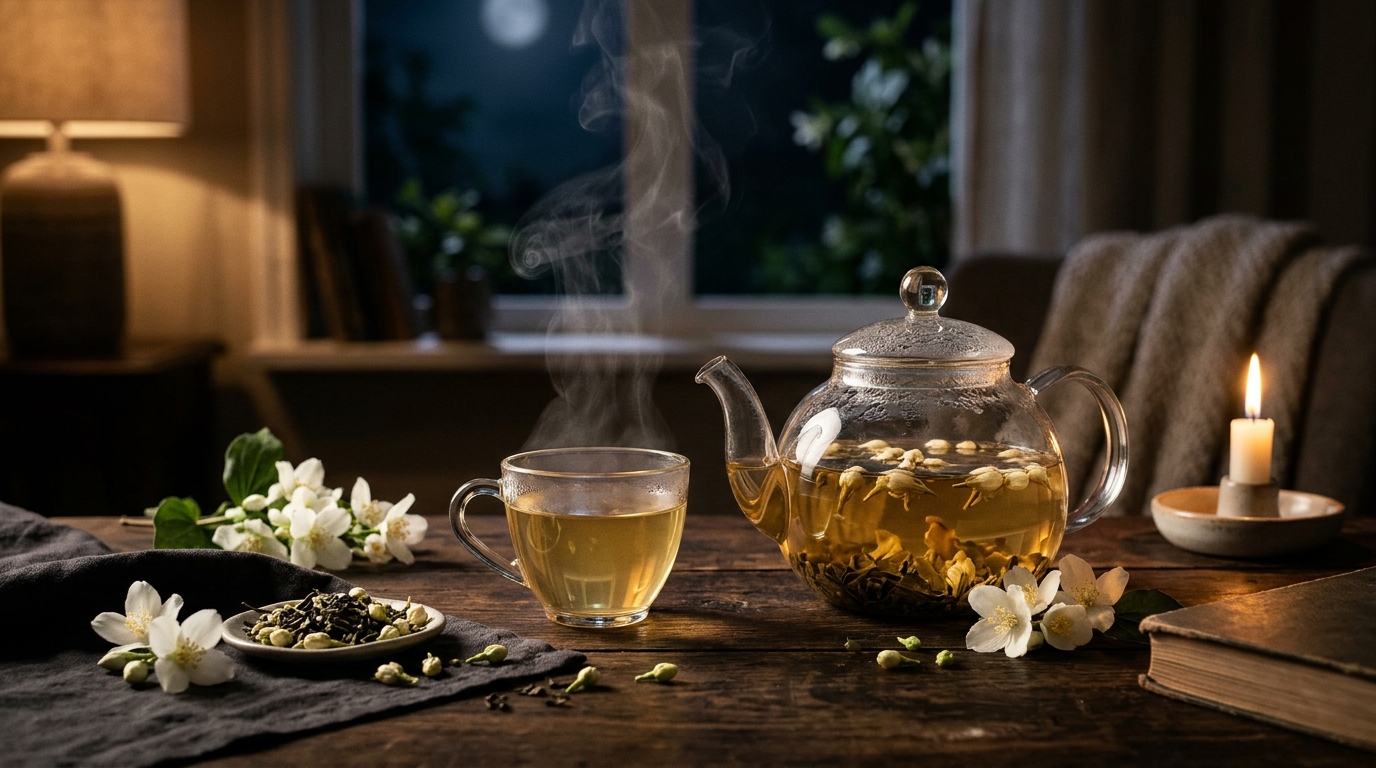
Few flowers announce themselves as dramatically as jasmine at nightfall. Jasminum sambac, the species most prized for scenting and flavoring tea, opens its white blossoms in the late afternoon and evening, releasing a heady, honeyed perfume that carries across a garden. In the tea-growing regions of Fujian, China, this timing is not a romantic detail but a working principle. Growers pick the tight buds in the afternoon, then hold them until they begin to open after dark, at which point they are layered with fresh tea leaves so the leaves can absorb the escaping fragrance. The process can be repeated several times over successive nights for the finest grades.
The history of jasmine in tea stretches back many centuries. Jasmine reached China from Persia and India, and the practice of scenting tea with its blossoms became established in the Song dynasty and flourished later. Beyond China, jasmine flowers hold deep cultural meaning across Asia. In the Philippines, sampaguita (the same species) is woven into garlands and offered in ceremonies, and in Indian traditions the flowers are tied to devotion, celebration, and evening rituals. Traditional Chinese medicine has long used jasmine flowers to move stagnant qi, ease tension, and lift a heavy mood.
This guide focuses on an evening ritual that honors that natural rhythm. You can make a lovely cup from scented jasmine green tea, or, for a caffeine-free night, from dried jasmine flowers alone. Because jasmine tea is often built on a green tea base, choosing pure dried blossoms or a decaf base is the key to a sleep-friendly experience. Brewed as dusk settles in, it becomes less a drink than a small ceremony for letting the day go.
2
cups
Ingredients
- 2 tspdried jasmine flowers (Jasminum sambac), or jasmine pearls for a lightly scented option
- 480 mlfiltered water, heated to 80°C / 176°F
- —raw honey to taste (optional)
- —a few fresh or dried rose petals for garnish (optional)
How to Brew
Click on an item below to shop for the recommended items for this recipe on Amazon.
As an Amazon Associate, we earn from qualifying purchases.
- Heat filtered water to about 80°C (176°F). If you do not have a thermometer, bring it to a boil and let it rest for 3 to 4 minutes off the heat.
- Warm your teapot or mug by swirling a little hot water inside, then discard it. This keeps the brew temperature steady and helps the aroma bloom.
- Add the dried jasmine flowers to an infuser or directly into the pot, using about 1 teaspoon per 240 ml of water.
- Pour the hot water over the flowers and cover immediately with a lid or small plate so the volatile aromatic oils stay in the cup rather than escaping as steam.
- Steep for 3 to 5 minutes, tasting at the 3-minute mark. Longer steeping deepens the floral flavor but can introduce bitterness, especially with a green tea base.
- Strain, add a small drizzle of honey if desired, and sip slowly while the aroma is at its peak.
- In the late afternoon, add 2 tablespoons of dried jasmine flowers to a clean glass jar with a lid.
- Pour 1 liter of cold filtered water over the flowers. Use cold water straight from the tap or filter, not hot, so the extraction stays gentle.
- Stir once with a clean spoon, seal the jar, and place it in the refrigerator.
- Let it infuse for 6 to 8 hours. A longer steep, up to 10 hours, will give a stronger flavor without harshness.
- Strain through a fine mesh sieve into a clean pitcher, pressing the flowers lightly to release remaining liquid.
- Serve chilled in a glass, or let a glass sit out for 10 minutes to take the edge off the cold. Keep refrigerated and drink within 48 hours.
- Heat 240 ml of filtered water to about 85°C (185°F).
- Add 2 tablespoons of dried jasmine flowers (double the usual amount) to a heatproof jug and pour the hot water over them.
- Cover and steep for 5 minutes to make a concentrated brew.
- Meanwhile, fill two tall glasses generously with ice cubes.
- Strain the hot concentrate directly over the ice, stirring gently as it chills. The ice will melt and bring the tea to a drinkable strength.
- Add a slice of cucumber or a few mint leaves for a cooling finish, and sweeten lightly with honey if you like.
Health Benefits
The aroma of jasmine, driven largely by linalool, has been shown in small human and animal studies to reduce stress responses and promote a sense of calm. The ritual of sipping a warm, fragrant tea also supports relaxation on its own.
Jasmine scent has been associated with improved sleep quality in some aromatherapy research. Choosing pure jasmine flowers or a decaffeinated base keeps the cup free of stimulants that could interfere with sleep.
Jasmine blossoms contain polyphenols and flavonoids, and teas scented with jasmine and made on a green tea base also deliver catechins. These compounds help neutralize free radicals in the body.
Jasmine has a long history in traditional Chinese practice as a gentle digestive aid, easing a sense of bloating and fullness after the evening meal. Evidence is largely traditional, but a warm cup after dinner is a pleasant and low-risk habit.
Traditionally used to ease emotional tension and low mood, jasmine’s fragrance is thought to influence the limbic system, the brain region linked to emotion. Research on aroma and mood is promising but still modest in scale.
🧪 Key Bioactive Compounds
The Science Behind Jasmine
The calming reputation of jasmine rests largely on its volatile aromatic compounds. Linalool, one of the most abundant, has been studied in animal models and small human trials for anxiolytic effects, with researchers observing reduced stress markers and changes in activity of the autonomic nervous system after exposure. Benzyl acetate and methyl jasmonate round out the scent profile, and together these compounds are thought to act through the olfactory system, which connects directly to brain areas involved in emotion and arousal.
When jasmine is paired with green tea, as in most commercial scented teas, the cup also carries catechins such as EGCG and the amino acid L-theanine. L-theanine is well documented to promote relaxed focus and may buffer the jittery edge of caffeine. However, caffeine remains present in a green tea base, which is why the choice of base matters for an evening tea. Pure jasmine flower infusions avoid this issue entirely, though they offer a lighter, more purely floral flavor.
It is worth being honest about the state of the evidence. Much of the research on jasmine and sleep or mood focuses on aromatherapy, meaning inhaled fragrance, rather than drinking the tea. The sensory ritual of brewing and inhaling the steam is itself part of the effect. Jasmine tea is best viewed as a soothing, pleasant support for an evening routine rather than a treatment for insomnia or anxiety disorders.
Brewing Tips
- Brew at dusk, when jasmine naturally opens, and hold the cup under your nose for a few breaths before the first sip to take in the full aroma.
- For a sleep-friendly cup, choose pure dried Jasminum sambac flowers or a decaffeinated base, and avoid scented green tea within several hours of bedtime.
- Keep water at 80°C (176°F) rather than boiling, since very hot water can scorch delicate blossoms and green tea leaves and flatten the fragrance.
- Store dried jasmine in an airtight, opaque container away from light, heat, and strong smells, since the flowers readily absorb odors and lose aroma over time.
- Reinfuse jasmine pearls two or three times; the second steep is often the most fragrant and balanced.