
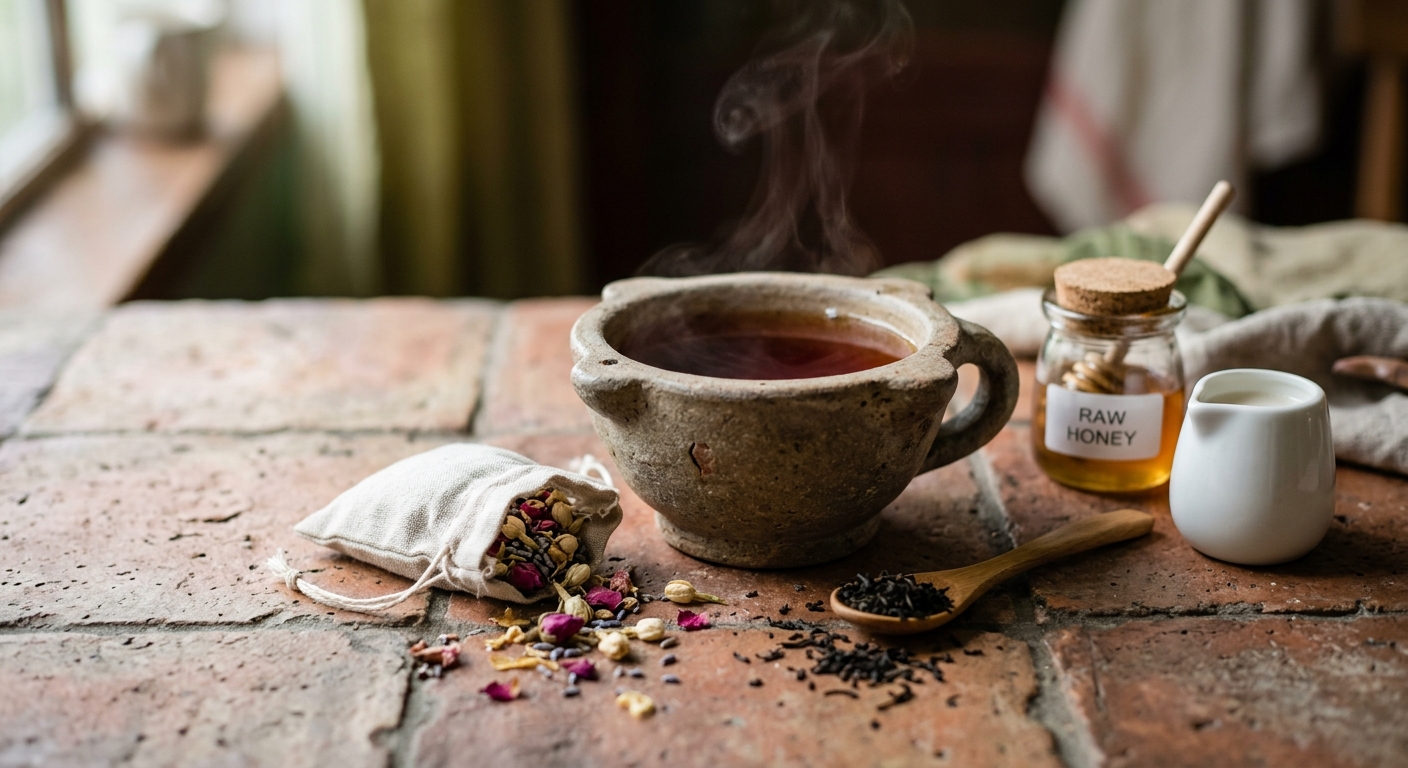
Few beverages carry the cultural weight and global reach of black tea. From the misty hillsides of Darjeeling to the rolling estates of Assam, from the smoky Lapsang Souchong of Fujian Province to the bright, brisk teas of Sri Lanka’s Uva Highlands, black tea has shaped civilizations, sparked trade wars, and become the daily ritual of billions. Its origins trace back to 17th-century China, where tea masters discovered that fully oxidizing the leaves of Camellia sinensis produced a bolder, more shelf-stable brew that could survive long trade routes along the ancient Silk Road. What began as a practical preservation technique gave rise to the most consumed tea category on Earth.
In Ayurvedic and Traditional Chinese Medicine traditions, black tea was used as a warming, stimulating tonic to sharpen mental clarity, support digestion, and combat fatigue. British colonial expansion transformed it into a global commodity, and the ritual of afternoon tea became a cornerstone of European culture. Today, black tea remains one of the most rigorously studied plants in food science, with researchers investigating its role in cardiovascular health, cognitive performance, gut microbiome diversity, and metabolic regulation. It is no longer simply a cultural icon; it is a subject of serious nutritional inquiry.
What makes black tea genuinely special is the interplay between its primary bioactive compounds. Caffeine delivers the immediate alertness most drinkers seek, but it is the amino acid L-theanine that distinguishes tea from other caffeinated beverages. L-theanine modulates the stimulant effect of caffeine, promoting what researchers describe as calm alertness, a state of focused mental engagement without the jitteriness or anxiety that coffee can sometimes provoke. Pair that synergy with a rich array of theaflavins, thearubigins, and polyphenols unique to the oxidation process, and you have a beverage that rewards both the curious palate and the health-conscious drinker.
2
cups
Ingredients
- 2 tsploose-leaf black tea (or 2 tea bags)
- 480 mlwater (95°C / 203°F)
- —raw honey or sugar to taste (optional)
- —splash of whole milk or oat milk (optional)
How to Brew
Click on an item below to shop for the recommended items for this recipe on Amazon.
As an Amazon Associate, we earn from qualifying purchases.
- Bring filtered water to 95°C (203°F). If you do not have a temperature-controlled kettle, bring water to a full boil and let it rest for 30 to 45 seconds before pouring.
- Warm your teapot or mug by filling it with hot water, letting it sit for 30 seconds, then discarding the water. This prevents the vessel from pulling heat away from the steep and ensures a hotter, more even extraction.
- Add 1 teaspoon of loose-leaf black tea per 240 ml of water to your infuser or teapot. For a stronger brew, increase to 1.5 teaspoons per cup rather than extending steep time, which risks bitterness.
- Pour the hot water over the leaves and steep for 3 to 5 minutes. Begin tasting at the 3-minute mark. Robust Assam and breakfast blends benefit from the full 5 minutes; lighter Darjeeling or Ceylon varieties are often best at 3 to 4 minutes.
- Remove the infuser or strain the leaves promptly at your preferred time. Do not let the leaves continue to steep in the cup, as over-steeping rapidly increases tannin extraction and bitterness.
- Add honey, sugar, or a splash of milk if desired, and serve immediately while the tea is at peak temperature and aroma.
- Measure 1 teaspoon of loose-leaf black tea per 240 ml of cold, filtered water. Because cold brewing is gentler, you may increase this to 1.5 teaspoons per 240 ml if you prefer a bolder, more concentrated result.
- Combine the tea leaves and cold water in a clean glass jar or pitcher. Give the mixture a brief gentle stir to ensure all leaves are submerged and evenly distributed.
- Leave the jar at room temperature for 1 hour to begin initial extraction, then transfer to the refrigerator and allow to steep for an additional 7 to 11 hours, for a total cold-brew time of 8 to 12 hours. Overnight steeping is ideal for convenience.
- Taste the brew at the 8-hour mark. If you prefer a stronger flavor, continue steeping up to 12 hours, but avoid exceeding this, as the tea can develop a flat, slightly fermented note.
- Strain the leaves through a fine-mesh sieve or remove the tea bags, then transfer the cold brew to a clean pitcher. Seal and refrigerate for up to 3 days.
- Serve over ice in tall glasses. Add a slice of lemon, a sprig of fresh mint, or a small amount of simple syrup if desired. No milk is needed, as cold-brewed black tea has a natural, smooth sweetness of its own.
- Bring filtered water to 95°C (203°F). For the concentrate, use double the standard ratio: 2 teaspoons of loose-leaf black tea per 240 ml of water. This higher leaf-to-water ratio is what creates the concentrated extraction.
- Add the tea leaves to your infuser or teapot and pour the hot water over them. Steep for exactly 5 to 6 minutes. Because the ratio is already doubled, do not extend the steep beyond 6 minutes, as the resulting bitterness will carry through even when diluted.
- Strain the concentrate promptly and allow it to cool to room temperature. Transfer to a clean glass jar and refrigerate. The concentrate will keep well for up to 5 days.
- To serve hot, combine equal parts concentrate and freshly boiled water in a mug. To serve as an iced tea, combine equal parts concentrate and cold water over ice. To make a tea latte, combine one part concentrate with one part steamed or frothed milk of your choice, and sweeten with honey or vanilla syrup to taste.
- For a spiced chai-style version, steep the concentrate with whole spices (cinnamon stick, cardamom pods, cloves, and a slice of fresh ginger) during the initial brew, then strain and store as above.
Health Benefits
The combination of caffeine and L-theanine in black tea produces a synergistic effect on cognitive performance. Multiple randomized controlled trials have demonstrated that this pairing improves attention, working memory, and reaction time more effectively than caffeine alone, with L-theanine smoothing out the stimulant’s sharper edges.
Theaflavins and thearubigins in black tea have been shown in clinical studies to reduce LDL (bad) cholesterol and improve the ratio of LDL to HDL cholesterol. Regular black tea consumption is associated with reduced risk of coronary artery disease and improved arterial function in epidemiological research.
Black tea polyphenols act as prebiotics, selectively feeding beneficial gut bacteria including Lactobacillus and Bifidobacterium strains. A 2019 study published in the European Journal of Nutrition found that black tea consumption shifted gut microbiota composition in ways associated with reduced obesity-related metabolic markers.
Black tea contains a diverse array of polyphenols that neutralize free radicals and reduce oxidative stress throughout the body. Regular consumption has been linked to lower markers of systemic inflammation, which underlies many chronic diseases including type 2 diabetes and metabolic syndrome.
Several studies suggest that theaflavins and other black tea polyphenols can inhibit alpha-glucosidase, an enzyme involved in carbohydrate digestion, thereby slowing glucose absorption and moderating post-meal blood sugar spikes. This effect is most pronounced when tea is consumed without added sugar.
🧪 Key Bioactive Compounds
The Science Behind Black Tea
The energizing effect of black tea is not simply a matter of caffeine content. While a standard 240 ml cup of black tea delivers between 40 and 70 mg of caffeine depending on origin, processing, and steep time, it is the co-presence of L-theanine that fundamentally alters how that caffeine is experienced. L-theanine, a non-protein amino acid found almost exclusively in the Camellia sinensis plant, promotes alpha brainwave activity, the neural pattern associated with relaxed focus and creative engagement. When combined with caffeine, L-theanine has been shown in multiple double-blind, placebo-controlled trials to improve sustained attention, reduce mental fatigue, and enhance reaction accuracy, effects that neither compound produces as strongly in isolation. This is why tea drinkers so often describe their alertness as cleaner and more manageable than the alertness produced by coffee.
What truly distinguishes black tea from green and white teas at a biochemical level is its unique polyphenol signature. During the oxidation process, the colorless catechins abundant in fresh tea leaves are enzymatically converted into theaflavins and the larger, more complex thearubigins. Theaflavins, which give black tea its characteristic briskness and contribute to its amber color, have been shown to inhibit LDL cholesterol oxidation, reduce inflammatory cytokine expression, and exhibit direct antiviral properties in laboratory models. Thearubigins, which comprise up to 60 to 70 percent of black tea’s total dry weight polyphenols, are still being actively characterized by researchers, but current evidence suggests they play a major role in the tea’s prebiotic activity in the gut and its broader antioxidant capacity.
The gut health implications of regular black tea consumption have attracted increasing scientific attention. Unlike many dietary polyphenols that are absorbed in the small intestine, a large proportion of black tea’s complex polyphenols travel intact into the large intestine, where they interact with and selectively support beneficial microbial populations. Research published in peer-reviewed journals including Nutrients and the European Journal of Nutrition has documented shifts in gut microbiota composition following regular black tea intake, including increases in Bifidobacterium and reductions in potentially pathogenic bacteria. These microbiome changes appear to produce downstream metabolic effects, including improved short-chain fatty acid production, reduced intestinal permeability, and modulated systemic inflammation, underscoring that black tea’s benefits extend far beyond its immediate stimulant action.
Brewing Tips
- Use freshly drawn, filtered cold water rather than re-boiled water. Re-boiling removes dissolved oxygen from the water, which flattens the flavor of black tea and dulls its characteristic briskness.
- Store loose-leaf black tea in an airtight, opaque container away from light, heat, and strong odors. Black tea absorbs surrounding aromas readily, so keep it away from spices, coffee, and cleaning products. Properly stored, quality loose-leaf black tea retains peak flavor for 18 to 24 months.
- If you find black tea too bitter or astringent, the solution is almost always a shorter steep time or a slightly lower temperature rather than using fewer leaves. Over-steeping is the single most common brewing mistake and is responsible for the majority of negative black tea experiences.