For more than 4,000 years, turmeric has held a place of reverence in Ayurvedic and traditional Chinese medicine, valued not only as a culinary spice but as a potent healer. Ancient Indian physicians prescribed it for everything from respiratory infections and digestive disorders to wound healing and liver support. In Sanskrit, turmeric is called haridra, meaning the one that improves the complexion, and its deep golden pigment has made it a sacred dye, a ceremonial offering, and a household remedy across South and Southeast Asia. The rhizome was carried along trade routes to the Middle East and eventually Europe, where medieval apothecaries prized it as a digestive tonic and liver herb.
What makes turmeric genuinely extraordinary, beyond its mythology, is the depth of modern scientific attention it has attracted. Curcumin, its primary bioactive polyphenol, has been the subject of thousands of peer-reviewed studies examining its anti-inflammatory, antioxidant, antiviral, and immunomodulatory properties. Turmeric immune tea is a deliberate, science-informed preparation that pairs the root with black pepper, which contains piperine, a compound shown to increase curcumin bioavailability by up to 2,000 percent. A small amount of fat, whether from coconut oil or whole milk, further aids absorption because curcumin is fat-soluble by nature.
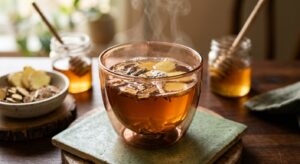
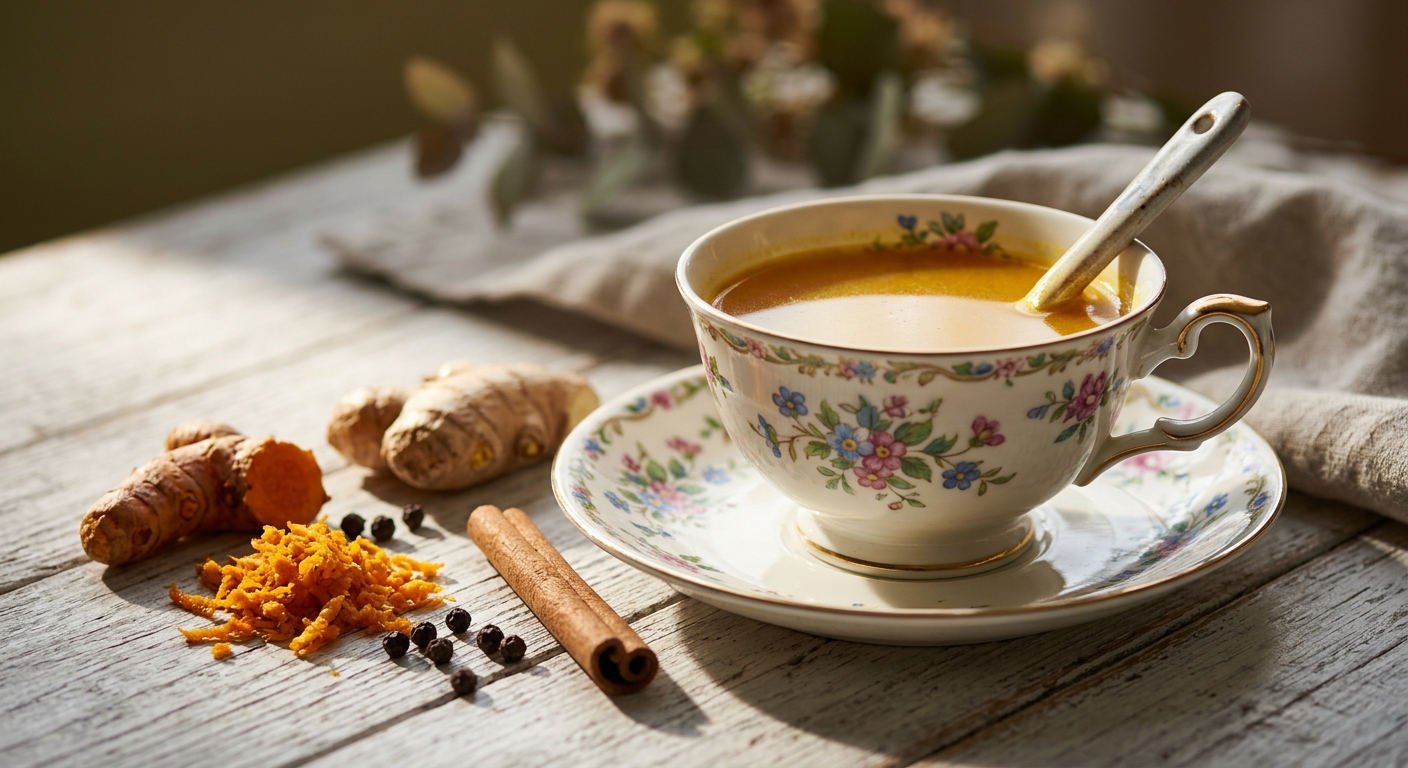
Drinking turmeric immune tea is a sensory experience that grounds you in the warmth of the earth. It pours a luminous amber gold, filling the air with a slightly peppery, resinous aroma edged with ginger and citrus. The flavor is earthy and gently bitter with a slow heat that builds at the back of the throat, softened beautifully by honey or a pinch of cinnamon. Whether you reach for it at the first sign of a cold, as part of a morning ritual, or as an evening wind-down, this is a cup with genuine purpose behind every sip.
2
cups
Ingredients
- 2 tspfreshly grated turmeric root (or 1 tsp dried ground turmeric)
- 1 tspfreshly grated ginger root
- 0.25 tspfreshly ground black pepper
- 480 mlwater (95°C / 203°F)
- 1 tspcoconut oil or whole milk
- —raw honey or maple syrup to taste (optional)
- —pinch of cinnamon (optional)
How to Brew
Click on an item below to shop for the recommended items for this recipe on Amazon.
As an Amazon Associate, we earn from qualifying purchases.
- Bring 480 ml of filtered water to approximately 90 to 95°C (194 to 203°F) in a small saucepan or using an electric kettle with temperature control. Avoid a rolling boil, which can degrade delicate aromatic compounds.
- Add the grated turmeric root, grated ginger, and freshly ground black pepper directly to the hot water. If using ground turmeric powder, whisk it in briskly to prevent clumping.
- Reduce to a very gentle simmer and allow the blend to steep uncovered for 10 to 15 minutes, stirring occasionally. The longer the steep, the deeper and more pungent the flavor and the greater the curcumin extraction.
- Remove from heat and stir in the coconut oil or splash of whole milk. The fat emulsifies with the curcumin, dramatically improving absorption in the body.
- Pour the liquid through a fine mesh strainer into two mugs, pressing the solids lightly to release remaining liquid.
- Sweeten with raw honey or maple syrup to taste, add a pinch of cinnamon if desired, and serve immediately while still hot.
- Combine 2 teaspoons of freshly grated turmeric root, 1 teaspoon of grated ginger, and 1/4 teaspoon of freshly cracked black pepper in a clean glass jar. If using ground turmeric, stir it thoroughly into the cold water first to help it disperse.
- Pour 480 ml of cold filtered water over the ingredients and stir or shake well to combine everything evenly. Do not add fat or honey at this stage.
- Seal the jar with a lid and leave at room temperature for 1 hour to allow the initial infusion to begin, then transfer to the refrigerator.
- Allow the blend to cold steep in the refrigerator for 10 to 14 hours, ideally overnight. Shake or stir the jar once midway through steeping to redistribute the solids.
- When ready, strain the cold brew through a fine mesh strainer lined with a piece of muslin or a coffee filter into a pitcher, pressing the solids gently to extract all liquid.
- Stir in 1 teaspoon of coconut oil or a splash of oat milk to support curcumin absorption. Sweeten with liquid honey or maple syrup to taste and serve over ice or chilled in glasses.
- Place 1 tablespoon of freshly sliced or coarsely grated turmeric root, 1 teaspoon of grated ginger, and 1/4 teaspoon of freshly cracked black pepper into a small saucepan. For a richer blend, add a small cinnamon stick and two cardamom pods lightly crushed.
- Pour 600 ml of cold filtered water over the herbs and bring to a full boil over medium heat, uncovered.
- Once boiling, immediately reduce the heat to a low simmer at 85 to 90°C (185 to 194°F) and allow the liquid to decoct steadily for 20 to 25 minutes, stirring every few minutes. The liquid will reduce and deepen to a rich amber color.
- Remove from heat and allow to rest for 3 to 5 minutes off the burner. The brief resting period allows the remaining volatile compounds to settle back into the liquid.
- Strain through a fine mesh strainer into mugs, pressing the solids firmly with the back of a spoon to extract every last drop of the concentrated infusion.
- Stir in 1 teaspoon of coconut oil or ghee (the traditional Ayurvedic fat carrier) and sweeten with raw honey to taste. Serve in small mugs as a potent daily tonic, or dilute with an equal part of warm water or oat milk for a gentler cup.
Health Benefits
Curcumin has been shown to regulate both innate and adaptive immune responses, enhancing the activity of natural killer cells and macrophages while preventing the excessive inflammatory response that characterizes severe infection. Regular consumption may help the immune system respond more efficiently and proportionately to pathogens.
Curcumin inhibits multiple molecular targets in the inflammatory cascade, including NF-kB, COX-2 enzymes, and pro-inflammatory cytokines. Chronic low-grade inflammation is linked to conditions ranging from cardiovascular disease to autoimmune disorders, and turmeric tea provides a gentle daily tool for managing this burden.
Curcuminoids neutralize free radicals directly and also upregulate the body’s own antioxidant enzymes, including superoxide dismutase and catalase. This dual antioxidant action helps protect immune cells from oxidative stress during periods of illness or high physical demand.
Traditional Ayurvedic medicine has long used turmeric milk and decoctions for respiratory infections, bronchitis, and sore throats. Modern research supports antimicrobial and anti-inflammatory activity that may reduce the severity and duration of upper respiratory symptoms when consumed regularly at the onset of illness.
Turmeric stimulates bile production in the gallbladder, supporting fat digestion and gut motility. A healthy gut microbiome and gut lining are closely tied to immune function, and curcumin has shown prebiotic-like effects that support beneficial bacteria and reduce gut permeability in early research.
🧪 Key Bioactive Compounds
The Science Behind Turmeric
The scientific story of turmeric begins and ends with curcumin, though the full truth is more nuanced than headlines suggest. Curcumin is a polyphenolic diarylheptanoid that gives turmeric its signature golden hue, and it works primarily by blocking NF-kB, a transcription factor that acts as a master regulator of inflammation. When NF-kB is overactivated, it drives the production of pro-inflammatory cytokines such as TNF-alpha, IL-1beta, and IL-6, molecules that underlie chronic inflammatory conditions and excessive immune responses. By intercepting this signaling pathway, curcumin effectively dials down runaway inflammation without suppressing the immune system entirely, making it a genuinely immunomodulatory compound rather than simply a suppressor.
The most clinically significant challenge with curcumin is its notoriously poor bioavailability when taken in isolation. Studies consistently show that curcumin is rapidly metabolized and conjugated in the gut and liver, resulting in very low plasma concentrations after oral ingestion. This is precisely why the addition of piperine from black pepper is not optional decoration but a scientific necessity in turmeric tea. A landmark 1998 study published in Planta Medica demonstrated that co-administration of piperine increased curcumin bioavailability by 2,000 percent in human subjects. Piperine achieves this by inhibiting glucuronidation, the liver’s primary method of conjugating curcumin for excretion. Adding a fat source simultaneously exploits curcumin’s lipophilic nature, allowing it to be absorbed through the lymphatic system and bypass some first-pass hepatic metabolism.
Beyond curcumin, turmeric contains two additional curcuminoids, demethoxycurcumin and bisdemethoxycurcumin, as well as aromatic sesquiterpenes such as ar-turmerone. Research suggests that the full curcuminoid complex extracted from whole turmeric root may outperform isolated curcumin in some immune applications, particularly in stimulating natural killer cell activity and supporting T-cell proliferation. Ar-turmerone, found in the volatile oil fraction, has independently shown antiviral activity in cell studies and may contribute to the broad-spectrum antimicrobial reputation turmeric has held in traditional medicine for millennia. A decoction or long simmered preparation extracts the broadest range of these compounds, which is why Ayurvedic tradition favored slow-cooked turmeric preparations over quick infusions.
Brewing Tips
- Always crack or grind black pepper fresh and add it to every preparation of turmeric tea. Pre-ground pepper loses piperine content rapidly once ground, so freshly cracked peppercorns give you the maximum bioavailability-enhancing effect.
- Fresh turmeric root produces a more complex, slightly floral and citrusy flavor compared to dried ground powder. Look for firm, bright orange rhizomes at health food stores or Asian grocery markets. Wear gloves when grating, as turmeric stains skin and textiles intensely.
- If turmeric sediment settles to the bottom of your cup or cold brew pitcher, this is normal. Give it a gentle stir before each sip rather than discarding the sediment, as it contains concentrated curcuminoids you do not want to leave behind.
- Store leftover decoction or cold brew in a sealed glass jar in the refrigerator for up to 3 days. Shake or stir before serving, and add fresh fat and honey at the time of drinking rather than storing the tea with those ingredients already mixed in.