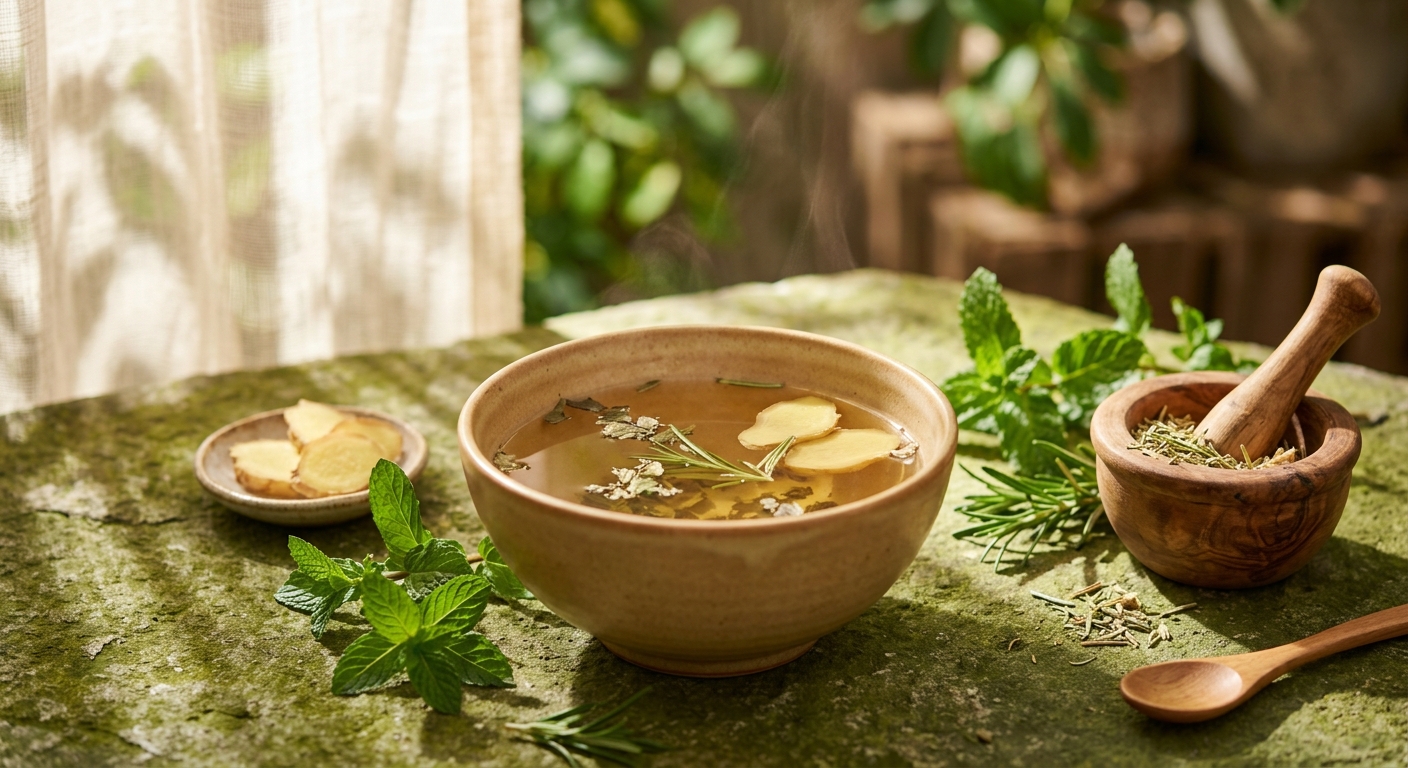
Long before espresso became the world’s morning ritual, herbalists from ancient Greece, Ayurvedic India, and traditional Chinese medicine were reaching for peppermint, ginger, and rosemary to awaken the body and sharpen the mind. Peppermint was prized by Egyptian healers and Roman physicians alike for its ability to clear the head and stimulate the senses. Ginger, native to Southeast Asia, has been documented in Sanskrit texts dating back over 3,000 years as a warming tonic that stokes the body’s inner fire. Rosemary, sacred to the ancient Greeks who wore it as a crown during study, has long been associated with memory, alertness, and mental clarity.
What makes this morning blend so compelling is how these three herbs work in concert. Peppermint’s cooling menthol opens the airways and delivers a rush of fresh alertness, while ginger’s volatile oils and gingerols ignite circulation and warm the digestive system from the inside out. Rosemary contributes its piney, resinous aromatics along with potent antioxidant compounds that support cognitive function. Together they create a tea that feels genuinely energizing, not just pleasant, and complex enough to rival your morning cup of coffee in terms of sensory experience.
This blend is also a beautiful entry point into caffeine-free morning rituals. Whether you are sensitive to caffeine, looking to reduce your intake, or simply want something that energizes without the inevitable crash, this trio delivers. The heat of the ginger, the lift of the peppermint, and the herbal depth of the rosemary combine into a cup that is bright, warming, spicy, and aromatic all at once, the kind of tea that genuinely wakes you up before you even take the first sip.
2
cups
Ingredients
- 2 tspdried peppermint leaves
- 1 tspdried rosemary leaves
- 4 slicesfresh ginger root (about 3mm thick each)
- 480 mlwater (95°C / 203°F)
- —raw honey or maple syrup to taste (optional)
- —fresh lemon slice to serve (optional)
How to Brew
Click on an item below to shop for the recommended items for this recipe on Amazon.
As an Amazon Associate, we earn from qualifying purchases.
- Bring 480ml of fresh, filtered water to 93 to 95°C (199 to 203°F). Avoid a rolling boil, as temperatures above 100°C can destroy some of peppermint’s delicate volatile oils and make rosemary turn bitter.
- While the water heats, lightly bruise the fresh ginger slices by pressing them firmly with the back of a spoon. This breaks the cell walls and releases the zingy gingerols and shogaols more readily into your cup.
- Place the dried peppermint leaves, rosemary leaves, and bruised ginger slices together into a large tea infuser or a pre-warmed teapot. Pre-warming your vessel with a splash of hot water and discarding it before adding the herbs prevents the temperature from dropping too quickly.
- Pour the hot water over the herbs, covering them completely. Place a lid or small plate over the top of your mug or teapot to trap the volatile aromatic compounds, particularly menthol and rosemary’s camphor, which would otherwise escape with the steam.
- Steep for 7 minutes for a balanced, aromatic cup. Extend to 10 minutes if you want a stronger ginger heat and more pronounced rosemary depth. Remove the infuser, stir once, and taste before adding honey or a squeeze of fresh lemon.
- Increase your herb ratio slightly compared to hot brew: use 1 tablespoon of dried peppermint, 1.5 teaspoons of dried rosemary, and 6 thin slices of fresh ginger per 480ml of cold, filtered water. Cold water extracts less aggressively, so the extra herbs compensate.
- Place all the herbs and ginger directly into a clean glass jar. No need to bruise the ginger aggressively here, a gentle press with your thumb is enough, since the long steep time will draw out plenty of flavor and heat naturally.
- Pour cold, filtered water over the herbs, ensuring everything is fully submerged. Place the lid on the jar and leave at room temperature for 1 hour to allow initial extraction to begin before transferring to the refrigerator.
- Refrigerate for 10 to 14 hours (overnight works perfectly). The cold-brew ginger will be noticeably milder and sweeter than its hot-brew counterpart, while the peppermint will taste crisp and clean without any bitterness.
- Strain through a fine mesh strainer into glasses filled with ice. Taste and adjust with a squeeze of fresh lemon or a drizzle of honey. Cold-brewed morning tea keeps well in the refrigerator for up to 48 hours, making it easy to prep several servings at once.
- Combine 3 tablespoons of dried peppermint, 2 tablespoons of dried rosemary, and a 5cm (2-inch) knob of fresh ginger (thinly sliced) with 480ml of nearly boiling water (95 to 100°C). Use a small saucepan for this method, since you will be simmering the ginger gently.
- Bring the water with only the ginger slices to a gentle simmer over medium heat and cook for 5 minutes. This brief decoction step draws out the ginger’s deeper, more resinous heat compounds that do not extract well through simple steeping alone.
- Remove from heat and immediately add the dried peppermint and rosemary to the ginger water. Cover the saucepan with a lid and steep for 15 minutes. Keeping it covered is essential at this stage to prevent the aromatic menthol and rosemary oils from evaporating.
- Strain the concentrate through a fine mesh strainer into a clean glass jar with a tight-fitting lid, pressing the spent herbs gently with a spoon to extract the last of the liquid. You should end up with approximately 350 to 400ml of deep, intensely flavored concentrate.
- To serve, dilute one part concentrate with two to three parts hot or cold water, adjusting to taste. Add honey and lemon if desired. Store the concentrate in the refrigerator for up to 5 days. You can also freeze it in ice cube trays and dissolve a cube or two in hot water each morning.
Health Benefits
The combined aroma of menthol and 1,8-cineole from peppermint and rosemary has been shown in multiple studies, including research from Northumbria University, to significantly improve speed and accuracy on cognitive tasks. Inhaling these aromatic compounds as you brew and sip appears to stimulate the central nervous system and improve working memory.
Ginger’s gingerols and shogaols promote vasodilation and improve blood flow throughout the body, delivering oxygen and nutrients to muscles and the brain more efficiently. This warming, circulatory effect is one reason ginger has been used as a morning tonic in Ayurvedic practice for millennia.
Peppermint relaxes smooth muscle tissue in the gastrointestinal tract, reducing bloating and cramping, while ginger stimulates the production of digestive enzymes and gastric motility. Drinking this blend in the morning prepares the digestive system for the day’s meals and can ease early-morning nausea.
Rosemary is among the most antioxidant-dense culinary herbs known, with rosmarinic acid and carnosic acid demonstrating significant free-radical-scavenging activity in laboratory studies. A morning cup of this blend provides a meaningful dose of these protective polyphenols before oxidative stress from the day’s activities begins.
Rosemary has been studied for its ability to lower cortisol levels and reduce physiological markers of stress. Combined with peppermint’s mood-lifting aromatic compounds, this blend may help counteract the cortisol-driven morning fatigue that many people experience, providing energy without the adrenal strain of stimulants.
🧪 Key Bioactive Compounds
The Science Behind Peppermint
The energizing effect of this herbal blend is rooted in well-documented interactions between aromatic volatile compounds and the human nervous system. Menthol, the dominant compound in peppermint, activates TRPM8 receptors, the same cold-sensing receptors that respond to cool air and fresh mint. This activation sends a signal through the trigeminal nerve to the brain that is interpreted as refreshing and stimulating, producing an immediate sense of alertness. Research published in the International Journal of Neuroscience found that participants exposed to peppermint aroma performed better on tasks measuring sustained attention, reaction time, and working memory. Separately, 1,8-cineole, shared between peppermint and rosemary, has been shown to inhibit acetylcholinesterase, the enzyme that breaks down acetylcholine, effectively increasing levels of this key neurotransmitter associated with memory and concentration.
Ginger’s contribution to the energy equation is primarily circulatory and metabolic. The gingerols and shogaols in ginger act as partial agonists at vanilloid receptors (TRPV1), producing a warming sensation that stimulates blood flow and raises thermogenesis. Improved circulation means more efficient oxygen delivery to the brain and muscles, which translates directly to higher alertness and reduced feelings of physical fatigue. A 2012 study in Evidence-Based Complementary and Alternative Medicine found that ginger extract improved cognitive function and reduced oxidative stress markers in healthy middle-aged women, suggesting neurological benefits that go beyond simple warming.
Rosemary’s rosmarinic acid and carnosic acid are among the most studied neuroprotective polyphenols in the culinary herb world. Carnosic acid, in particular, has been shown to activate the Nrf2 pathway, a key cellular defense mechanism that upregulates antioxidant gene expression and protects neurons from oxidative damage. A 2016 study in Therapeutic Advances in Psychopharmacology found a direct correlation between 1,8-cineole concentrations in participants’ blood and their cognitive performance scores, with higher levels corresponding to faster and more accurate mental processing. Taken together, the science strongly supports what generations of herbalists observed intuitively: this combination of herbs genuinely sharpens the mind, warms the body, and sets the stage for a productive day.
Brewing Tips
- Always cover your mug or teapot while steeping this blend. Menthol and rosemary’s camphor are highly volatile and escape rapidly with steam, taking much of the energizing aroma and bioactive potency with them.
- Use fresh ginger whenever possible. Fresh ginger contains predominantly 6-gingerol, while dried ginger is richer in shogaols. Both are beneficial, but fresh ginger produces a brighter, juicier heat that integrates beautifully with the cool peppermint.
- Drink this tea mindfully and slowly. Part of the energizing effect comes from the aromatic experience itself. Taking slow, deliberate sips and inhaling the steam before each sip maximizes the olfactory stimulation that drives the alertness response.